






Can women take finasteride? Some can, but only as an off-label prescription from a doctor. The FDA has approved it for men, not women. The evidence in women is mixed, it's strictly off-limits in pregnancy, and most doctors try other options first.
Maybe you've typed "finasteride women" into your phone for the third time this week. And every thread you find is men swapping notes on their hairlines. Then one lone reply from a woman: "my dermatologist said no." No reason given. Thanks a lot, internet.
One honest note before we go on. The research on women is smaller, shorter, and messier than the research on men. So we'll separate three things: what's been tested properly, what looks encouraging but wasn't controlled, and what nobody has studied yet. Then we'll cover safety, side effects, and the options that come first for most women.
Is Finasteride FDA-Approved for Women?
No. The Propecia label says the drug is "not indicated for use in women". Finasteride is approved for men, at 1 mg for hair loss and 5 mg for prostate enlargement. For female pattern hair loss, topical minoxidil is the only FDA-approved drug (Cleveland Clinic Journal of Medicine).
What does off-label mean, and why does it matter?
Off-label means a doctor prescribes an approved drug for something it wasn't approved for. It's legal, and it's common. But no regulator has reviewed the evidence for that use, so the dose, the monitoring, and the responsibility sit with your prescriber and you. The European guideline for hair loss describes finasteride use in women as off label and on own responsibility.
That's not a scare line. It just means the paperwork isn't there to lean on, so the conversation with your doctor matters more.
Why do some doctors prescribe it and others say no?
We don't have a survey of doctors, so this is our reading of the evidence. The "no" camp has good reasons: pregnancy risk, one negative placebo-controlled trial, mood warnings from regulators, and other treatments with better evidence. The "yes" camp tends to see a woman past menopause, or one with signs of high androgens, or one who has tried the usual options.
Neither doctor is being difficult. They're weighing the same evidence differently.
Can women use finasteride tablets meant for men?
Same molecule, different strength. Propecia is 1 mg for men's hair loss. Proscar is 5 mg for prostate enlargement. Women in studies took these doses too, but under supervision and with a plan for preventing pregnancy. That's the gap between a prescription and borrowing your partner's pills. The pregnancy section below shows why borrowing is a bad idea.
How Does Finasteride Work for Female Hair Loss?

What is DHT, and what does it do to hair follicles?
DHT (dihydrotestosterone) is a strong androgen. Your body makes it from testosterone with the help of an enzyme called 5-alpha reductase. In scalp follicles that are genetically sensitive to it, DHT shortens the growth phase and shrinks the follicle. Hairs come back finer and shorter, until some barely show. Men born without the type II version of that enzyme don't develop pattern baldness at all, which shows how much weight this pathway carries in men (European guideline).
How does finasteride lower DHT?
Finasteride blocks type II 5-alpha reductase, so less testosterone turns into DHT. In the scalp, DHT drops by roughly 60 to 70% (Cleveland Clinic). It isn't a hormone, and it doesn't add estrogen or testosterone. In one review of 284 women, estrogen rose in about a third, fell in about 5%, and stayed put in the rest (Breast Cancer Research and Treatment).
Its blood half-life is short, about six hours. The enzyme takes weeks to recover, though, so the effect lingers (PDR).
Is DHT really behind thinning in women?
Less than you'd think. The European guideline says the role of androgens in women is uncertain and that other factors seem to be involved, even though some women do have hormonal imbalance. Plenty of women with pattern thinning have normal hormone levels. That's probably why finasteride helps some women and does little for others.
DHT is a suspect in women's thinning. Convicted? Not yet.
How Do You Know What Kind of Thinning You Have?
Finasteride aims at one cause. If your thinning comes from something else, it's the wrong tool, however sensible it sounds at 1 a.m. So the diagnosis comes first.
|
What you notice |
Likely cause |
Would finasteride be expected to help? |
|
Wider part, thinner crown, hairline mostly kept, slow over months or years |
Female pattern hair loss |
It's the target, but the evidence is mixed |
|
Heavy shedding 1 to 6 months after illness, surgery, childbirth, or big stress |
Telogen effluvium |
No. Treat the trigger. It can unmask pattern loss underneath |
|
Thinning at hairline and temples, tender scalp, tight styles |
Traction alopecia |
No. Take the tension off |
|
Redness, scale, burning, shiny smooth patches, receding hairline with eyebrow loss |
Scarring alopecia, such as frontal fibrosing alopecia |
A specialist decision only |
|
Thinning plus irregular periods, acne, or extra facial and body hair |
Possible PCOS or other androgen excess |
Sometimes discussed, after a work-up |
What should a doctor check first?
A good visit starts with your history and a look at your scalp. Expect a gentle hair pull test and a magnified scalp check called trichoscopy. Blood tests come in when the picture calls for them, and doctors commonly check iron stores and thyroid function. Androgen tests make sense when you also have irregular periods, acne, or extra hair growth (Endocrine Society).
Start with a dermatologist or your GP. Suspected PCOS often adds an endocrinologist or gynecologist. Our guide to the types of hair loss in women helps you sort the possibilities before you go.
Does Finasteride Work for Women? What the Studies Show
Sometimes, maybe. The evidence splits by dose and by study design. One good placebo-controlled trial at 1 mg found nothing. Higher-dose studies report improvement, but they had no placebo group.
The main placebo-controlled trial: 1 mg, no benefit
In 2000, researchers randomized 137 postmenopausal women aged 41 to 60 to finasteride 1 mg or placebo for 12 months. Hair counts, photo panels, patient and doctor ratings, and scalp biopsies all told the same story: no difference between the groups. Hair counts in the frontal and side scalp even dipped in both. The drug was well tolerated, and it did nothing measurable.
What higher-dose studies reported (2.5 mg and 5 mg)
|
Study |
Women |
Dose |
Result |
The catch |
|
37 premenopausal |
2.5 mg plus a contraceptive pill |
23 of 37 rated improved at 12 months |
The pill can help hair on its own. No placebo group |
|
|
87 |
5 mg |
Density rose from 90 to 107 hairs per cm² at 12 months. 81% improved on photos |
No control group |
|
|
112 |
2.5 mg |
About 65% rated significantly better, about 30% slightly better |
No control group |
Two catches run through that table. Nobody was compared with placebo, and "improved" is a generous word when a doctor is rating photos. Several of these results are real signals. None of them settle the question.
What the pooled analysis and guidelines conclude
A pooled analysis of nine studies and 490 patients found no gain in hair density and called its own reliability poor, because the studies varied a lot. Women taking 2.5 mg or more did rate their results better than women on lower doses. That's self-assessment, though. And all three randomized trials used 1 mg.
The European guideline does not suggest 1 mg for postmenopausal women. It says off-label use in women who can conceive needs safe contraception. The Cleveland Clinic review calls topical minoxidil first-line. Our verdict: mixed, leaning unproven.
Postmenopause, PCOS, and high androgens: who might respond best?
Postmenopausal women are the group studied most, and results are mixed. In the 5 mg study, pre- and postmenopausal women did about equally well. You'll read that falling estrogen "unmasks" androgens. It's plausible, but nobody has tested it here.
Women with signs of androgen excess look like a better fit. The Cleveland Clinic review says higher doses can work when hair loss comes with high androgens. In hirsutism trials, finasteride at 2.5 to 5 mg lowered hirsutism scores against placebo, though contraceptive pills usually go first (Endocrine Society). That's limited evidence, but it points in a sensible direction.
Does it help frontal thinning or scarring types?
For men, the Propecia label says efficacy in temple recession isn't established. In women, a receding line can be frontal fibrosing alopecia, a scarring condition. Dermatologists sometimes use 5-alpha reductase inhibitors for it off-label. A meta-analysis found dutasteride stabilized it in 63% of patients over 18 to 45 months (scoping review). No randomized trials exist. That's a specialist decision.
Who Might Be Considered, and Who Should Never Take It?
Not everyone. Doctors weigh menopausal status, pregnancy potential, mood history, liver health, and the diagnosis.
|
Situation |
Can it be considered? |
Why |
|
Pregnant or trying to conceive |
No |
Contraindicated. Risk to a male fetus |
|
Breastfeeding |
Avoid |
Not known whether it passes into milk |
|
Premenopausal, could get pregnant |
Sometimes, with safe contraception |
Off-label. Many dermatologists try other options first |
|
Postmenopausal |
Sometimes |
Most studied group. 1 mg failed in the main trial |
|
Hysterectomy or permanent sterilization |
Pregnancy risk largely removed |
Other risks still apply |
|
PCOS or high androgens |
Sometimes, after a work-up |
Best-fitting group. Evidence is limited |
|
Teens and women in their 20s |
Rarely |
No hair-loss trials in young women. Pregnancy potential is highest |
|
Liver disease |
Only with specialist input |
The label urges caution |
|
Past depression or suicidal thoughts |
Only with specialist input |
Regulators tell prescribers to ask |
|
History of hormone-sensitive cancer |
Only with oncologist input |
Limited data |
Can trans women take finasteride?
Some clinicians use 5-alpha reductase inhibitors in feminizing care, especially when spironolactone isn't tolerated (UCSF Transgender Care). Solid evidence is lacking, so talk with a gender-affirming endocrinologist.
Is Finasteride Safe During Pregnancy? Critical Reproductive Risks
No. Finasteride is contraindicated in pregnancy. Blocking DHT can disrupt the development of a male baby's external genitalia.
Pregnancy contraindications and birth defects
The label contraindicates finasteride for any woman who is or may be pregnant. DHT is needed for normal male genital development. Finasteride can lead to abnormal development of a male baby's external genitalia, similar to what's seen in boys born with a genetic 5-alpha reductase deficiency. In rats, low doses caused these abnormalities in male offspring (FDA label).
If you get pregnant while taking it, stop and call your prescriber and an obstetric provider straight away.
Handling precautions for tablets
Intact tablets are coated, and the coating blocks contact with the drug. The concern is crushed or broken tablets. Women who are pregnant or might be shouldn't handle them, because the drug can be absorbed through the skin. If contact happens, wash the area right away with soap and water. Standing in the same room as a pregnant woman who is taking whole tablets? No known problem.
Splitting tablets at home breaks the coating. Only do it if your prescriber says so, and keep the pieces away from anyone who is or could be pregnant.
Can women take finasteride if they could get pregnant? Contraception and medical oversight
Only with safe contraception. The European guideline calls it essential for off-label use in women who can conceive. The Endocrine Society's phrase is "adequate contraception" for antiandrogens, and it counts permanent sterilization and long-acting reversible methods as adequate. Pills reduce the risk without erasing it. We found no source that says "dual-form" is required, so ask your prescriber which method they'll accept.
Monitoring is a similar story. Expect a talk about pregnancy status, mood, and medical history, and follow-up visits with photos. Blood tests are the doctor's call. The label only urges caution with liver problems. Ask what your prescriber plans to check.
Breastfeeding and trying to conceive
Nobody knows whether finasteride passes into breast milk, so avoid it while nursing. If you're planning a pregnancy, stop before you try. The US label gives no set waiting time, and we couldn't find a regulator figure to hand you. Ask your prescriber how long to wait. Don't guess from a blog.
One more thing matters here. Topical minoxidil is also contraindicated in pregnancy and lactation (Cochrane). So postpartum thinning needs its own plan.
What Are the Side Effects of Finasteride in Women?
Most data on women comes from small studies lasting 6 to 12 months. Side effects in those studies were mostly mild. But regulators now flag mood and sexual effects, so read the mood section below.
Common side effects reported in women
The usual reports are headache, dizziness, menstrual irregularities, and increased body hair. In the 5 mg study, four patients had those effects, and one woman (1.1%) stopped because of headache. Some reports also mention breast tenderness. Decreased libido shows up in some studies: in 40 postmenopausal women on 5 mg for 18 months, four had persistent low libido (systematic review). The 137-woman trial at 1 mg reported no sexual side effects.
Many studies in women never asked about sexual function, so problems may be undercounted. We found no evidence of weight gain or swelling with finasteride in women. Fluid retention belongs to oral minoxidil.
Mood, anxiety, and the latest regulator warnings
The FDA added depression to the finasteride label in 2011. In 2022, it had suicidal ideation and behavior added to the adverse reactions listed for Propecia (review). In May 2026, the UK's MHRA tightened its warnings. It says finasteride is associated with depression, suicidal thoughts, and sexual dysfunction that may persist after stopping. Prescribers should ask about a history of depression or suicidal thoughts and monitor afterward. For 1 mg users, the advice is to stop immediately and contact a doctor if depression or suicidal thoughts appear.
The MHRA's figures include 170 reports of suicidal ideation and 19 reports of suicide to May 2025. Those are reports, and they don't prove cause. They also cover all users, not women specifically.
Most of the data comes from men. We found no female-specific numbers. That doesn't mean women are safe, and it doesn't mean they're at risk. It means nobody knows.
If you ever have thoughts of harming yourself, contact local emergency services or a crisis line right away.
What is post-finasteride syndrome, and does it affect women?
The term describes sexual, psychiatric, and physical symptoms that people report continuing after stopping the drug. It isn't an official diagnosis, and researchers still argue about how often it happens and what causes it. The MHRA had 426 reports of sexual dysfunction with finasteride by April 2024, and almost half were recorded as not recovered.
Nearly all of that comes from men. We found no data on women. That's a gap, not a green light.
Breast, liver, and other worries
Breast. A US cohort followed 810 women on oral 5-alpha reductase inhibitors and compared them with 5,472 matched women. The odds ratio for breast cancer was 0.95 (95% CI 0.49 to 1.72), with a median follow-up of 3.7 years (JAAD). A population-based cohort also found no increase. It's reassuring, but observational and short.
Liver. The drug is broken down in the liver, and the label urges caution with liver problems. Mild to moderate enzyme rises can happen, usually settling on their own.
Other drugs. No clinically important drug interactions have been identified.
What Dose, How Long, and How Do You Get It?
What dose do doctors use in women?
No dose is approved. Studies used anywhere from 0.5 to 5 mg a day. In one US center's review of 713 women on oral finasteride, 79% took 5 mg and 18% took 1 mg. Your prescriber sets the dose. This blog can't, and won't.
How long until results, and what if you stop?
For men, the label says three months or more. The European guideline gives a minimum of 6 months to judge slowing of loss and 12 for regrowth. In men, the gains fade within 12 months of stopping. It's fair to assume similar for women, though that's an inference.
Missed a dose? Don't double up the next day.
Can you split tablets, or is topical finasteride safer?
Splitting: see the pregnancy section, and only on your prescriber's say-so. Topical finasteride isn't proven safer for women. The FDA expects finasteride to be absorbed through the skin into the bloodstream, and it has warned about compounded topical products. It received 32 reports between 2019 and 2024, with side effects similar to the oral drug. A small systematic review found topical use lowers scalp and blood DHT, with limited data.
How do you get a prescription safely?
See a doctor, ideally a dermatologist, and use a licensed pharmacy. Avoid random online sellers, and treat compounded products with caution, since they aren't FDA-approved. Bring the questions in the last section.
What Are the Alternatives to Finasteride for Women?
For most women, better-evidenced options come first.
|
Option |
Evidence in women |
Hormonal? |
Pregnancy note |
|
Topical minoxidil |
Strongest. Cochrane: relative risk 1.86 for moderate regrowth vs placebo |
No |
Contraindicated in pregnancy and lactation |
|
Oral minoxidil |
Growing, mostly observational. Off-label |
No |
Minoxidil is avoided in pregnancy. Ask your doctor |
|
Spironolactone |
Decades of use. Open-label trial: 44% regrowth at 12 months (200 mg). Off-label |
Yes, antiandrogen |
Needs contraception |
|
Oral finasteride |
Mixed |
Yes, acts on DHT |
Contraindicated |
|
Laser Phototherapy |
Sham-controlled trials in women, some industry-linked |
No |
Not tested in pregnancy |
|
PRP |
Preliminary |
No |
Ask your doctor |
|
Hair transplant |
For selected women with stable loss and donor hair |
No |
Ask your doctor |
Topical minoxidil
It's FDA-approved, and the Cleveland Clinic review calls it first-line. A Cochrane review of 22 trials and 2,349 women found women on minoxidil were about 1.9 times as likely to report moderate regrowth as women on placebo. Side effects run to itching, irritation, and extra hair growth. Early shedding is normal. The European guideline recommends 2% twice a day and says how it works isn't clear. Stop it and the gains fade.
Spironolactone and oral minoxidil
Spironolactone blocks androgen receptors and trims ovarian androgen output. It's the most-used off-label antiandrogen, with more than two decades of use at 100 to 200 mg. It needs contraception in fertile women. Side effects include menstrual disturbance and high potassium.
Low-dose oral minoxidil has a big safety review: 1,404 patients, 943 of them women. Extra hair growth hit 15.1%, lightheadedness 1.7%, fluid retention 1.3%, and racing heart 0.9% (JAAD). It's off-label, so doctors monitor it.
Where does Laser Phototherapy fit?
Laser Phototherapy (LPT) shines low-power red light onto the scalp. Studies often call it low-level laser therapy. A review of 10 randomized trials found every sham-controlled trial showed higher hair density or diameter. Three trials were women only. A meta-analysis of seven double-blind trials of FDA-cleared home devices found a clear gain over sham.
In women, a 26-week sham-controlled trial of a laser comb reported about 20 more terminal hairs per cm², against about 3 with sham (Jimenez 2014). A 16-week helmet trial in 47 women found hair counts up 48% versus 11% with sham (Lanzafame 2014). Those trials tested other devices.
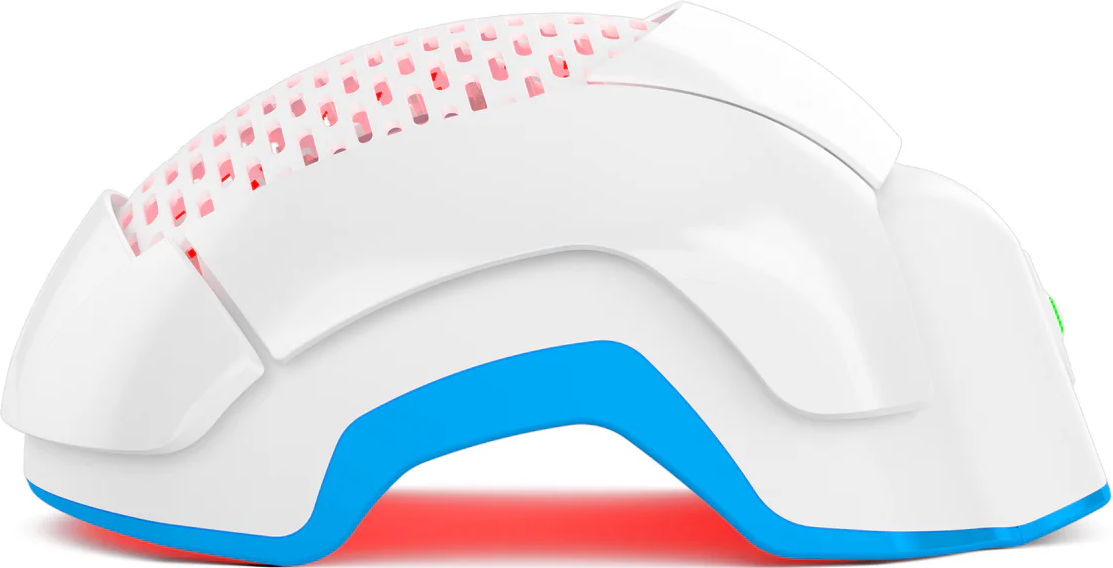
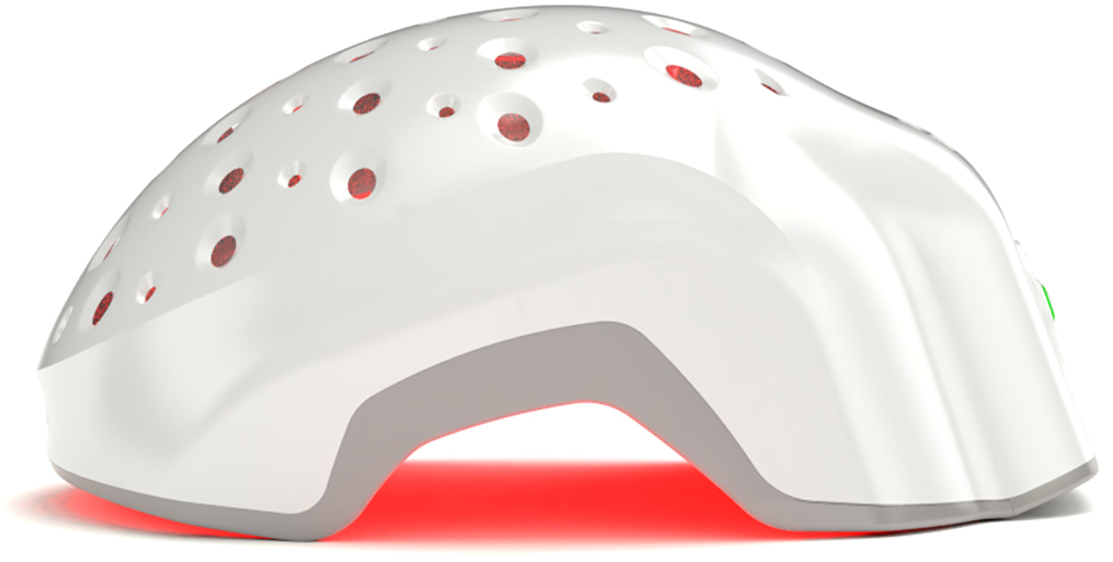
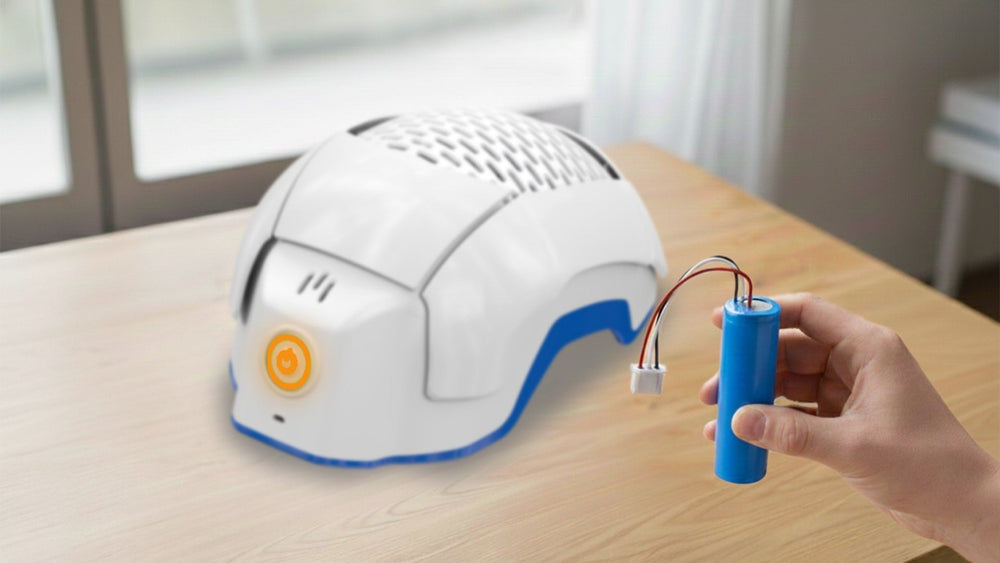
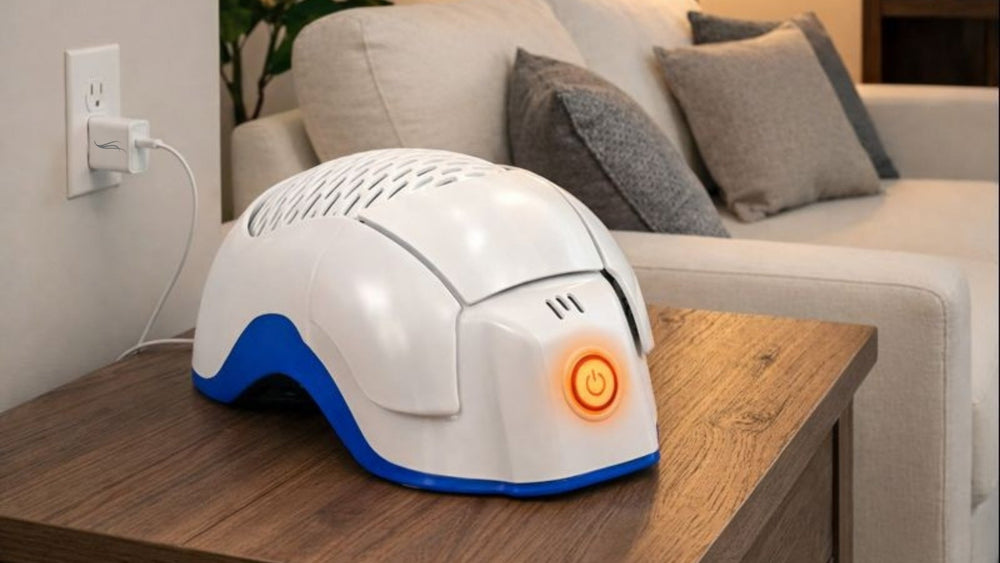
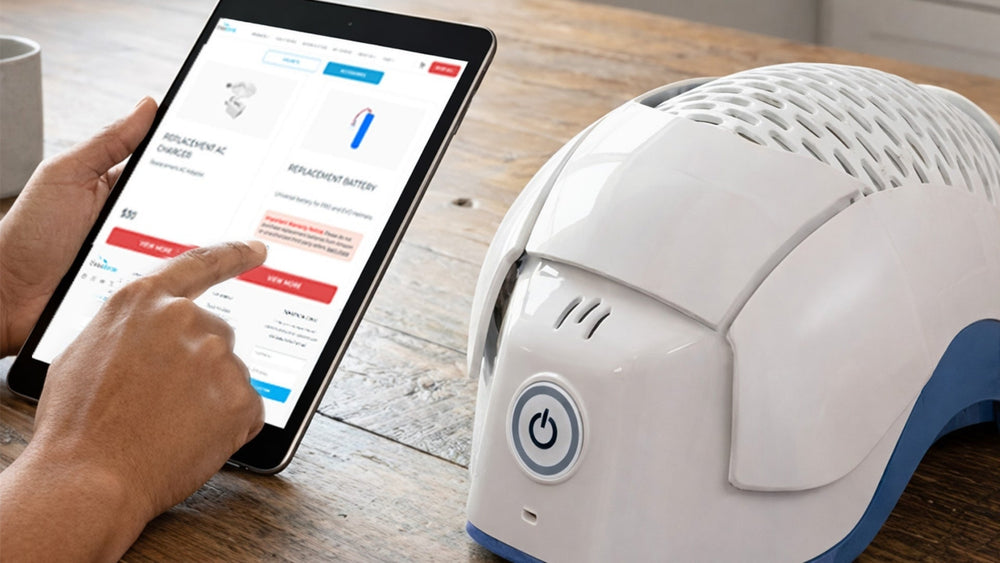
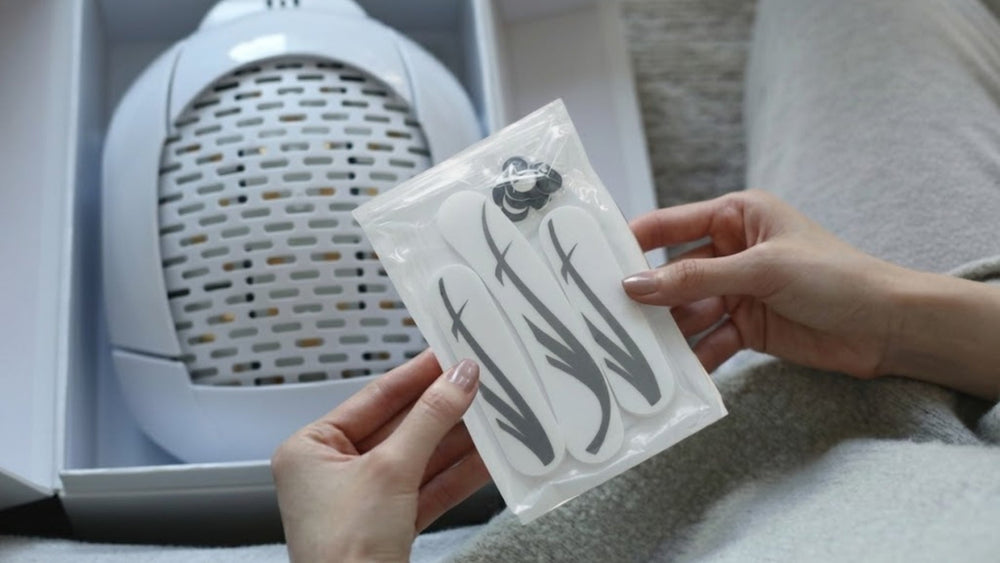
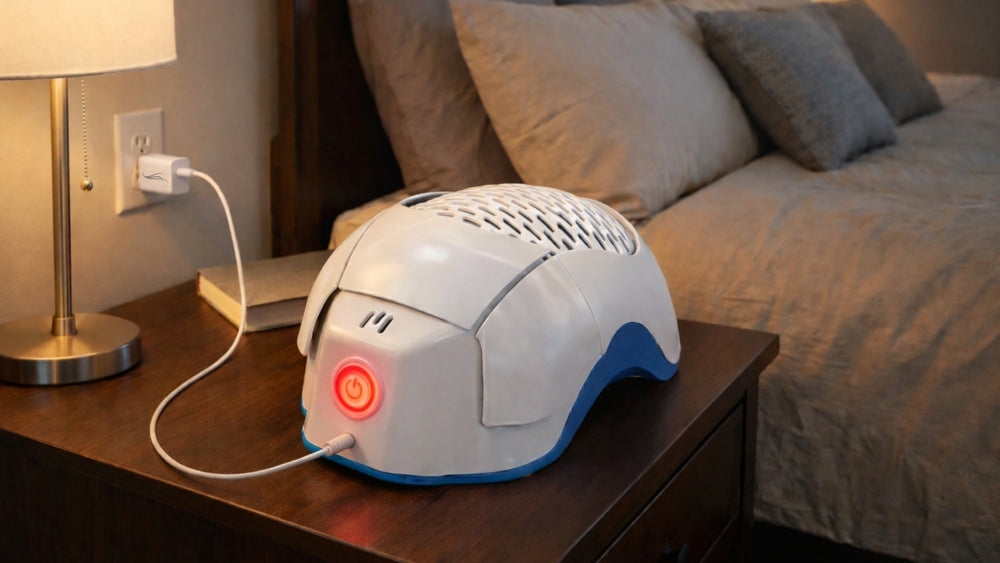
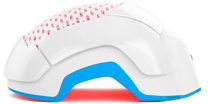
Theradome's PRO LH80 is FDA-cleared (510(k) K171775) for androgenetic alopecia in women with Ludwig-Savin patterns I-1 to I-4, II-1, and II-2, and skin types I to IV. It uses 80 lasers at 680 nm, in a 20-minute session twice a week. The company's argument is that dose matters more than diode count. It isn't a hormone, so contraception isn't part of the deal.
Theradome doesn't recommend it during pregnancy, in the first 2 to 3 months after birth, or with a scalp cancer history. It won't repair a scarred follicle, and it doesn't replace a diagnosis. See our pages on why sessions last 20 minutes and early versus advanced hair loss.
PRP, transplants, and camouflage
PRP has preliminary evidence, and side effects include redness, pain, and pinpoint bleeding. Transplants suit selected women whose loss has stabilized and who have donor hair. Camouflage options such as scalp colorants, wigs, and extensions are legitimate and recognized aids.
Which Finasteride Myths Deserve Retiring?
"Women can just take the men's dose."
The men's 1 mg dose failed in the placebo-controlled trial in women, and no dose is approved. Borrowing your partner's tablets is a bad plan for other reasons too.
"Finasteride is only for men."
It's only approved for men. Some doctors prescribe it to women anyway. "Only approved for men" is the accurate version.
"Hormonal hair loss means my hormones are out of balance."
Often not. Many women with pattern loss have normal hormone levels. Their follicles may simply be more sensitive.
"Natural means safe, and prescription means dangerous."
Neither one holds. Saw palmetto and its cousins lack proof, and minoxidil is a plain drug that's off-limits in pregnancy.
"One month with no change means it isn't working."
Hair is slow. Give it 6 months to judge slowing and 12 for regrowth.
How Do You Decide What to Do Next?
Is finasteride even on the table for me?
Four quick questions. This isn't medical advice, just a way to organize your thinking.
- Are you pregnant, trying, or breastfeeding? If yes, stop here and ask your doctor about other options.
- Do you have depression now, or a past history of it or of suicidal thoughts? If yes, tell your doctor before anything else.
- Has a clinician diagnosed your type of thinning? If not, get that first.
- Are you postmenopausal, sterilized, on reliable contraception, or showing signs of high androgens? If yes, finasteride may be worth discussing. Discussing isn't deciding.
What to ask your doctor
- Is this really pattern hair loss?
- Why finasteride rather than minoxidil or spironolactone?
- Which dose, and what's the evidence for it?
- What contraception do you require, and for how long after I stop?
- Which mood or sexual changes should make me stop?
- How will we measure success, and when do we reassess?
When to stop and call, and what to expect
|
What you notice |
What to do |
|
Mild headache that fades |
Mention it at your next follow-up |
|
Cycle changes or new sexual changes |
Call your prescriber |
|
Low mood, anxiety, or trouble sleeping |
Stop and call promptly |
|
You might be pregnant |
Stop and call your prescriber and an obstetric provider |
|
Thoughts of harming yourself |
Get urgent help now |
|
Swelling of face, lips, or throat, or a spreading rash |
Seek urgent care |
Realistic timelines: 6 to 12 months to judge. Take photos every 3 months in the same light and the same part. The European guideline ranks standardized photos as the best follow-up method.
Coping while you wait
Hair loss weighs on women, and the European guideline calls it substantially more distressing for them. Scalp powders, colorants, toppers, and wigs are fair tools while treatment does its slow work. The mirror doesn't get a vote at month two.
Conclusion
So, can women take finasteride? Some can, off-label, under a doctor's watch. The evidence is mixed, the dose isn't settled, and pregnancy is a firm no. Regulators also warn about mood and sexual effects, and data on women is thin.
Diagnosis comes first. Topical minoxidil has better evidence for most women, and spironolactone is a common alternative for those who can use contraception. Laser Phototherapy adds a non-hormonal option if your doctor confirms pattern loss.
Book a dermatologist visit, take photos, and bring the questions above. You don't have to guess at 1 a.m. anymore.