





Can clip in extensions cause hair loss? Yes. They can, mainly through traction, the repeated pulling that stresses hair follicles. It usually takes heavy wefts, the same clip spots day after day, or long hours of wear. The risk sits below glued or sewn styles. It just isn't zero.
It's 11 p.m. You unclip the wefts, shake your head out, and notice one spot near your temple that feels sore in a way it didn't last week. You press it again, just to check. Yep. Still sore.
So now you'd like to know whether your favorite way to add volume is quietly costing you hair. Fair question. Clip-ins are popular because they're fast, they need no glue or salon appointment, and they come out at night. That last part matters a lot, and we'll get to it.
One honest note up front: nobody has run a study that measures hair loss from clip-ins alone. What exists is solid research on traction alopecia, reviews of extension types, and case reports. We lean on all three, and we'll tell you where the evidence runs thin.
How Do Clip In Extensions Cause Hair Loss?
Mostly through tension. A weft adds weight. That weight hangs from a clip, the clip grips your natural hair, and your natural hair is anchored in a follicle. Tug a shaft and the follicle at the other end feels it. Once in a while, no problem. Every day for months, different conversation.
Dermatologists call the resulting hair loss traction alopecia. It shows up where the pull is strongest and the hair is weakest, and it tends to build quietly. Below: what happens under the skin, where it starts, and how to tell it from ordinary shedding.
What Does Mechanical Tension Do to a Hair Follicle?

A hair shaft works like a rope, and the follicle is the anchor at the end of it. Pull the rope and the anchor takes the load. A narrative review of hair extensions describes tension bending the tissue around the base of the follicle and the dermal papilla, the small cluster of cells that tells the follicle to make hair. Blood flow to the area becomes unstable, the growth phase shortens, and hairs start returning finer. That thinning is called follicle miniaturization.
Early on, StatPearls reports more follicles pushed into their resting phases and hair shafts turning soft and fragile. Inflammation often joins in: redness, small bumps, sometimes folliculitis, which is an irritated or infected follicle that can make the loss worse.
Where Does Clip-In Damage Show Up First?
Usually the hairline and temples. The hairs there are finer and the skin moves more, so they give way first, according to that same review. Your part line, crown, and nape can follow, depending on where the clips sit.
One published case tied a horseshoe-shaped patch of loss to glued-in wefts, and the bald area traced the attachment line. Glued, not clipped, so treat it as a lesson about patterns, not a clip-in statistic. StatPearls makes a related point: loss in lines, curves, or geometric shapes should raise suspicion of traction, because the loss copies the shape of whatever is pulling.
Is It Breakage, Shedding, or True Hair Loss?
Three different things, and they get mixed up constantly.
Breakage means the shaft snapped somewhere along its length. You see short, uneven hairs, often near the clip line, with no bulb at the end. Shedding means the whole hair left its follicle, and a shed hair usually ends in a small, white, club-shaped bulb. True hair loss means the follicle itself is producing less, or nothing.
Clips can cause the first, tension can push follicles toward the second, and long-running tension can lead to the third. The review notes that a reversible, traction-related shedding phase can turn into traction alopecia if the pulling goes on and rest days never come. Meanwhile, sudden heavy shedding two or three months after an illness, surgery, or childbirth is usually telogen effluvium, which has nothing to do with your wefts. Our hair pull test guide shows how clinicians sort these out.
What Is Traction Alopecia, and Is It Permanent?
Traction alopecia is hair loss caused by repeated or prolonged pulling on hair follicles. It usually starts along the hairline and temples. Early on it's non-scarring and can regrow once the tension stops. If the pull continues, follicles can scar and stop making hair for good.
What Are the Stages of Traction Alopecia?
It runs in two phases.
The first is non-scarring, and the follicles are still alive. You may notice tenderness, redness around individual follicles, small bumps, itching, and broken hairs of different lengths. Hair along the edge thins. Under magnification, dermatologists sometimes spot hair casts, tiny tube-shaped bits of debris hugging the shaft. Some people get headaches that ease the moment the hair is loosened.
Then there's the fringe sign, a quirk worth knowing. A thin row of short, fine hairs stays put right at the front edge while the hair behind it thins. One case series found it in 90% of patients. The second phase is scarring: follicles get replaced by fibrous tissue and smooth skin takes over.
How long until phase two with clip-ins? Nobody has published that. What research does show is that risk climbs with how hard and how long the pull lasts (Billero and Miteva). For continuously worn weaves and extensions, the AAD suggests two to three months at most before a break. Clip-ins come out daily, so that rule doesn't map neatly. It does show how seriously dermatologists take duration.
When Does Traction Alopecia Become Permanent, and Can You Reverse It?
Timing decides it. When tension is mild and intermittent, stopping the offending style can lead to complete regrowth, according to StatPearls. When tension is chronic, follicles shrink, scar tissue forms around them, and irreversible stem cell damage can follow. The AAD describes the endpoint plainly: shiny, bald skin where hair used to be, and hair that can't grow back.
So can you reverse it? Early, yes. Late, mostly no. Nobody can hand you a date for the tipping point, and no home test tells you whether your follicles are still viable. A dermatologist can check with dermoscopy. Our guide on what traction alopecia is goes deeper on the signs.
What Raises the Risk of Extension-Induced Hair Loss?
Four things decide your risk, and we'll call them Load, Location, Time, and You. Load is how much weight hangs from each clip. Location is where it sits, since the hairline and temples are touchier than the mid-scalp. Time is hours per day and days in a row. You is your hair, scalp, and health. Change any one of them and the risk moves.
Which Habits Raise the Risk Most?
- Heavy wefts and clips too close to the hairline. The extensions review names added mass, weft density, and scalp mobility as risk drivers. Thick wefts on thin sections, or clips parked near the front edge, put the most force on the weakest follicles.
- Long wear and sleeping in clips. Hours add up, and sleep adds movement. Turning against a pillow twists and tugs hair at the clip. A 2021 paper on nocturnal traction linked overnight curlers and tight ponytails to patchy loss. Not clip-ins, but the same physics.
- The same sections every day. Clip into the same rows daily and the same follicles carry the load daily. Traction damage tends to copy the shape of what pulls, so loss can show up as a patch right where you always clip.
- A ponytail over clips. Tension sources add together. StatPearls lists ponytails, pigtails, braids, weaves, and extensions among the tension habits. Stack a ponytail over weighted clips and the same follicles carry both.
- Clipping onto damp or fragile hair. Wet hair stretches and snaps more easily, and bleached, relaxed, or heat-damaged strands are already weaker. Clip onto either and the grip point becomes a snapping point.
Do Clip In Hair Extensions Cause Hair Loss More Easily in Fine or Thin Hair?
Probably, though no trial has tested hair diameter as a clip-in risk factor. The reasoning is simple: fewer strands sharing the same load means more work per strand. And your hairline hairs are already the finest on your head.
There's a second thing to know. If you already have a widening part or thinning temples, the cause might be androgenetic alopecia, not your wefts. One proposed explanation for the fringe sign is that people with pattern hair loss may be more susceptible to traction, since their hairs are already miniaturized. That's a hypothesis, not a finding.
|
Factor |
Why it matters |
How solid is the evidence? |
|
Fine hair |
Fewer strands share the load |
Reasoning only |
|
Relaxed, bleached, or heat-treated hair |
Weaker shafts snap more easily under tension |
StatPearls |
|
Tightly curled hair |
Traction alopecia is more common, though every texture can get it |
StatPearls, AAD |
|
Recent childbirth |
Shedding can unmask hidden traction damage |
Small case series |
|
Sensitive or inflamed scalp |
Friction and pressure land on skin already irritated |
Reasoning only |
After chemotherapy, or with alopecia areata, no study covers clip-ins. Ask your dermatologist first. The National Alopecia Areata Foundation notes that when there's little hair to cushion the scalp, comfort matters a great deal in choosing anything that sits on it.
Are Clip-Ins Safer Than Tape-Ins, Sew-Ins, and Wigs?
Generally yes. Clip-ins are gentler than tape-ins, sew-ins, or bonded styles. They come out daily, use no adhesive, and don't hold one spot for weeks. But no head-to-head trial exists, so this ranking rests on mechanism and clinical reasoning, not measured incidence.
|
Type |
Where strain concentrates |
Typical wear |
Worth knowing |
|
Clip-ins |
Clip grip points |
Hours, out nightly |
No permanent anchor |
|
Tape-ins |
Along the tape lines |
Weeks |
Adhesive and sustained occlusion |
|
Sew-ins |
Along braided tracks |
Weeks to months |
Tension runs along each track. AAD advises 2 to 3 months at most |
|
Bonded, fusion, micro-links |
Small contact points |
Weeks to months |
Concentrated load, and some methods add heat |
|
Toppers and wigs |
Combs, clips, or cap edge |
Hours to days |
No comparison trials. Toppers clip on too |
People think clip-ins are safer for good reasons. There's no permanent anchor. There's no glue, and the review notes that bonding adhesives can strip lipids from the skin barrier and bring on irritation or allergy. And there's daily rest. Where the reasoning falls apart is easy to spot: a clip is still a point load. Heavy wefts, the same rows, and long days bring the risk right back.
Don't lean on big prevalence numbers either. Figures like the 31.7% of adult women with hair changes in one South African dataset (StatPearls) come from tight-braiding communities, not clip-in wearers. If you're comparing styles, our articles on braids and dreadlocks cover their tension points too.
What Are the Warning Signs That Clip-Ins Are Damaging Your Hair?
Stop and reassess if you notice scalp pain or headaches while wearing them, bumps or redness along the clip line, itching, short broken hairs near the hairline, a wider part, or receding edges. Shiny, smooth bald patches mean advanced damage. See a dermatologist promptly.
When Should You Keep Going, Pause, or See a Dermatologist?
|
Keep going, with care |
Pause and watch |
See a dermatologist |
|
|
How it feels |
Comfortable all day |
Tender spots, itching, an occasional headache |
Ongoing pain or burning, or headaches that ease when hair is loosened |
|
Skin |
Clear |
Mild redness, a few bumps |
Pustules, crusting, spreading redness |
|
Hair |
Normal shedding |
Short broken hairs near the clip line |
Thinning that isn't recovering, a wider part, a receding edge |
|
Pattern |
None |
Loss that follows your clip rows |
Shiny, smooth patches |
The AAD says pain or a headache means a style is too tight. Pain alone doesn't prove traction alopecia, but it's free information, so use it. Bumps could be folliculitis or a contact reaction. Itching and flakes can come from seborrheic dermatitis instead. And shiny patches have look-alikes, such as frontal fibrosing alopecia and other scarring conditions. That's why a clinician's look beats guessing.
How Do You Tell Extension Damage From Normal Shedding?
Losing 50 to 100 hairs a day is normal, per the AAD. Extension damage stays local, near where the clips sit. Shedding from illness, birth, or stress is spread across the whole scalp.
Clinicians sometimes use a gentle pull test. A 2017 study found that in healthy people, two hairs or fewer usually come away. A single hair on the bathroom floor won't diagnose anything, though. If one side or one area keeps thinning, our piece on why hair thins on one side helps you sort the possibilities.
How Do You Wear Clip-In Extensions Without Damaging Your Hair?
Choose light wefts, clip them well behind the hairline, and keep the grip comfortable, never tight. Take them out at night and before washing. Start with clean, conditioned hair, rotate placement, and give your scalp regular breaks. Pain or headaches mean loosen or remove them.
How Should You Apply Clip-Ins to Spread the Weight?
- Use wide, comfortable sections. Each clip should grab a full section of hair, not a thin pinch. Wider sections spread the weight over more strands. If the clip tugs when you turn your head, the section is too small or the weft too heavy.
- Rotate placement and stay off the front edge. Shift clip rows slightly each wear. Keep wefts well behind the hairline and away from your temples, where hairs are finest and skin moves most. Lighter pieces belong at the sides.
- Choose lined or padded clips. Smooth, silicone-lined clips grip without biting. No study compares clip designs, so this is common sense, not proof. Bare metal teeth on fragile hair are still worth skipping.
- Clip on and off gently. Open the clip fully before sliding it in or out. Steady the hair at the root with your free hand so the pull lands on your fingers, not your follicles. Never yank.
- Keep wefts clean and untangled. Buildup and knots add weight and snag natural hair. Detangle from the ends upward, store wefts flat, and retire pieces when clips loosen or wefts shed heavily.
What Scalp Care and Wearing Habits Protect Your Roots?
- Take them out before sleep, workouts, and swimming. Sleeping in clips adds friction and unpredictable pulling. Sweat and chlorine add mess. Let your natural hair rest overnight so follicles get a break from the day's load.
- Remove them before washing. The AAD advises taking clip-ins out before washing your natural hair. Wet hair is fragile, and heavy wefts hanging from it invite trouble. Wash the extensions separately.
- Schedule rest days. No published number says how many. Lower frequency lowers the dose, so save them for occasions when you can, and give your scalp days off in between. Daily wear at a light weight beats daily wear at a heavy one.
- Keep your scalp clean and calm. Start with clean, conditioned hair, as the AAD suggests. A clean scalp lowers the odds of folliculitis, which can worsen traction-related loss. Skip harsh scrubs on tender skin.
- Protect your edges. Hairline hairs are the most fragile you have. The AAD suggests water-based styling gels, conditioner on baby hairs, and less heat styling near them.
Safer Habits vs Risky Habits
|
Safer |
Riskier |
|
Wide sections, clips well behind the hairline |
Thin pinches near the front edge or temples |
|
Rotating clip rows |
The same rows every day |
|
Out before bed and before washing |
Sleeping or showering in them |
|
The lightest setup that gets the look |
Stacking extra wefts for maximum volume |
|
A loose, comfortable feel |
"It'll stop hurting once I get used to it" |
|
Clean, dry, detangled hair |
Clipping onto damp hair |
|
No ponytail while wearing them |
A ponytail over the clips |
|
Clips alone |
Adding glue or tape to hold clips |
|
Light styling |
Heavy backcombing at the root |
Backcombing at the root gets recommended as "cushioning." We found no evidence for that. It adds friction and tangles, so lean away from it.
How Do You Choose Clip-Ins That Won't Harm Fine or Thin Hair?
No clinical standard tells you how many grams or wefts suit your density. Anyone quoting a precise number is passing on a stylist's rule of thumb. What holds up is the principle: pick the lightest setup that gets the look, then let comfort set the limit.
Fewer, smaller wefts beat a full head of thick ones. Flat, seamless wefts add less bulk, though weight matters more than thickness. Human hair versus synthetic? No study compares damage, so look at total weight and fit, not fiber. Cheap versus premium? No data either, though rough clip edges and bulky wefts snag hair at any price. Buying online, read the listed weight, not just the length. Two 20-inch sets can differ a lot.
Got real thinning at the crown? A topper might serve you better than a full set. The NAAF describes toppers as adding volume and coverage where you need it, usually clipped on with combs. Same rules apply, since toppers clip too. And treat the cause. If your part keeps widening, extensions are a cover, not a fix.
Can You Wear Clip-Ins If You Are Already Losing Hair?
Possibly, but get the cause identified first. Extensions cover thinning without treating it, and added weight on fragile follicles may not help. Pattern hair loss, temporary shedding, and traction need different plans. If you do wear them, keep them light, avoid the thinnest areas, and take breaks.
The AAD notes that many people with hereditary hair loss keep losing hair without treatment, and that the sooner treatment starts, the better the outlook. Hiding it delays the part that matters.
How Do You Tell Traction Damage From Pattern Hair Loss?
The two look alike early on. Traction thins the hairline and temples, and so can androgenetic alopecia. Some temple thinning is simply genetic, per StatPearls. The clues sit in the details.
|
Clue |
Traction alopecia |
Androgenetic alopecia |
Telogen effluvium |
|
Where |
Follows the tension: hairline, temples, clip rows |
Part and crown. In women the frontal hairline is usually kept |
Spread all over |
|
Onset |
Gradual, tied to the habit |
Slow, over years |
Sudden, 2 to 3 months after a trigger |
|
Signs on the scalp |
Tenderness, bumps, hair casts, fringe sign |
Hairs shrinking in diameter, usually painless |
A normal-looking scalp |
|
Pull test |
Can be positive in active disease |
Not the main clue |
Positive across several areas |
|
Runs in the family? |
Not a factor |
Often |
Not a factor |
A dermatologist uses trichoscopy, a magnified look at the scalp and hair, to tell these apart. DermNet explains what they look for.
What Else Could Be Causing Your Thinning?
Plenty. The AAD lists common triggers for heavy shedding: losing 20 pounds or more, giving birth, a high fever, surgery, a stretch of serious stress, or stopping birth control pills. Clinicians may also check thyroid function and iron studies, including ferritin. Medscape notes that a normal blood count can miss mild iron deficiency and that inflammation can hide a low ferritin. Leave the testing to your doctor, and don't start iron on a hunch.
If your pattern points to androgenetic alopecia, that's the one place Laser Phototherapy has evidence behind it, and we cover it below. Our guides on androgenetic alopecia and the types of hair loss in women help you sort the options.
Will Hair Grow Back After Clip-In Damage, and What Helps?
Often, yes, if caught early. When tension stops before follicles scar, hair can regrow fully. Once follicles are scarred, hair usually doesn't return without procedures like transplantation. A dermatologist can check with dermoscopy whether follicles are still viable, which is why getting assessed early matters.
What Should You Do Right Away?
Take the extensions off and go easy on tight styles. Photograph the area monthly in the same light, so you're comparing evidence and not memory. Brush that area gently, and skip heat and chemical treatments there, as StatPearls advises.
You'll see online advice for anti-inflammatory serums and botanical oils. We found no evidence for them in traction alopecia, and botanicals can trigger allergic reactions. If the skin looks inflamed, a dermatologist can prescribe topical or injected corticosteroids, which do have a place in early, inflamed cases.
When Should You See a Dermatologist, and What Will They Check?
Sooner than you'd think. The AAD says the best way to halt hair loss is to partner with a board-certified dermatologist as soon as symptoms start.
Expect questions about your habits. One paper on nocturnal traction suggests asking, "How do you wear your hair when you sleep?" Then comes the exam: dermoscopy for hair casts and miniaturization, sometimes a severity score, sometimes a pull test. If shedding looks widespread, blood work may follow. A trichologist can add scalp and hair analysis and practical care guidance, but diagnosis and prescriptions come from a physician.
Which Treatments Have Evidence Behind Them?
|
Option |
What it does |
Evidence in traction alopecia |
|
Stopping the tension |
Removes the cause |
Strongest available. The main treatment for early disease |
|
Corticosteroids, topical or injected |
Calm inflamed, tender early disease |
Recommended for inflamed early cases. Prescription |
|
Minoxidil |
Likely prolongs the growth phase |
Very weak. A 2025 review found six mostly case-report studies. Off-label for traction |
|
Platelet-rich plasma (PRP) |
Injected growth factors from your own blood |
Studied in pattern hair loss, with no standard protocol. We found no controlled traction trials |
|
Hair transplant or scalp micropigmentation |
Cosmetic repair of scarred areas |
Used for longstanding, scarred cases |
|
Nutrition |
Corrects a measured deficiency |
Only after testing |
On minoxidil, the honest summary is that it might help as an add-on and nobody has proved it. Treat it as a conversation for your dermatologist.
On nutrition, keep it general. A 2024 study of women with long-running shedding found ferritin, vitamin D, B12, and thyroid results didn't differ from controls, while zinc and selenium status did. Test first, then act.
How long will regrowth take? No controlled data gives a traction timeline. For reference, telogen effluvium typically improves three to six months after the trigger goes, and postpartum fullness tends to return within six to nine months. Hair grows about half an inch a month on average, so even good regrowth looks slow. Stop wearing extensions for good, or nearly, if you see scarring, keep getting flare-ups, or your dermatologist says so.
Where Does Laser Phototherapy Fit?
Laser Phototherapy can help thin hair in androgenetic alopecia. Randomized trials and a meta-analysis show hair density rising compared with sham devices, though studies are small and varied. For traction alopecia, we found no dedicated controlled trials. Treat the cause first.
What Is Laser Phototherapy?
Laser Phototherapy (LPT) shines low-power red light onto the scalp, and the exact wavelength isn't a minor spec. Red light in the 650 to 680 nanometer range gets absorbed by cytochrome c oxidase, an enzyme inside the mitochondria that researchers believe is the main receptor for this kind of light, and that absorption is what's thought to drive the downstream effects on hair follicles.
Theradome builds its devices around 680 nanometers specifically, the deeper-penetrating end of that range. Tamim Hamid, the laser engineer and former NASA scientist who founded Theradome, has written that 680 nm reaches scalp tissue more effectively than shorter red wavelengths, drawing on laser researcher Tiina Karu's work on how tissue absorbs light at different points in that band, and that in his own testing, 680 nm stimulated follicles roughly two and a half times more than 650 nm did. We can't independently verify that exact multiple since it hasn't appeared in peer-reviewed literature. The underlying physics, that 680 nm sits at the more deeply absorbed end of the red light window, holds up on its own.
LPT is non-thermal, so it doesn't heat tissue, and side effects reported in trials are few and mild. The short version of the mechanism: light reaches the scalp, mitochondria inside the cells absorb it, and the cell responds with changes in energy production and signaling that are thought to support the hair growth cycle. That mechanism is proposed, not proven beyond doubt, which is where most of this field still sits. You'll see the technology called low-level laser therapy in a lot of the published studies. We'll stick with Laser Phototherapy here, same as the rest of the site.
What Does the Evidence Show, and Where Does It Stop?
A 2019 meta-analysis pooled 11 double-blind randomized trials and found greater hair density with low-level laser therapy than with sham devices. One 16-week trial of a helmet-type device in 60 people with androgenetic alopecia reported gains of 41.9 hairs per square centimeter against 0.72 with the sham, and no adverse events.
Good numbers, with limits. Trials are small, devices and schedules vary, and reviewers flag subjective outcomes. The meta-analysis also found that device type, comb or helmet, didn't change results, so shape alone doesn't settle which works better. And none of it tested traction alopecia.
Can You Use LPT With Clip-Ins, and How Long Does It Take?
Not at the same time. Light has to reach the scalp, so wefts come out before a session. The order matters more than the device: stop the tension, get a diagnosis, treat what's treatable. If that diagnosis includes androgenetic alopecia, LPT belongs in the conversation.
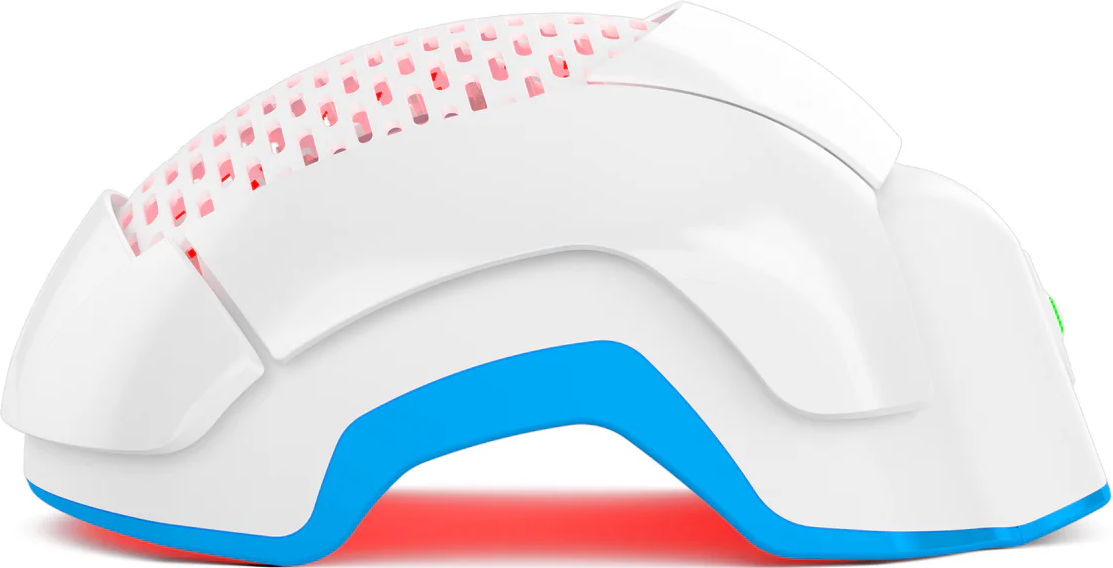
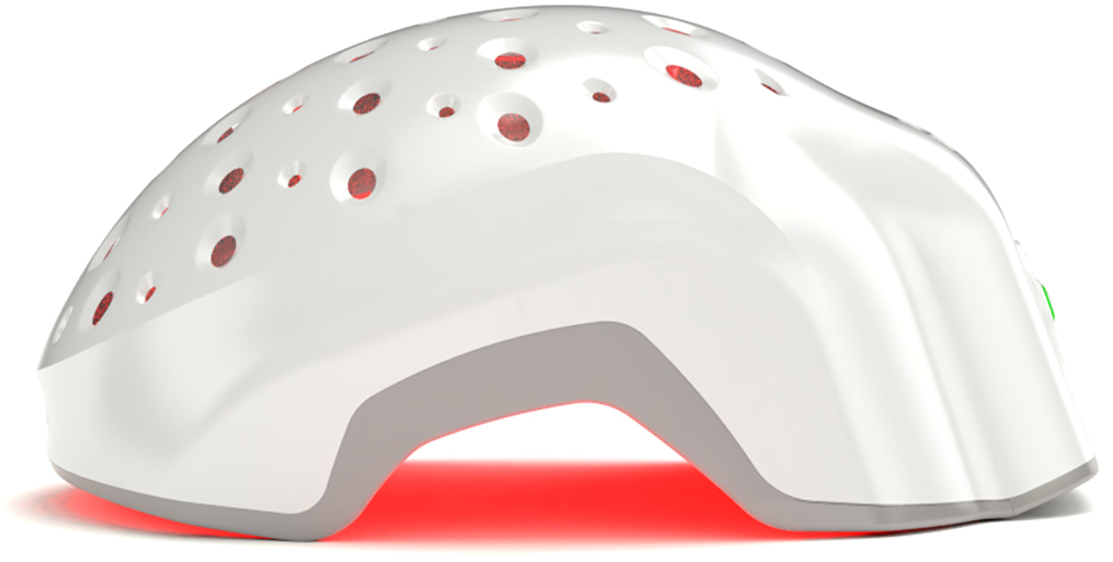
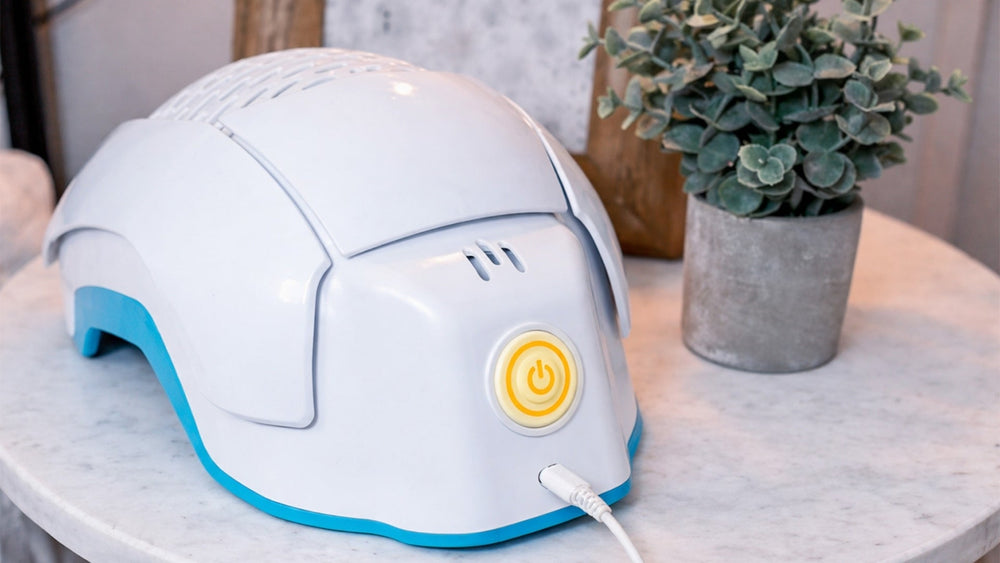
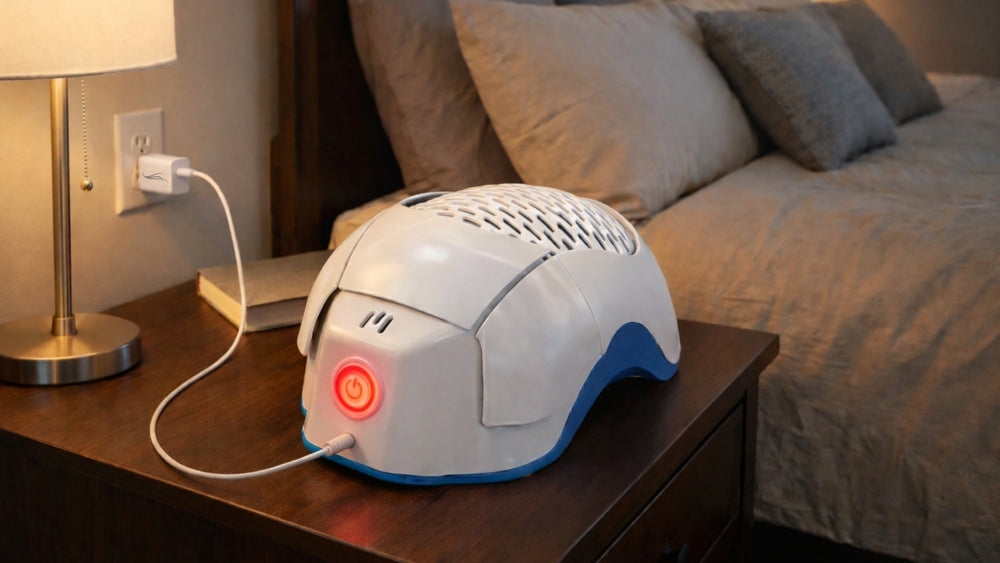
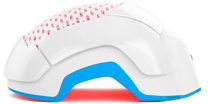
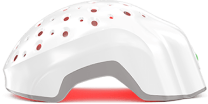
Theradome's laser helmet is FDA-cleared for androgenetic alopecia, treats the whole scalp hands-free, and runs 20-minute sessions. It won't repair a scarred follicle, and it isn't a treatment for traction alopecia itself. Our pages on the laser helmet, why sessions last 20 minutes, early versus advanced hair loss, and how it compares with wigs and extensions on cost go further.
On timing, a 12-month open-label study of a helmet-type device saw statistically significant gains from week 16 that continued through week 48, with most of the gain between weeks 16 and 24. There was no control group, so read it as supportive, not conclusive. Think months, not weeks, and think denser, not fully restored.
Which Clip-In Myths Deserve Retiring?
"Clip-ins can't hurt because they're temporary."
The extensions review notes that temporary devices skip permanent anchors but can still cause friction damage with repeated application and removal. Temporary shortens exposure. It doesn't erase it.
"Extensions make your hair grow faster."
We found no evidence. Growth speed comes from your follicles' own cycle. Extensions only add weight.
"Only glued or sewn styles cause loss."
Those carry more structural risk, but StatPearls lists extensions in general among the tension habits.
"If it doesn't hurt, it isn't damaging."
The early inflammatory phase is often silent, and gradual thinning may be the only sign. Pain works as a warning. Silence isn't clearance.
"Thin hair means no clip-ins, ever."
Nothing supports a blanket ban. Load and placement matter. Get the cause checked, keep the weight low, and stay off the thinnest areas.
"It always grows back."
Early damage often does. Scarred follicles don't.
Conclusion
So, can clip in extensions cause hair loss? Yes, through traction, and mostly when they're heavy, clipped into the same spots, or worn for long stretches. Risk is lower than with glued or sewn styles. It's still real, and no extension is gentler than tension-free hair.
Run the check: Load, Location, Time, You. Keep the weight light, stay off the hairline, take days off, and know your own hair. Early damage often recovers. Scarring doesn't, so tenderness, bumps, or shiny patches deserve a dermatologist visit.
Today, look at your hairline in good light. If something looks off, take the wefts out and book an appointment. If pattern hair loss turns up, Laser Phototherapy is one option to raise with your doctor.