







The hair itself is nearly identical. A strand from a man's head and a strand from a woman's head share the same three layers, sprout from the same kind of follicle, and run the same growth cycle. What differs is the hormonal weather around that follicle. And that weather decides where hair thins, how fast it goes, and which treatments you're even allowed to use.
You've stood in that aisle. Two bottles, same shelf, roughly the same shampoo. One is matte navy with a serif font that suggests engine oil. The other is rose gold and promises luminosity. Flip them over and read the ingredient decks side by side, and... yeah. Mostly the same molecules, different perfume.
So the aisle is theater. That much is easy.
But here's the part that gets glossed over in every "gendered marketing is a scam" article: the difference isn't entirely invented. It's just nowhere near the bottle. It sits about four millimeters under your scalp, in an enzyme gradient nobody prints on a label, and it explains why your brother's hairline retreats while yours quietly thins across the top. That's what we're getting into. Including the part where women get told "it's probably stress" for three years running.
What Is A Hair Strand Actually Made Of?
Every hair you own is dead protein. The living bit is underneath.
The shaft has three concentric zones: a medulla at the center, a cortex that makes up most of the fiber's bulk, and a single-cell-thick cuticle wrapped around the outside like overlapping roof tiles (Martel et al., 2024). The cortex is where strength and color live. The cuticle is what heat tools chew up. And the medulla is often just... missing, in finer hairs.
Below the surface sits the follicle, which is where things get genuinely interesting. The bulb wraps around a structure called the dermal papilla, and the matrix cells there divide faster than any other tissue in the human body (Martel et al., 2024).
Read that again. The fastest-dividing tissue you own is currently manufacturing the thing you complain about in the bathroom mirror.
Two words worth learning now, because the rest of this article leans on them. Terminal hair is the thick pigmented kind on your scalp. Vellus hair is the fine, short, barely-there fuzz on your forearm. Sex hormones influence hair distribution, texture and color (Buffoli et al., 2023), but the follicle's basic architecture is not sexually dimorphic. Men and women are working with the same hardware.
The difference arrives later, and it arrives from outside the follicle.
Do Men's And Women's Hair Grow At Different Rates?

Yes. Slightly. And it leans female.
This one has decent numbers behind it. Researchers used contrast-enhanced phototrichograms to measure 59,765 individual anagen hairs, and found that linear hair growth rate in normal women ran generally higher than in normal men. Thinner hairs grew more slowly than thicker ones, and growth rate correlated with fiber diameter at P < 0.006 (Van Neste, 2016). Caucasian cohort, so treat it as one population rather than a universal law. Still, nearly sixty thousand hairs is not a small look.
Growth rate matters less than people assume, though. Maximum length is really a multiplication problem: how fast it grows, times how long it stays in the growth phase before quitting. Normal anagen runs anywhere from two years to as long as seven (Ohnemus et al., 2012). Seven years at roughly a centimeter a month gets you somewhere near your waist. Two years does not. That gap is genetic, not gendered.
Why Your Ancestry Matters More Than Your Sex Here
Under a microscope, Asian hair is round in cross-section and larger in diameter than the other groups. African hair is more elliptical with wide variation in shape. Caucasian hair sits in between. Lengthwise, African hair shows irregular curling and twisting, and that irregularity is part of why it breaks more readily (ISHRS, n.d.). Average African fiber diameter runs around 55µm, the smallest of the subgroups, with the greatest variation in thickness along a single strand (Rathnayake & Sinclair, 2010).
Those gaps dwarf anything sex does to the fiber.
Which is not permission to slot people into three tidy boxes, and the field knows it. A 2023 critical appraisal concluded that classifying hair by geo-racial origin fails to account for global diversity and within-group variability in curl, shape, size and color (Daniels et al., 2023), with substantial overlap between the groups in the actual data sets.
Also worth flagging, since it causes endless confusion: "thick hair" means two different things. It can mean strands with a wide diameter, or it can mean lots of strands. Someone can have fine hair and loads of it. Someone else can have coarse hair and gaps. When a stylist says thick and a dermatologist says thick, they are frequently not discussing the same measurement at all.
How Does The Hair Growth Cycle Work?
Four phases. Anagen is growth. Catagen is the brief shutdown. Telogen is rest. Exogen is the actual shedding.
Roughly 85 to 90% of scalp follicles sit in anagen at any given moment (TeachMeAnatomy, 2025), with catagen lasting about two weeks and telogen about two to three months.
Although even those textbook numbers are being poked at. A 2024 paper argued that the standard proportions rest on methods (plucking, phototrichograms, histology) that struggle to tell catagen and telogen follicles apart (Jimenez et al., 2024). Another review puts telogen closer to 9% of scalp hair, against 40 to 50% on the trunk (Chen et al., 2023). Not settled. Nice to know the ground still shifts occasionally.
Unlike most mammals, which moult in a synchronized wave, human follicles cycle independently of one another (Jimenez et al., 2024). Small mercy. Otherwise we'd all go bald every October and grow it back by spring.
Here's the sentence that carries the rest of this article, so slow down for it. In men with androgenetic alopecia, anagen duration collapses from years to months, sometimes weeks, while telogen stays the same or stretches. The anagen-to-telogen ratio slides from a normal 6 to 8:1 down toward 0.1 to 3:1 (Ohnemus et al., 2012).
Hair loss isn't really hair falling out. It's hair not growing back long enough to matter.
Why Hormones Are The Real Difference Between Men's And Women's Hair
Both sexes make androgens. Both sexes make estrogens. The divide isn't which hormones you have. It's how much enzyme and receptor your follicles carry, and where.
In 1997, Sawaya and Price took scalp biopsies from twelve women and twelve men aged 18 to 33, sampling both the front and the back of the head. Both sexes showed higher androgen receptor and higher 5-alpha reductase (types I and II) in frontal follicles than occipital ones, with more aromatase at the back. Androgen receptor content in women's frontal follicles came in around 40% lower than men's (Sawaya & Price, 1997). Aromatase in women's frontal follicles measured six times that of men's, and women carried roughly 3 and 3.5 times less type I and type II 5-alpha reductase respectively (Zouboulis & Degitz, 2004).
Twenty-four people. 1997. Small, and old. I'd normally be skeptical of a sample that size, except this one has anchored the field for nearly thirty years and the direction of the finding keeps replicating.
What it gives us is a map. More enzyme and more receptor at the front, more aromatase (which converts testosterone toward estrogen) at the back. That single front-to-back gradient explains temple recession, explains why the back and sides hold on, and explains why hair transplants work at all.
Then there's the bit that made me put my coffee down the first time I read it properly.
The same hormone that builds a beard dismantles a hairline. Androgens prompt beard dermal papilla cells to produce IGF-1, a growth signal. In balding scalp cells, the same androgens prompt TGF-β1, TGF-β2, dickkopf1 and IL-6, all of which suppress growth (Inui & Itami, 2013). Incubating androgens with beard cells raised their capacity to stimulate growth. The same treatment on scalp cells lowered it. The likely explanation is differential gene expression inside the follicle, probably locked in during embryonic development (Randall et al., 2001).
Your follicle's postcode was assigned before you were born. It decides whether testosterone shows up as a contractor or a demolition crew.
Which kills the most stubborn myth in this category. It isn't about having more testosterone. Most women with female pattern hair loss have androgen levels sitting squarely in the normal range (Herskovitz & Tosti, 2013). Sensitivity, not quantity. Same goes for men. The guy with the shiny crown isn't more virile than his friend with the full head of hair. He just drew follicles that listen harder.
Estrogen's role is usually summarized as "protective," and roughly speaking that holds. But it's messier than the version you'll read elsewhere. Estrogen actually inhibits hair shaft elongation in cultured female scalp follicles, and pregnant women replace shed or plucked hair more slowly, not faster (Ohnemus et al., 2012). So it isn't simply fertilizer. It changes the timing of the cycle, and timing is what you notice.
Why Do Men Recede And Women Thin All Over?
Same disease. Same mechanism. Wildly different map.
The mechanism is follicular miniaturization, meaning the follicle shrinks a little more each cycle until it's producing something too fine and too short to see. DHT binds the androgen receptor in susceptible follicles, and the hormone-receptor complex switches on genes that gradually convert large terminal follicles into miniaturized ones (Price, 2003).
In men, that plays out along the Norwood-Hamilton scale. Temples first, then the crown. Among white men, 16% aged 18 to 29 and 53% aged 40 to 49 already show at least moderate androgenetic alopecia (Öztürk et al., 2025). Populations differ, sometimes a lot. In Korean men, all-ages prevalence at Norwood III or above was 14.1%, climbing from 2.3% in the third decade to 46.9% past seventy (Paik et al., 2001).
In women it shows up three ways. Diffuse crown thinning with the frontal hairline intact, graded on the 3-point Ludwig or 5-point Sinclair scale. A widening central part that breaches the hairline, which Olsen described as the Christmas tree pattern. Or thinning with bitemporal recession, following the male distribution (Ramos & Miot, 2020). Women with a Ludwig pattern sometimes shift toward a Hamilton pattern after menopause (Herskovitz & Tosti, 2013).
So "women keep their hairline" is mostly true. Not always. Worth knowing before you rule yourself out.
Total baldness in women stays rare, though. Severe loss at Ludwig III or Sinclair 5 affects under 1% of women (Sinclair et al., 2011). Trace that straight back to the aromatase and receptor numbers a few paragraphs up. The biochemistry drew the map before the mirror ever showed it to you.
Now, the honest bit. Ask how common female pattern hair loss is and the literature shrugs. Comparison across studies is hampered by the absence of universally accepted criteria, and estimates of women with some degree of frontal or frontal-parietal loss range from 6% to 38%. Detectable loss reaches 12% of women by age 29, 25% by 49, 41% by 69, and over half by 79 (Fabbrocini et al., 2018).
A range of 6 to 38 is a signal. Women's hair loss is measured badly, which is part of why it gets treated badly.
On genetics, the maternal-grandfather thing needs retiring. A UK Biobank analysis of 205,327 European men found male pattern baldness strongly heritable and polygenic, with pedigree-heritability of 0.62 and 624 near-independent genome-wide loci. The X chromosome contributed 26 of those loci, explaining 11.6% of the SNP-heritability (Yap et al., 2018). So your mum's dad is one data point out of several hundred. And three SNPs in the AR/EDA2R region turned out to be monomorphic among Asian populations, suggesting that locus contributes little or nothing to androgenetic alopecia in Asia (Marcińska et al., 2015).
Look at both sides of your family. Then stop looking, because it won't change what you do next.
How Do Pregnancy, Menopause And Other Life Stages Change Hair?
Puberty is where the paradox first shows itself. Same hormonal surge, opposite outcomes depending on which part of the body the follicle happens to live in.
Pregnancy and postpartum. High estrogen pushes most hairs into anagen and holds them there. After delivery, a large cohort shifts into telogen at once, producing postpartum telogen effluvium (Aditya et al., 2025). Shedding typically shows up two to three months after the trigger, and in telogen effluvium up to 30% of follicles move into telogen against a normal 15% (Elsaie et al., 2024).
If you are four months postpartum and pulling handfuls out in the shower, you are not losing your hair. You are giving back what you borrowed. It regrows once the trigger clears. That knowledge doesn't make the shower drain less alarming, but it does make it survivable.
Perimenopause and menopause. Estrogen drops while androgen levels may rise, and telogen effluvium and frontal fibrosing alopecia both show up more often after menopause (Aditya et al., 2025). Postmenopausal women show a reduced proportion of anagen hairs, and the reduction is more pronounced at the frontal scalp than the back.
PCOS and thyroid. Hirsutism affects 4 to 11% of women generally, but 65 to 75% of women with PCOS, and conventionally measured androgen levels correlate poorly with how severe it looks (Spritzer et al., 2022). There's a cruel wrinkle here too. Treatment gets complicated because agents that encourage scalp hair can worsen unwanted facial and body hair (Carmina & Lobo, 2022). Growing hair where you want it and not where you don't turns out to be a genuinely hard pharmacological ask.
On thyroid, a retrospective study of 500 women with telogen effluvium found the hypothyroid group had significantly higher severity scores and a greater proportion of severe loss than either euthyroid or hyperthyroid groups (Almohanna et al., 2024).
Men have no equivalent cliff. No sudden hormonal drop-off, no three-month delayed avalanche. Their version arrives slowly, over decades. Which is partly why men's loss feels like weather and women's often feels like an event.
What Else Causes Hair Loss In Men And Women?
Not everything is pattern loss. Some of the alternatives are reversible, and a couple are urgent.
Alopecia areata. Lifetime incidence sits around 2% worldwide, and both formal population studies found no sex predominance (Villasante Fricke & Miteva, 2015). Clinic samples skew female and modelled estimates run much higher, so whether there's a genuine sex difference is still an open argument. Patchy, well-defined, often sudden.
Traction alopecia. Prevalence is highest among women and children of African descent, driven both by the mechanics of the curved follicle and by styling practice, and in later stages it can become an irreversible scarring alopecia if the pulling continues (Billero & Miteva, 2018). Reported rates swing enormously by population, from 1.0% in one London clinic sample to 37% among women attending a Cape Town primary care center. A cross-sectional study of 401 Nigerian women found hair density falling from 227.56 per cm² at grade 1 to 131.22 per cm² at grade 4 (Ogunbiyi et al., 2025).
Central centrifugal cicatricial alopecia. A scarring alopecia affecting predominantly women of African descent, with prevalence of 2.7 to 5.6% in Black women, and badly understudied relative to how common that is (Wehner et al., 2025). In a review of 185 patients, mean onset came 3.7 years before the patient first presented to anyone (Cline et al., 2023). PubMednih
Nearly four years. Of a condition that scars. That number should bother you.
Iron. The internet is very confident about ferritin. The literature is less so. Association turns up in meta-analysis and vanishes in some controlled studies, and there's a good methodological reason for the mess: ferritin is an acute-phase reactant that rises with inflammation independent of iron status, while telogen effluvium can be triggered by fever, rapid weight loss or medication with no iron deficiency involved at all (Thamotharan et al., 2025). Test it. Correct it if it's low. Don't expect it to be the whole answer. Jaad
Medications. Anagen effluvium is usually chemotherapy. Telogen effluvium accounts for virtually every other drug-related loss, spanning anticoagulants, beta-blockers, ACE inhibitors, hormonal agents and anticonvulsants, with valproic acid running 12 to 28% dose-dependently (Ngan & Oakley, 2024). And shedding can begin when you stop a medication as readily as when you start one (Watras et al., 2023).
Why Is Women's Hair Loss Harder To Diagnose?
Because it's diffuse, because nobody agreed on the criteria, and because "it's probably stress" is a cheap answer that happens to be right often enough to keep getting handed out.
Pattern loss in men announces itself. There's a shape to it. A receding line you can photograph against last year's photo. Diffuse thinning across a whole scalp doesn't announce anything until roughly half of it is gone.
A proper assessment isn't complicated. History, pull test, trichoscopy, targeted bloods, biopsy if the picture stays murky. Trichoscopy gives magnified views from around ×10 with a handheld dermatoscope up to ×1,000 with a videodermatoscope, and it's particularly good at separating androgenetic alopecia, alopecia areata, telogen effluvium and trichotillomania (American Hair Loss Association, 2024). Guidance for female pattern hair loss also calls for asking about anxiety, depression and self-esteem, not just about the scalp (British Association of Dermatologists, 2024).
Get seen promptly if you notice any of these:
- Rapid onset over weeks rather than months
- Patchy loss with defined edges
- Scalp pain, burning or persistent itch
- Visible change in the scalp surface itself, shiny or smooth patches
- Loss of eyebrows, eyelashes or body hair
Those point toward the scarring alopecias, and scarring alopecias destroy follicles for good. Frontal fibrosing alopecia, for instance, involves persistent inflammation and immune privilege collapse that wipes out the stem cells in the follicle's bulge region (Miao et al., 2022). You cannot un-scar a follicle. Speed is the only lever you have.
One last thing for this section, and it's the one I'd underline if this were on paper. Even clinically inconspicuous hair loss correlates with reduced quality of life, and patients frequently rate their own loss as more severe than their dermatologist does (Kim et al., 2024).
Meaning: it can look like nothing to somebody else and still not feel like nothing to you. Both of those are allowed to be true at the same time.
Is There A Difference Between Men's And Women's Scalps?
This is the one place the aisle has a partial point.
Why Men's Scalps Run Oilier
Men produce more sebum than women, which is thought to feed the higher dandruff rate. Sex differences also show up in skin pH, transepidermal water loss and hydration, and male scalps have been reported to carry lower ceramide levels and higher total protein loss, pointing to a weaker barrier (Chen et al., 2025).
Why Dandruff Shows Up More In Men
Seborrhoeic dermatitis affects 3 to 12% of the population and is more common in males (Oakley, 2026). The National Eczema Society puts adult prevalence near 4% and likewise records male predominance (National Eczema Society, 2023). The usual explanation combines androgen influence with the fact that scalp sebaceous glands get larger in males after puberty (Pray, 2013).
Three independent sources, same direction. Comfortable calling that one settled.
Medicated shampoo belongs right here, and only here. Zinc pyrithione, ketoconazole, selenium sulphide: these manage a scalp condition. They are not hair growth treatments, and any bottle claiming otherwise is selling you a different product than the one inside it.
Do Men's And Women's Hair Products Actually Differ?
Mostly no, and the "mostly" is doing real work.
The obvious answer first. Fragrance changes. Packaging changes. The insecurity being sold against changes. Anti-dandruff control tends to lead in men's positioning, while women's products lead on shine and length, which sit closer to conventional standards of femininity (Typology, 2025). That is a merchandising decision made in a meeting room. It is not formulation science.
But the reason this section isn't just a lazy debunk is the previous one. Scalps do differ, on average, in oil output and barrier strength. The error isn't believing scalps vary. The error is sorting the shelf by pronoun when it should be sorted by scalp.
Buy for the scalp you actually have.
If yours is oily and flaking, the molecule that helps is identical regardless of which font it came packaged in. If yours is dry and irritated, ditto. Nobody's follicles check the label for gendered marketing before deciding whether to respond.
Is Your Hair Breaking Or Falling Out?
Genuinely different problems. Genuinely different fixes. And almost nobody explains how to tell them apart.
Look at the end of a shed hair. If there's a small pale bulb, a club shape, it completed its cycle and left the follicle on schedule. Normal. If the end is blunt, frayed or splintered, it snapped somewhere along its length. That's damage, not loss, and no growth treatment on earth will fix it.
The distinction matters more in some populations than others. Shed hair in Caucasian and Asian groups tends to come away as full-length shafts with a telogen club. Shed African hair shafts are often shorter, lacking a proximal club and showing longitudinal fissures, which indicates breakage rather than shedding as the primary mechanism of loss (Rathnayake & Sinclair, 2010).
What does the snapping? Johns Hopkins researchers found that thermal tools, flat irons and blow dryers included, along with chemical processing such as permanent dye and straightening, damage the cuticle and alter the hair's protein structure, exposing cortical fibers that fray into weak points where breakage happens (Practical Dermatology, 2016). Split ends show reduced cystine toward the distal portions, and that weathering plus thinning cuticle coverage determines exactly where the nodules form (Mubki, 2025).
And tension, which loops back to traction alopecia. Risk climbs with the extent of pull (Billero & Miteva, 2018). Braids aren't the villain. Weaves aren't the villain. Tightness is. If a style hurts on day one, that isn't it settling in.
What Actually Works For Men's And Women's Hair Loss?
Three approaches carry randomized evidence. Only two of the three are open to both sexes, and that asymmetry is the sharpest sex difference in this entire article.
|
Option |
Who it's for |
What the evidence shows |
What it can't do |
|
Topical minoxidil |
FDA-approved, men and women |
Superior to placebo in meta-analysis |
Modest gains, must continue |
|
Oral finasteride |
Men only |
Effective in men |
Contraindicated in pregnancy |
|
Spironolactone / oral minoxidil |
Women, off-label |
Weaker evidence base |
Not formally approved for this |
|
Laser phototherapy |
Cleared for both sexes |
Density gains vs sham |
Not a cure for the underlying sensitivity |
|
PRP |
Both |
Low-quality evidence |
No standard protocol |
|
Transplant |
Both, many women unsuitable |
Redistributes hair |
Adds no new hair |
Minoxidil. Topical minoxidil in 5% foam, 5% solution and 2% solution is FDA-approved for androgenetic alopecia in men and women. It works through several routes including Wnt/β-catenin signaling and effects on anagen and telogen length, and it's a prodrug converted by follicular sulfotransferase, which is why people with higher enzyme activity tend to respond better (Suchonwanit et al., 2022). The women's 5% foam labelling notes results may appear at three months, though some women need at least six (DailyMed, n.d.).
Finasteride, and here's the divide made concrete. Propecia is indicated for men only and is explicitly not indicated in women. It is contraindicated in women who are or may become pregnant, because blocking the conversion of testosterone to DHT can cause abnormalities of the external genitalia in a male fetus (FDA, 2022).
That is not sexism in prescribing. It's teratogenicity. But the practical result is the same: half the population gets a smaller menu.
What women get instead is a set of off-label options with thinner evidence behind them. Spironolactone evidence comes largely from case reports, retrospective and open-label work, with no dose-response study available. Below 100mg daily it doesn't appear to improve thinning. At 100 to 200mg it appears to stabilize and improve, with additive effect alongside topical minoxidil, which itself stabilizes progression in roughly 90% of women over 6 to 12 months and produces regrowth in 46 to 68% (Vaňková et al., 2022).
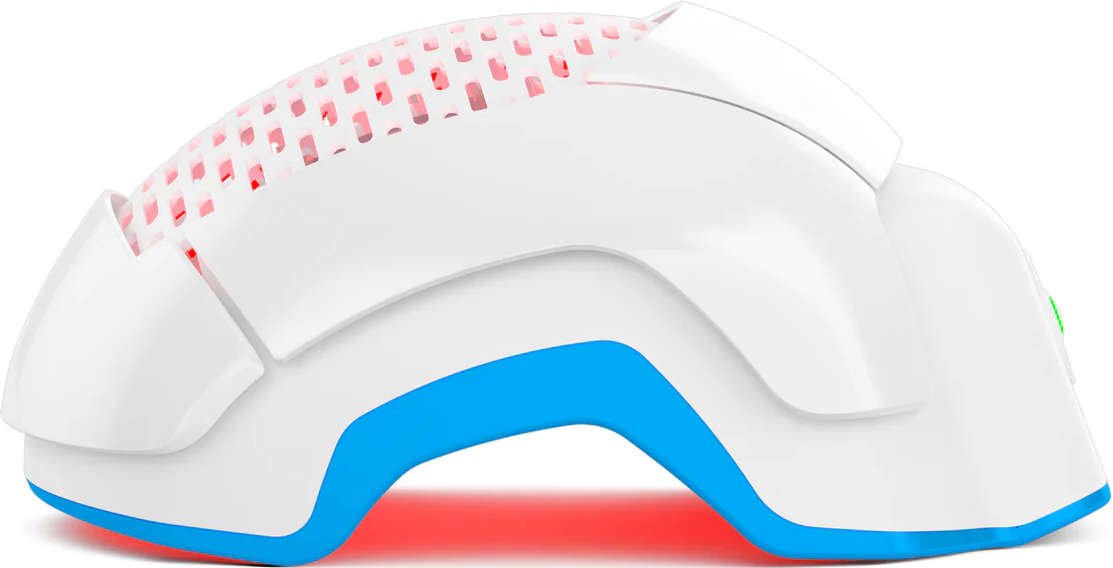
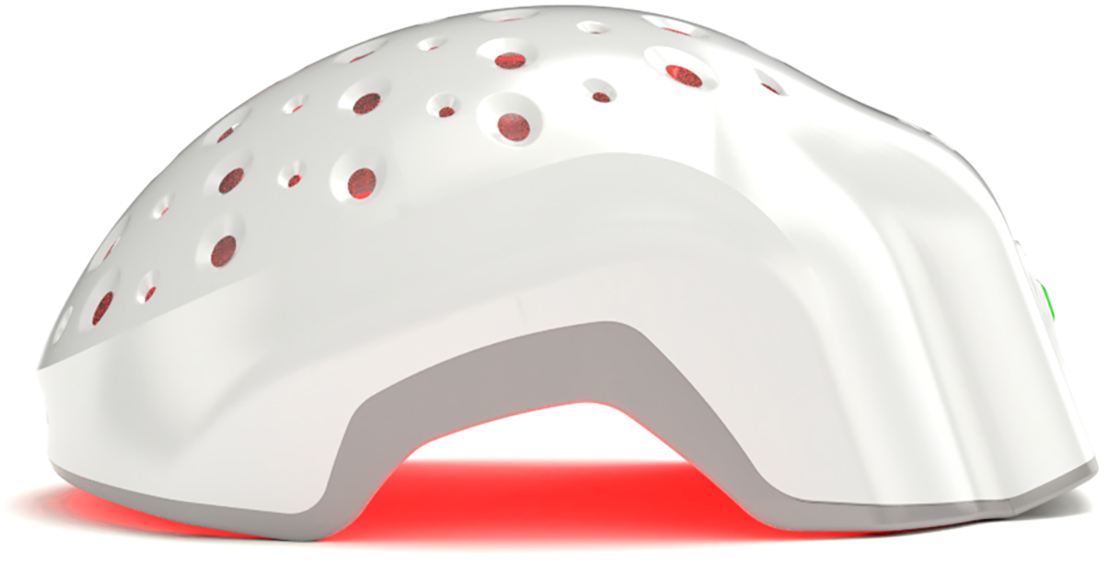
Laser phototherapy. A systematic review and meta-analysis of good- and fair-quality double-blind randomized trials ran five separate analyses covering laser therapy in men, minoxidil at both concentrations in men, finasteride in men, and minoxidil in women. Every treatment beat placebo at P < .00001 (Adil & Godwin, 2017). A later meta-analysis pooling 11 double-blinded randomized trials found a significant increase in hair density against sham devices, standardized mean difference 1.316 (95% CI 0.993 to 1.639), with benefit holding across both sexes and across device types (Liu et al., 2019). In absolute numbers, a 26-week trial reported gains of +17.2 hairs per cm² in men and +19.9 in women against sham (Shin et al., 2026).
The mechanism, stated as the hypothesis it currently is. Red and near-infrared light appears to be absorbed by cytochrome c oxidase in the mitochondrial respiratory chain, boosting electron transport and ATP synthesis, possibly by displacing inhibitory nitric oxide from the enzyme's copper and heme centers (Hamblin, 2019). Although a study using cell lines engineered without cytochrome c oxidase found that proliferation enhancement at 660nm didn't actually require it (Lima et al., 2019). So the leading explanation is leading, not proven.
And for balance, because leaving this out would be dishonest: one randomized controlled trial of 54 patients found laser plus 5% minoxidil produced 14.78% density improvement against 11.43% for minoxidil alone, and the difference was not statistically significant at P = 0.45 (Sarkar et al., 2023).
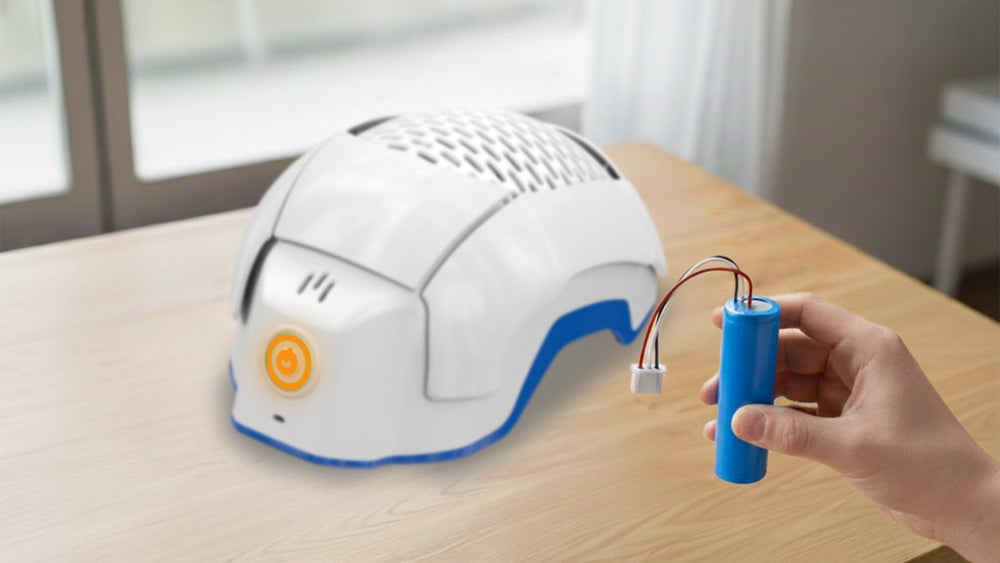
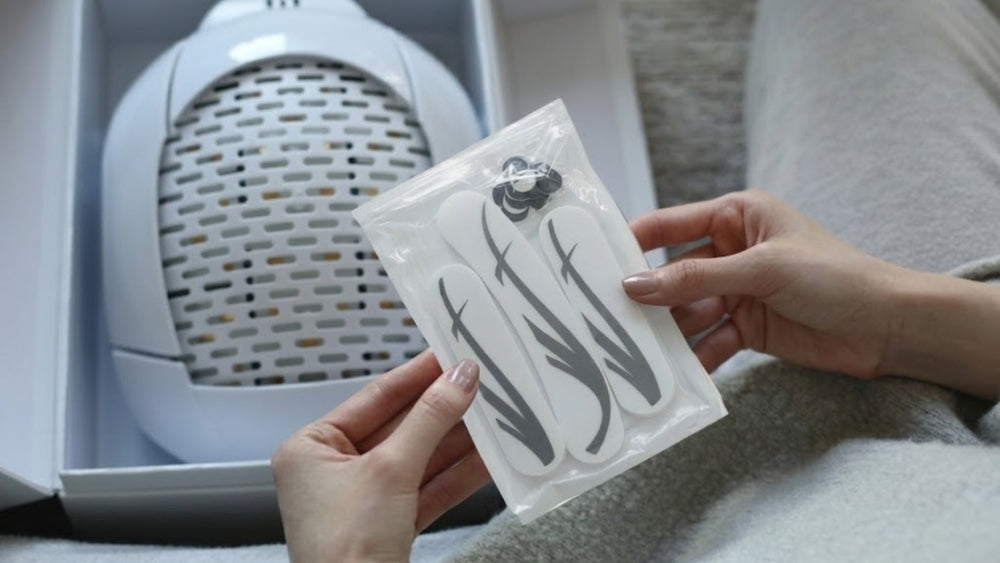
Regulatory-wise, these are Class 3R devices under IEC 60825-1 with individual laser output at or below 5mW, cleared for female pattern hair loss at Ludwig-Savin I-II and male androgenetic alopecia at Norwood-Hamilton IIA to V, in Fitzpatrick skin types I to IV (FDA, 2016).
Why it earns a mention in an article about sex differences specifically: it's cleared for both, carries no pregnancy restriction, and does nothing hormonal. In a category where women keep hitting closed doors, an option that doesn't care about your reproductive plans is worth knowing about. It isn't magic. It's one tool with reasonable evidence, sitting beside the others.
PRP. Meta-analysis found a mean difference of 27.55 hairs per cm², but with heterogeneity at I² = 95.99%, graded low-quality, with evident publication bias (Lima et al., 2024). No standardized preparation protocol exists, and PRP varies widely in actual platelet and growth factor content between clinics (Donnelly et al., 2024). Promising. Expensive. Under-evidenced.
Transplants, and here's the hard truth women rarely get told upfront. Although the crown shows the most obvious reduction, there's usually a global density decline across the whole scalp, which leaves many women unsuitable for transplantation because of a poor occipital donor supply (Sinclair et al., 2011). Donor dominance is the whole principle: grafts must come from scalp the pattern spares (Bicknell et al., 2021). And a transplant redistributes hair you already have. It does not add volume (American Hair Loss Association, 2023).
Supplements. Correct low vitamin D and low iron where a deficiency is documented. There's insufficient evidence to recommend zinc, riboflavin, folic acid or B12 supplementation. Excess vitamin A and excess selenium both contribute to hair loss (Almohanna et al., 2019). The thresholds worth knowing: vitamin A above 10,000 IU daily, selenium above 400mcg daily (Kaliyadan et al., 2024).
Test first. Then supplement. Not the other way round.
On timelines, universally: nothing works inside three months, everything needs to continue, and the realistic target is holding your ground plus partial regrowth. Anyone promising more than that is not describing hair.
Common Myths About Men's And Women's Hair
Baldness comes from your mother's father. One clue among 624 loci. Look at both sides.
Hats cause baldness. No. Tension causes traction alopecia. A hat is not tension.
Shaving makes hair grow back thicker. Tested in 1928 on four men shaving under controlled conditions, with no evidence it accelerated beard growth, and again in 1970 with five men shaving one leg weekly for months, finding no significant difference in width, coarseness or growth rate (Scientific American, 2024). Mayo Clinic agrees (Mayo Clinic, n.d.). The blunt cut end just feels different.
Women don't really go bald. Under 1% reach the severe end. Rare is not the same as never.
Frequent washing causes hair loss. What you see in the drain is exogen, which was leaving anyway.
And a bonus, because it's a real sex difference and it demolishes a famous rule of thumb: a worldwide survey found that between ages 45 and 65, 74% of people had some grey with a mean intensity of 27%, and men had significantly more grey than women. The proportion with at least 50% grey coverage at age 50 ranged globally from 6 to 23%, well below the familiar "50 by 50" claim (Panhard et al., 2012).
What Should You Do If You Think You're Losing Hair?
- Photograph it. Same light, same part, same angle, monthly. Memory is a terrible instrument for this. Your phone is a good one.
- Look at the ends. Club-shaped bulb or blunt break. That single check tells you whether you have a growth problem or a damage problem.
- Count backwards two to three months. Illness, surgery, a new prescription, a crash diet, a birth. The trigger is almost never recent.
- Get looked at before you start buying things. Pattern hair loss is a clinical diagnosis based on distribution rather than blood results, with bloods used to rule out reversible contributors that may be sitting alongside it (Trichometrics, 2026). University of Manchester
And two things to stop today: tight styling that hurts, and unsupervised megadoses of anything.
Conclusion
Same fiber. Same follicle. Same four-phase cycle running underneath both of you.
What differs is hormonal, and it's quantitative rather than categorical. More 5-alpha reductase and more androgen receptor at the front of a man's scalp. Considerably more aromatase in a woman's. That gradient draws the map, sets the pace, and decides which shelf of treatments you get handed at the pharmacy counter.
Which means the aisle was never really the difference. Neither, mostly, was your sex, at least not where the fiber itself is concerned. Ancestry did more to your hair's shape and strength than either one. Hormones did more to your follicles than both.
If something is changing on your head, the useful next move isn't a new bottle. It's a photograph, a look at the ends, and a conversation with someone qualified to examine your scalp properly.