







Yes, telogen effluvium can affect the hairline. It thins density along the frontal and temporal edges, and bitemporal thinning has been described in the dermatology literature since 1996. But it behaves differently from genetic hair loss. Telogen effluvium does not push your hairline permanently backward, and it does not widen your central part. The follicles stay intact, which is why regrowth is the rule rather than the exception.
You know when your hand comes away from your scalp in the shower with more hair in it than there should be, and you do that thing where you stick it to the tile wall, because binning it feels like destroying evidence. Then you count it. Which helps nobody. And you do it anyway.
A few weeks on, the worry relocates. It stops being about volume and starts being about your hairline. You are standing closer to the mirror than you used to stand. Checking your temples under the bathroom light, then the car light, then that unforgiving strip light at work, essentially canvassing lamps for a second opinion.
The part worth holding onto is this. Temporary shedding and permanent recession leave different fingerprints, and much of the time you can separate them by pattern alone. Not perfectly. Not always without help. But the difference is real, and knowable, which beats lying awake doing arithmetic on hair.
What Is Telogen Effluvium?
Every hair on your head is cycling through three phases: anagen (growing), catagen (a brief transition), and telogen (resting). At any given moment most of your scalp is in the growth phase. StatPearls puts the normal split at roughly 85 percent growing and 15 percent resting, while other clinical references give a range of 5 to 15 percent resting.
Telogen effluvium happens when something knocks a large batch of growing hairs into rest all at once. Under sustained, significant stress, StatPearls notes that this can reach around 70 percent of anagen hairs, though that figure sits at the severe end rather than the middle.
Now, the shedding you are watching is the new hair pushing the old one out. With this type of hair loss, hair fall is a sign of hair regrowth. The strand landing on your pillow was already finished. Something is coming up underneath it.
And crucially, telogen effluvium is non-scarring. The follicle structures survive intact, which is precisely why this condition is described as benign and spontaneously reversible. Nothing is being destroyed. Something is being interrupted.
So, Does Telogen Effluvium Affect the Hairline?
Yes. It is a diffuse process, and diffuse includes the front of your head.
This gets stated wrongly on the internet quite a lot, usually as some version of "telogen effluvium spares the hairline," which is tidy and reassuring and not quite what the research says.
Whiting's 1996 study in the Journal of the American Academy of Dermatology followed 355 patients with diffuse thinning of unknown origin. His description: diffuse thinning across the scalp, frequently accompanied by bitemporal recession. That paper is still the reference point for chronic telogen effluvium nearly thirty years on.
A 2021 review from Wake Forest looking specifically at bi-temporal hair loss says the same thing: clinical examination in telogen effluvium usually reveals bitemporal recession without involvement of the central scalp. And a seven-year prospective follow-up published in JAAD describes patient after patient presenting with exactly that combination... thinner ponytail, receded temples, central part unchanged.
Three independent sources. Twenty-five years apart. So yes, your temples are fair game.
But read that last clause again, because it is doing enormous work: without widening of the central part.
That is the whole distinction.
Telogen effluvium takes density off the margin. Pattern hair loss widens the part. Two different signatures, and you can check one of them yourself in about four seconds with a comb.
Which brings up a question worth answering honestly. If the loss is genuinely diffuse, why does the front always look like the disaster zone? Because the front is the least camouflaged part of your scalp. High contrast against skin, no surrounding hair to hide behind, and it is the exact patch you have been inspecting under four different lamps. Loss that is perfectly even everywhere still announces itself first where you are looking hardest.
Those Tiny Hairs Along Your Hairline Are Good News

Alright. Deep breath. This is the part people find genuinely surprising.
DermNet describes it directly: as new hair comes up through the scalp and pushes out the dead shaft, a fine fringe of new hair is often evident along the forehead hairline.
Read that again, slowly. That halo of wispy little hairs framing your face, the one you have been reading as your hairline disintegrating? It is the visual signature of recovery. It is the thing clinicians look for.
So how do you tell regrowth from the other kind of tiny hair, the miniaturized sort that shows up in genetic loss?
Caliber and uniformity. Regrowth hairs come in as a matched set: same short length, same thickness, same healthy pigment, because thousands of follicles restarted together on roughly the same schedule. Miniaturizing hairs are a mess by comparison, thick next to thin next to thinner. Under trichoscopy this is called hair diameter diversity, and above 20 percent it is treated as a hallmark of androgenetic alopecia.
Uniform baby hairs, good. Wildly mismatched thicknesses, worth investigating.
Telogen Effluvium or Genetic Hair Loss? How to Tell the Difference
Five markers. None of them requires equipment.
- Even thinning versus patterned recession. Telogen effluvium pulls density down across the whole frontal margin at once. Androgenetic alopecia recedes in a shape, typically an M or deepening temporal points in men. In women it more often shows up as thinning through the centre with the frontal line preserved.
- Sudden onset versus slow shrinking. Telogen effluvium arrives fast, roughly two to three months after a physiological shock. Genetic hair loss is a years-long process of follicles gradually shrinking under hormonal sensitivity. One is an event. The other is a slope.
- The uniform crop of baby hair. As telogen effluvium resolves, follicles re-enter growth together and produce that even fringe of short fine hairs described above. Pattern loss does not generate spontaneous widespread regrowth like that.
- The part test. Telogen effluvium leaves your central part where it was. Pattern hair loss frequently widens it, and the Sinclair scale grades severity largely by how much that part has opened up.
- Front versus back. In telogen effluvium the whole scalp is affected equally, and trichoscopy shows no difference between frontal and occipital scalp. In female pattern hair loss, frontal hairs average thinner than the ones at the back. That is why a clinician will peer at the back of your head while you are complaining about the front.
Now the finding that reframes this entire question.
A 2024 study in the Journal of Clinical and Aesthetic Dermatology assessed 200 women with postpartum hair loss, clinically and with trichoscopy. Only 9.5 percent had telogen effluvium on its own. Fifty-six percent had telogen effluvium plus androgenetic alopecia. Another 28 percent had both of those plus traction alopecia. Roughly nine in ten were running a second condition underneath the shedding.
Those women were recruited from a hospital dermatology clinic. Meaning they were the ones whose shedding got bad enough to seek help. Everyone whose hair quietly sorted itself out never made it into the dataset. The true proportion across all women is lower. Possibly much lower.
Still. It explains something people describe constantly, which is that the shedding stopped but the density never quite came home. Often the effluvium was temporary and did exactly what it was always going to do. It just took away the cover from something that was already there.
What Else Thins a Hairline (And What Should Send You to a Doctor)
Telogen effluvium is not the only thing that goes after a hairline. Two of the alternatives scar. Which is why this section exists, and why we are not going to be cute about it.
Frontal fibrosing alopecia
A scarring condition affecting the frontal and temporal hairline, first described by Kossard in 1994. Cases have climbed sharply since the 1990s and nobody has established why.
What it looks like: a band of loss following the contour of the hairline rather than diffuse thinning. Skin that reads pale, shiny, smooth, with no visible follicle openings. Redness or fine scale around individual hairs. Occasional lone hairs stranded out in front of the new margin, which clinicians actually call the lonely hair sign.
And the eyebrows. This is the one to check tonight. Depending on the case series, somewhere between roughly three-quarters and 95 percent of women diagnosed have lost some or all of their eyebrow hair, and the AAD notes that eyebrow thinning often comes first, before any hairline change is obvious. Many people also recall itch or scalp discomfort beforehand.
Why the urgency? Because it scars. Caught early, progression can be slowed. Caught late, that hair is not coming back. Telogen effluvium gives you time. This does not.
Traction alopecia
Tension damage, worn along the frontal and temporal margins, usually from tight styles held for long stretches. StatPearls describes the giveaway as the fringe sign: a band of finer, retained hairs left along the very front edge. It was named by Samrao and colleagues in 2011 and turned up in around 90 percent of patients in one series.
It is biphasic. Early on, reversible. Chronic, it scars.
Worth flagging for anyone reading this at 3am with a newborn on their shoulder: in that 200-woman study, 34.5 percent had traction involvement. A tight bun worn every day for six months while you are also postpartum means two separate processes chewing on the same square inch of scalp.
Alopecia areata and a few others
Patchy, well-defined, smooth-skinned loss suggests alopecia areata rather than effluvium. The exception, and it is a genuine trap, is a diffuse variant that can look almost exactly like telogen effluvium.
Thyroid dysfunction and iron deficiency both belong on the list too. More on those shortly.
What Set It Off, and Why You're Probably Blaming the Wrong Month
Shedding shows up two to three months after the trigger, sometimes stretching to six. By the time hair is collecting in the drain, you have long since recovered from whatever caused it, and you are now suspicious of the shampoo you started three weeks ago.
The usual culprits: fever and infection, surgery, childbirth, rapid weight loss, low protein intake, thyroid problems, iron deficiency, stopping hormonal contraception, and certain medications.
COVID deserves its own note, because the timing broke the usual rule. A systematic review of 19 studies covering 465 patients found shedding starting at a mean of 74 days after symptom onset, earlier than classic telogen effluvium. A multicentre series in JAAD put median onset at 45 days and median duration around 47 days. Oddly enough, something similar was recorded after the 1918 influenza pandemic, with diffuse loss beginning two to six weeks in.
On stress, which everyone asks about. A 2021 paper in Nature from a Harvard team showed that the stress hormone corticosterone acts on the dermal papilla to suppress a signalling molecule called Gas6, holding follicles in an extended resting phase in mice. Restoring Gas6 reversed it. Elegant work, and the lab explains it well. Still mice, though. Human trials have not followed.
On medications, one firm line: do not stop a prescription over your hair. Speak to whoever prescribed it. Worth knowing that the dedicated 2023 review in Cutis found the evidence for beta-blockers thinner than general references imply, mostly isolated case reports.
Then there is the answer nobody wants.
In up to a third of cases, no trigger is ever identified. Not because your clinician gave up. Because sometimes the body simply does not file a report.
Oh, and taking too much of certain things is itself a trigger. Excess vitamin A and selenium both show up on the standard trigger list. More is not automatically better, which is a slightly awkward sentence for anyone whose bathroom cabinet currently resembles a small pharmacy.
How Long Until My Hairline Looks Normal Again?
Shedding takes three to six months to stop once the trigger passes. Regrowth takes another three to six months after that. Meaningful, visible restoration can run twelve to eighteen months.
DermNet frames it slightly differently: the fall peaks, then tapers back toward normal over six to nine months in most cases.
You are measuring in weeks. Your follicles are working in seasons. That mismatch is where most of the suffering lives.
And your hairline is not actually recovering slower than the rest of your head, even though it will absolutely feel that way. New hair at the front is short and fine and standing directly against exposed skin at the most scrutinized patch of scalp you own. Everywhere else, that same short regrowth is hiding inside surrounding hair. Same hairs. Same timeline. Different amount of camouflage.
Remember the lamp canvassing from earlier? This is the stage where it gets worst, right when things are actually turning.
If heavy shedding is still going strong past six months, that moves into chronic telogen effluvium territory and needs a proper look. Whiting described a fluctuating course that can persist for years in women roughly 30 to 60. Notably, the women in those series did not go bald.
What Actually Helps While You Wait
Something we should probably admit up front, given what we sell.
Telogen effluvium is self-limiting. StatPearls goes as far as saying that prescribing hair growth medications or referring patients for transplants is unnecessary in straightforward cases. We are a laser device company printing that sentence on our own blog, which should tell you how seriously we mean it.
Gentle grooming and styling practices
- Lose the high-tension styles. Tight ponytails, buns, and braids pull directly on the frontal scalp and can stack traction alopecia on top of what is already happening. Your hairline is having a rough quarter. Do not also hang weight off it.
- Detangle like the hair is borrowed. Wide-tooth comb, damp hair, minimal force. This reduces friction and stops you dragging out loosely anchored resting hairs before they were ready.
- Wash your hair. Seriously, wash it. StatPearls specifically notes that patients worry normal grooming worsens shedding and should be reassured that it does not. The hairs that come out in the shower were already released. Skipping washes does not rescue them. It just stockpiles them for a more theatrical reveal on Sunday.
Scalp hygiene and nutritional foundations
- Test, then treat. Not the other way round. Blind supplementation is a poor plan and occasionally a harmful one.
- Understand what ferritin does and does not tell you. Ferritin rises with inflammation, so a normal reading does not rule out iron deficiency, and iron saturation is the more sensitive marker. If you have been told your bloods are fine and your hair disagrees, that is worth raising.
- Know that the iron evidence is genuinely contested. Some studies find lower ferritin in telogen effluvium patients. Others find no significant difference from controls. We are not going to hand you a target number, because the popular ones come from individual authors and have never been confirmed by randomized trials.
- Get thyroid function checked if the other symptoms fit, and eat enough protein. Follicles are metabolically expensive tissue.
What not to do
Do not start five things at once, because if something works you will have no idea which one it was. Do not count hairs daily (we all did it, it helps nothing). Photograph monthly instead: same light, same part, same angle, dated. Do not quit an intervention at week three when the biology needs months. And do not megadose fat-soluble vitamins, for reasons covered a few paragraphs back.
Where Laser Phototherapy Fits
Laser phototherapy is FDA-cleared to treat androgenetic alopecia. It is not indicated for telogen effluvium, and there is no randomized controlled trial showing it shortens a shedding episode. Anyone telling you otherwise is selling harder than the evidence allows.
So why is it in this article at all?
Go back to that 200-woman study. Fifty-six percent had androgenetic alopecia sitting underneath the postpartum shedding. When the shedding settles and density still has not returned, the part that persists is frequently genetic. That is the thing laser phototherapy is actually built for.
The mechanism, briefly. Red light in roughly the 600 to 900 nanometre range is absorbed by cytochrome c oxidase, an enzyme in the mitochondria. That absorption lifts ATP output, and photobiomodulation has been shown to move resting follicles into the growth phase and extend how long they stay there.
The evidence, both directions. A meta-analysis of seven randomised controlled trials covering 607 participants found a 37 percent increase in hair counts against sham devices, with no reported side effects. The largest single trial was Jimenez and colleagues in 2014, with 269 participants. Against that, a 2023 randomised trial in the International Journal of Trichology found no significant added benefit when laser therapy was combined with minoxidil versus minoxidil alone. Sample sizes across this field are small and follow-up is short. Both those things are true at once.
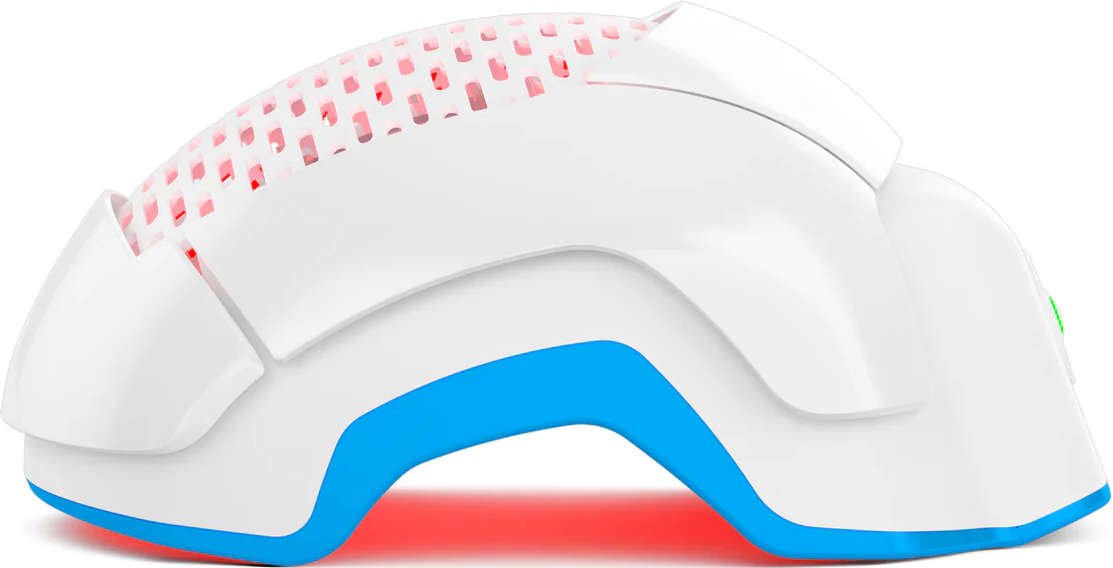
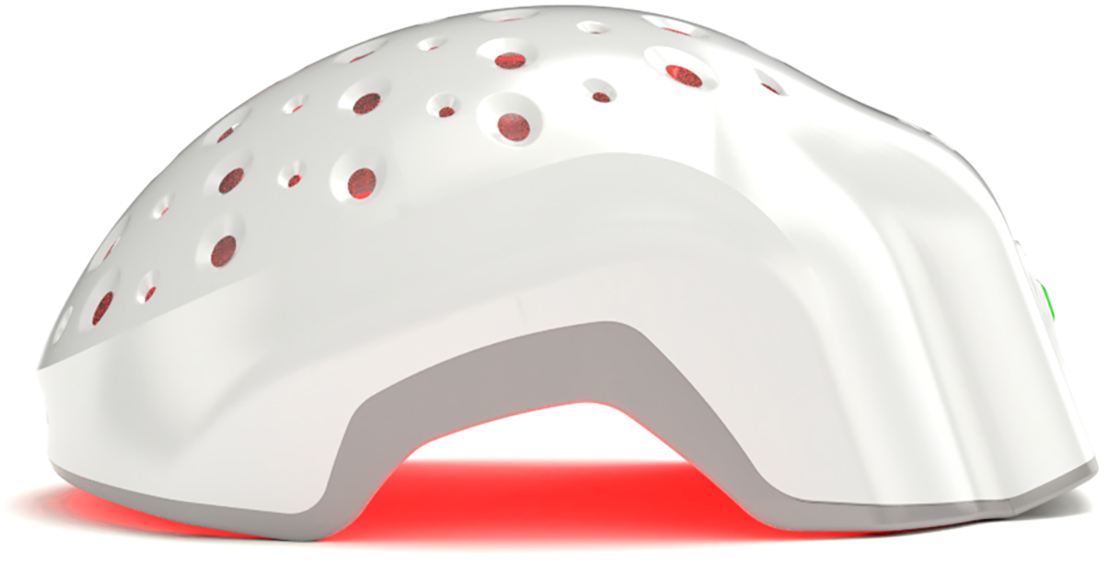
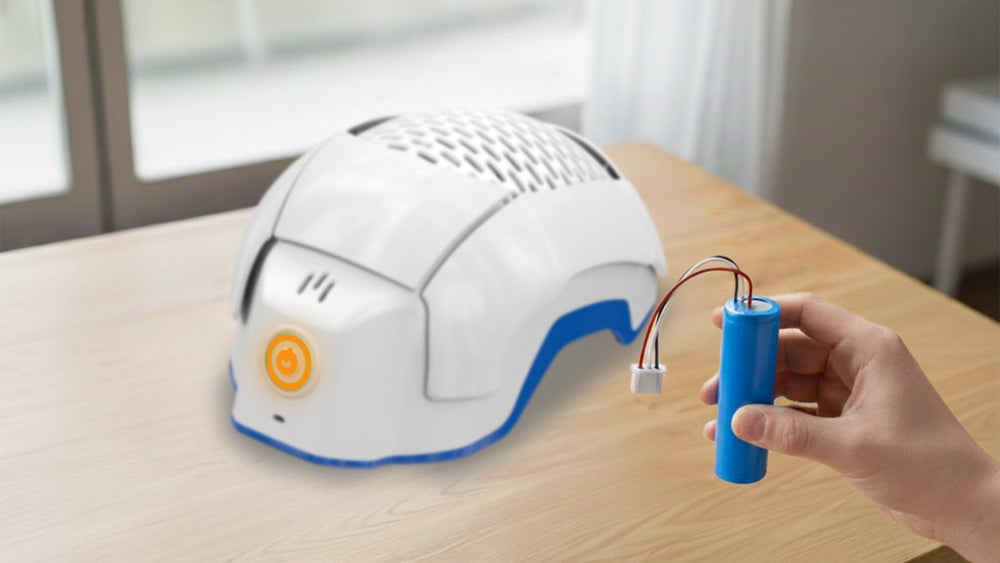
Theradome devices are cleared by the FDA to treat androgenetic alopecia, using 678 nanometer laser diodes classified as Class 3R, in a hands-free helmet covering the full scalp including the frontal region, in fixed twenty-minute sessions with no heat generated. The cleared indications are specific: Ludwig-Savin I to II for women, Norwood-Hamilton IIA to V for men, Fitzpatrick skin types I to IV.
The sequencing matters more than the product. Establish the diagnosis. Deal with the trigger. If a genetic component is confirmed underneath, that is the point where this belongs in the conversation. Not before.
When to Stop Waiting and See Someone
Book an appointment if any of these apply:
- Eyebrow thinning, particularly at the outer edges
- Itch, burning, pain, or tenderness along the hairline
- Shiny, pale, smooth skin where hair used to be, with no visible follicle openings
- A clean band of loss tracing the shape of your hairline
- Patchy or one-sided loss rather than all-over thinning
- Redness, scaling, or spots on the scalp
- Heavy shedding still going at six months
- Eyelash or body hair involvement
- Fatigue, weight change, or cold intolerance alongside the hair loss
- A history of tight styles with loss concentrated at the margins
Who to see: a dermatologist or trichologist, and your GP for baseline bloods. Bring a timeline, your dated photos, a list of medications, any recent illness, and any dietary changes.
A hairline complaint honestly deserves a lower threshold for getting assessed than general thinning does. Two of the conditions that go after hairlines leave scars, and one of them is only reversible if somebody catches it early.
Conclusion
Telogen effluvium can absolutely leave a hairline looking thin, soft, and see-through. What it does not do is scar the scalp, destroy follicles, or permanently move your hairline backward. Recovery is the norm, even when the middle stretch feels like proof of the opposite.
If density does not return once the shedding stops, the reason is usually a second condition that the effluvium revealed rather than damage the effluvium caused. That is worth identifying properly, not worrying about indefinitely.
So: sort out the trigger, be gentle with the front of your head, take a photo once a month instead of counting strands, and get eyes on it if any of those red flags apply. Your follicles are still there. They are just running late.