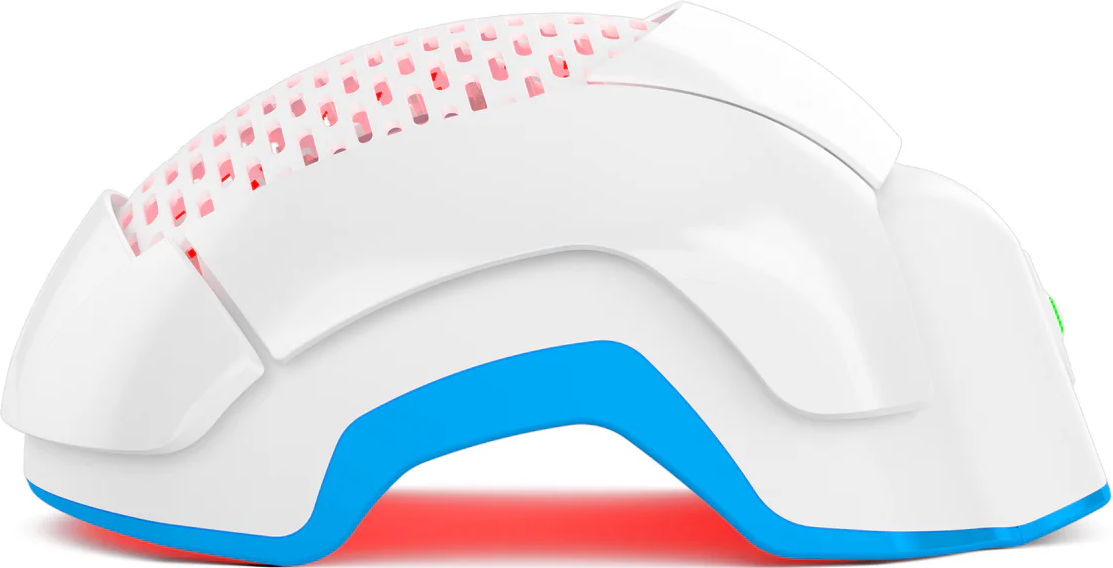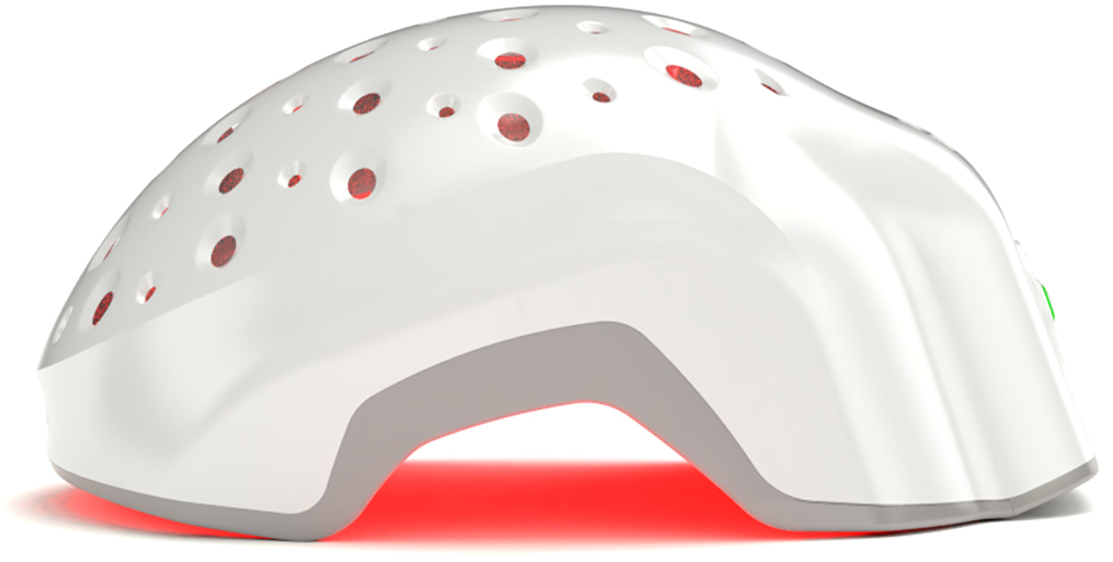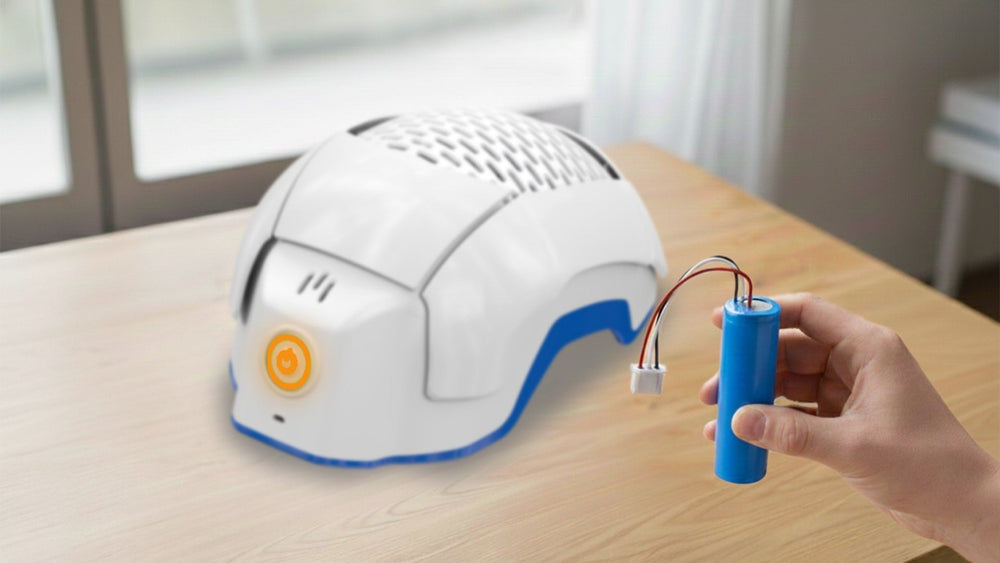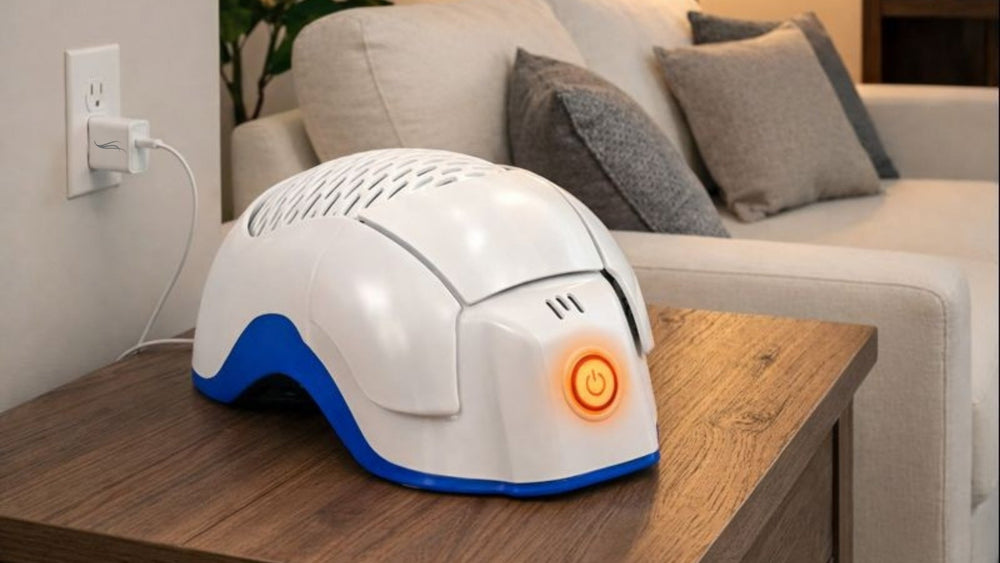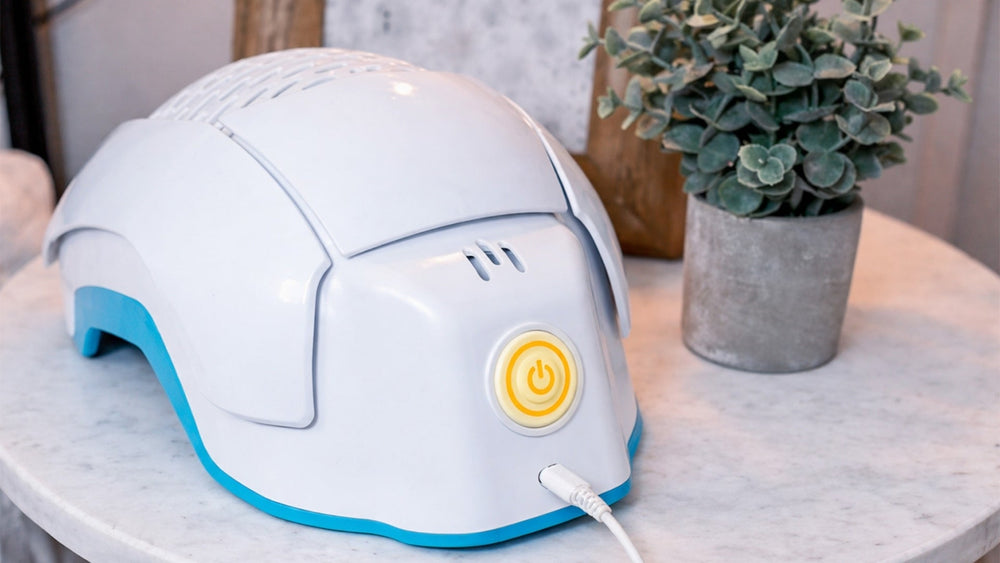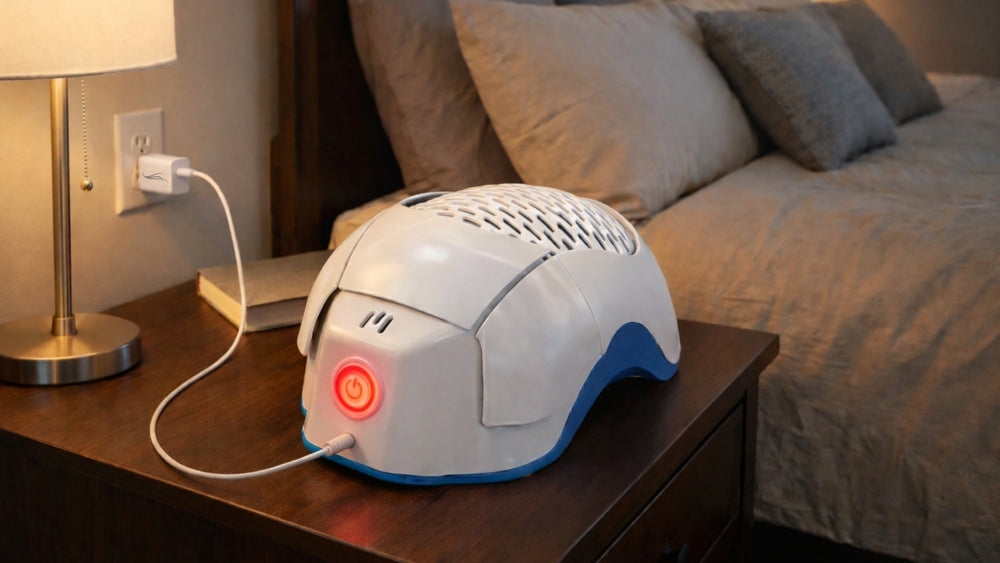

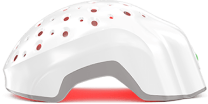





If a hair growth helmet or cap uses true lasers, it will say so in the technical specs, list a laser class (often Class 3R), give a wavelength in nanometers, and usually show a 510(k) clearance number if it is FDA-cleared. LED caps often mention only “LEDs” or “red light” and skip laser class language. In simple terms, lasers create tight, focused points of light, while LEDs give off a softer, more diffused glow, and that difference shows up in both the label and how the light behaves on a surface.
If you are staring at a red-glowing hair device and wondering “Is this actually a laser or just LEDs?”, you are not alone. The difference is not just marketing. It changes how light is delivered to the follicle, which devices have solid clinical trials, and which ones regulators have cleared as medical devices.
The red light therapy for hair loss treatment also has various types like LPT, LED, and LLLT.
This guide walks you through:
- The real difference between lasers and LEDs
- What clinical research says about light-based devices for androgenetic alopecia
- Simple, at-home ways to tell whether your cap uses lasers, LEDs, or both
- How to judge safety and spot red flags in product claims
- When it makes sense to bring a trichologist or dermatologist into the decision
You will finish with a calmer head, a clearer checklist, and a much better sense of which devices deserve your scalp.

What’s the Real Difference Between a Laser and an LED?
Let’s get the slightly nerdy bit out of the way, then talk about what it means for your scalp.
A laser produces light that is:
-
Monochromatic – tightly grouped around one wavelength
-
Coherent – the light waves are in step with each other
-
Collimated – the beam spreads slowly, so it stays fairly narrow as it travels
That is what LASER stands for: Light Amplification by Stimulated Emission of Radiation. It sounds intense, but in hair devices we are talking about low-power “cold” lasers, not surgical beams.
An LED (light-emitting diode) is different. LEDs:
- Emit wider bands of wavelengths
- Are non-coherent
- Spread out more quickly, bathing a larger area with gentler intensity
Inside tissue, something interesting happens. As soon as light enters the skin, it starts scattering. That means the neat coherence of a laser beam does not stay neat for long. Several reviews of photobiomodulation note that once light has passed a few millimeters into tissue, cells mainly “care” about the wavelength and dose they receive, not whether those photons started life as a laser or an LED.
There is one everyday effect that really shows the difference in how lasers behave, even before the light enters tissue. It is called speckling. Speckling is the grainy, shimmering pattern you see when coherent laser light hits a rough surface and the reflected light waves interfere with each other. Because lasers are coherent and tightly aligned, they form this dancing, dotted pattern. LEDs do not. LED light is non-coherent and much smoother, so it illuminates a surface without that fine, grainy texture. In other words, only true laser sources speckle while LEDs stay flatter and more even.
So why do we still talk about lasers at all?
Because before scattering happens, the way that beam leaves the device affects how much energy reaches the skin surface and how deep it can go. A collimated laser can deliver higher power density into a defined zone. An LED spreads the same power over a wider area. For hair devices, that difference in beam profile is one reason many FDA-cleared helmets use laser diodes.
Cold lasers vs surgical lasers
When people hear “laser”, they often think of tattoo removal videos or sci-fi scenes. Those involve higher power classes, engineered to cut, ablate or cauterize tissue.
Hair growth devices use low-power visible lasers, typically in the red range around 650–680 nm, and fall into Class 3R under many safety standards.
Class 3R lasers:
- Have visible continuous power up to 5 mW
- Are considered low risk when handled with care
- Carry a small eye-injury potential if someone stares directly into the beam for a sustained period, especially with magnifying optics
- Are not designed to burn or cut tissue
So the lasers inside a hair helmet are in a different universe from surgical systems. They are meant to stimulate, not destroy. Under normal use, they should not hurt, heat, or mark the scalp. Random curiosity about shining one into your friend’s eyes is still a terrible idea though, and safety guidelines make that very clear.
Which reaches follicles more consistently?
Here is where things get closer to your actual hair.
Because of collimation and higher achievable irradiance, laser diodes can deliver a tighter, more predictable dose of energy to a target area before scattering takes over. Several technical reviews point out that this allows deeper penetration and more concentrated power compared with many LED configurations, at least in the first layers of tissue.
LEDs shine in other ways. They:
- Cover large areas
- Are inexpensive
- Do not trigger laser safety classifications
- Can be built into light panels and masks rather easily
For hair, both approaches can work if the wavelength, dose and treatment schedule are right. However, when you look at which home-use devices have gone through full FDA 510(k) clearance for pattern hair loss, you see more laser-based caps and helmets than LED-only systems. That is not by accident.
Why Do Hair Growth Devices Use Lasers, LEDs, or Both?
The three device types you meet in the wild
Most consumer hair devices fall into one of three buckets:
1. Laser-only devices
- Use arrays of low-level diode lasers
- Often shaped as helmets, caps or combs
- Marketed as “laser phototherapy” or “laser hair growth”
2. LED-only devices
- Use red or near-infrared LEDs
- Common in general “red light therapy” panels
- Sometimes repurposed for scalp use, even when not designed specifically for androgenetic alopecia
3. Hybrid devices
- Combine lasers and LEDs in the same cap
- Aim to mix higher intensity focal zones with broad LED coverage
A 2018 review of lasers and LEDs in photobiomodulation notes that both light sources can support tissue repair under the right conditions, which explains why hybrids exist at all.
FDA-cleared vs “we swear it works”
For hair loss devices, wording matters.
- FDA-cleared means the device has gone through the 510(k) process and been judged substantially equivalent in safety and effectiveness to a legally marketed predicate device for a specific indication.
- This is different from a device that simply says “LED therapy” or “red light cap” with no clearance number and no reference to pattern hair loss.
For example, the Theradome LH80 PRO Laser Helmet is described in its 510(k) summaries as a low-level laser therapy device intended to promote hair growth in people with androgenetic alopecia, using 80 visible red diode lasers at 680 nm.
When a device is FDA-cleared for androgenetic alopecia, you are not just relying on marketing. You are looking at a category that has required safety testing, performance data and regulatory review.
How Can You Tell If Your Device Uses a Laser or an LED?
Step 1: Read the label and the technical specs
This is the least glamorous step, but it is the most reliable.
Look for:
- The words “laser” or “diode laser” in the technical description
- A laser class, often Class 3R for home-use red lasers
- A wavelength, written as something like “650 nm” or “680 nm”
- Power per emitter, expressed in milliwatts (mW)
- An FDA 510(k) number or a statement that the device is “FDA-cleared for treatment of androgenetic alopecia”
Laser safety and regulatory documents consistently describe Class 3R visible lasers as having continuous power up to 5 mW, with low but non-zero eye risk if directly viewed for long periods.
If your device never mentions lasers, never lists a laser class, and talks only about “LEDs” or “red light panels”, you are almost certainly dealing with an LED-based system.
You can also search the FDA 510(k) database directly and plug in a brand name to see whether there is a clearance on record.
Step 2: Watch the light pattern on a surface
This one feels strangely satisfying.
In a dim room, switch the device on and point it gently at a matte surface, like a wall or a piece of white card, at a short distance.
- Laser diodes typically show as small, sharp points of light. When you move the device further away, those points stay relatively tight, just a bit larger.
- LEDs create a softer, more diffused glow. The light spills out and the edges are less defined as you change the distance.
You are not performing a laboratory-grade test here. You are simply using the physics of beam divergence as a visual clue.
Step 3: Check how the light behaves with distance
Take it a little further.
If you slowly move the device away from the surface:
- Laser light will keep a relatively tight spot, enlarging gradually
- LED light will bloom and spread quickly, with brightness fading more evenly
Again, this is observational. It should be combined with label information, not used alone to overrule what the device officially claims.
Step 4: The safe “reflection” check
Another small test is to look at how the light appears when it reflects off a surface, without staring anywhere near the emitters themselves.
- Laser points tend to form cleaner, sharper reflections
- LED clusters create larger, gentler pools of reflected light
If your eyes start to feel strained, stop. Laser safety bodies consistently advise against deliberate staring at beams or reflections, even from lower classes.
Step 5: Let the manual speak
Legitimate medical-grade devices tend to over-explain rather than under-explain. In the user manual or technical sheet, you should find:
- Number of lasers
- Wavelength
- Recommended treatment schedule based on clinical trials
- Clear indications, such as “androgenetic alopecia in men with Norwood–Hamilton IIa–V”
If you only see vague language, no specifications, and phrases like “laser-like energy” or “quantum light” without any actual numbers, that deserves a pause.
The Speckling Test: A Simple At-Home Way To Catch Real Lasers
Speckling sounds fancy, but it is just a very specific kind of “graininess” that only true laser light produces. Because laser waves are aligned and in step with each other, they interfere when they hit a rough surface. That interference shows up as a fine, dancing pattern of bright and dark dots. LEDs do not do this. Their light is non-coherent and spreads more softly, so the surface looks smoother and more even.
You are not building a lab here. You are just using that speckle pattern as one more practical clue.
Step 1: Set up the scene
- Choose a matte, slightly textured surface. A painted wall with a bit of texture, a cardboard box, or a sheet of plain paper taped to a wall works well. Avoid glossy tiles or glass, because reflections can muddy what you see.
- Dim the room lights so the device light is obvious but you can still move around safely.
- Place the device so that the emitters face the surface from a short distance. You do not need to be very far away.
Keep your eyes away from the direct beams. You are looking at the lit patch on the surface, not into the device itself.
Step 2: What to look for in laser light
Switch the device on and watch the bright patch on the wall or card. Then:
- Move your head a little from side to side.
- If needed, move the device a few centimetres closer or further.
With true lasers, you should see:
- A fine, grainy pattern inside the bright patch.
- Tiny dots that seem to shimmer or crawl when you move your head or when the device shifts.
- Areas that look slightly mottled rather than perfectly smooth.
That dancing grain is the speckle pattern. It is a direct consequence of coherent laser waves interfering with each other after bouncing off the uneven surface. If you see clear speckling, you are almost certainly dealing with a real laser source.
Step 3: What to expect from LEDs
Repeat the same setup and movement if you are testing an LED device.
With LED light, you should see:
- A patch that looks smooth and soft, almost like a gentle spotlight.
- Brightness that may be stronger in the centre and weaker at the edges, but without that gritty, moving grain.
- No shimmering pattern when you move your head.
If the surface looks evenly lit and a bit fuzzy around the edges, with no speckle at all, that is typical LED behaviour.
Step 4: Special cases and limitations
A few things can blur the test, so it helps to know where speckling might be harder to see.
- Hybrid devices. If a cap combines lasers and LEDs, you might see speckle in some zones and smooth light in others. That does not mean it is fake. It just means lasers and LEDs are mixed.
- Diffusers and covers. Some medical devices deliberately soften the light with diffusers or internal optics. Speckling can still appear, but it may be less dramatic.
- Very bright or very dark rooms. If the room is too bright, the pattern gets washed out. If it is completely dark, your eyes may strain. A gently dim room is usually the sweet spot.
That is why the speckling test should sit alongside the label check, the laser class listing, and the FDA 510(k) search. It is a supporting clue, not a stand-alone verdict.
Step 5: When the speckle test and the label do not match
If a device loudly advertises “laser technology” yet:
- Shows no speckling at all on a textured surface
- Lists no laser class or wavelengths
- Has no trace in the FDA 510(k) database
…it is worth slowing down and asking more questions. At that point, checking the technical sheet, user manual and regulatory status is basic self-protection for your scalp and your wallet.
Also Read: How to Spot Fake LPT Devices Available in the Market?
How Does Light Actually Interact With Your Scalp And Follicles?
Light-based hair devices sit in a field called photobiomodulation (PBM). PBM refers to the use of non-ionizing red or near-infrared light to modulate cell activity in a beneficial way.
One leading model centers on cytochrome c oxidase (CCO), an enzyme in the mitochondrial respiratory chain. Red and near-infrared light in certain ranges appears to:
- Interact with CCO
- Change how mitochondrial respiration behaves
- Alter cellular signaling, including reactive oxygen species and nitric oxide dynamics
The outcome is increased cellular energy production and a shift in signaling that can nudge certain cells, including those in hair follicles, towards more active, repair-oriented behavior.
In hair research, PBM has been associated with:
- Increased proportion of follicles in anagen (growth phase)
- Reduced miniaturization in androgenetic alopecia
- Improved hair shaft thickness and density in controlled trials
You will notice we are talking about cellular bioenergetics and signalling, not “boosting circulation”. There is ongoing research into microvascular effects, but the most consistent focus in the literature is on mitochondrial and follicular biology rather than blood flow alone.
Why energy dose matters more than marketing adjectives
PBM is very dose-sensitive. Too little energy and not much happens. Too much and the effect can plateau or even reverse. Many in vitro and animal studies show a bell-shaped response curve.
For devices, the key elements are:
- Wavelength – commonly 630–680 nm for visible red, occasionally near-infrared
- Irradiance – power per unit area at the scalp
- Total energy – irradiance multiplied by time
- Treatment frequency – how many sessions per week, over how many months
Clinical trials that reported meaningful gains in hair density generally used protocols with treatments several times per week, for at least 16 weeks, with defined energy doses.
Hair structures that seem to benefit
PBM is not waking up every follicle type under every condition. It appears to be most helpful when:
-
Follicles are miniaturizing in androgenetic alopecia, but still alive
- There is an opportunity to extend anagen or encourage anagen re-entry
- The scalp environment is otherwise reasonably healthy
That is why many guidance papers now list low-level light or laser therapy as a supportive option in androgenetic alopecia, particularly alongside pharmacologic treatments when appropriate.
Common Consumer Myths About Lasers, LEDs, And Hair
Myth 1: “If it glows red, it must be a laser”
A lot of devices glow red. Not all of them are lasers.
LED strip caps can look visually similar at a glance, especially in marketing images. Without specs, it is impossible to judge the underlying light source by colour alone.
Physics and regulatory documents both push back on colour-only thinking. What matters is the combination of wavelength, power and delivery pattern.
Myth 2: “More diodes automatically means better results”
It is tempting to assume that if 40 lasers are good, 200 lasers must be amazing. Reality is more boring.
Beyond a certain point, simply adding emitters can:
Raise cost
Create overlapping beams that do not meaningfully increase dose
Make the device heavier without improving clinical outcomes
Meta-analyses focus on dose and protocol, not diode counts. Devices with different numbers of lasers can still deliver similar total energy if treatment time and spacing are adjusted.
Myth 3: “LED caps and laser caps are identical in effect”
Mechanistically, both lasers and LEDs can support PBM when wavelength and dose are right. Heiskanen and Hamblin put it simply in their review: coherence differences have not clearly translated into consistent treatment superiority for lasers across all tissues.
In hair, however, most of the controlled trials and FDA-cleared home-use devices have used lasers, not LEDs alone. That does not mean LEDs cannot work. It means you want to see strong, device-specific data rather than assuming that any glowing cap is equivalent to devices that have gone through trials and regulatory review.
Also Read: 15 Common Myths About Laser Phototherapy
Safety: What Is Actually Safe, And What Should Raise An Eyebrow?
Class 3R hair devices operate at low powers that are considered safe for skin and hair with proper use. Laser safety bodies describe Class 3R as low-risk, with potential eye hazard mainly during deliberate direct viewing or when optical instruments are involved.
Clinical trials of low-level laser devices for pattern hair loss report:
- No serious adverse events
- Occasional mild events like transient scalp itching or brief shedding phases that settled during continued use
So if a reputable, FDA-cleared device is used as instructed, it is not expected to burn, scar, or “cook” follicles.
LED safety
Consumer-grade LEDs in the red and near-infrared range are generally considered safe at typical outputs. Because they are not collimated lasers, they usually avoid laser classification entirely.
The challenge with unregulated LED caps is less about acute injury, and more about inconsistent dosing and exaggerated claims. If a device has no clinical data, no listed energy parameters and no oversight, you cannot assume it will behave like a regulated medical device.
Red flags when you are shopping
A few warning signs to watch:
- No wavelengths listed anywhere
- No mention of device type (laser vs LED)
- Bold promises with phrases like “works for every cause of hair loss”
- No indication that the device was designed specifically for androgenetic alopecia
- Lack of any dermatologist or trichologist involvement at the level of trials or guidance
If a product claims to be “as strong as a clinic laser” yet cannot show you any registration, trial or technical sheet, that should slow you down.
How to Choose A Hair Growth Device Without Regretting It Later
Questions to ask before buying
A small list you can keep in the notes app on your phone:
- Is this device laser, LED, or hybrid?
- What is the wavelength range?
- Is there a laser class and power per diode listed?
- Is it FDA-cleared for androgenetic alopecia with a 510(k) number?
- Are there published trials on this specific device or a direct predecessor?
- What treatment schedule was used in those trials, and does the manual match it?
What actually matters for results
If we strip away the branding, three elements rise to the top:
- Wavelength in a biologically active range
- Adequate dose over time
- Consistent usage for enough months
Reviews of androgenetic alopecia management repeatedly stress that light-based devices are not instant-change tools. They sit alongside topical and oral options as long-term interventions that can help maintain or improve density when adhered to carefully.
Life sometimes gets in the way. That is normal. The key is to pick a device whose protocol realistically fits your routine, instead of one that demands a schedule you already know you cannot keep.
Go through the 10 guidelines to choose the right LPT device for maximum hair growth results.
When to talk to a trichologist or dermatologist first
Light-based devices are designed primarily for androgenetic alopecia. They are not one-size-fits-all for every shedding complaint.
You should seek professional assessment before relying on a device alone if:
- Your hair loss started suddenly or progressed very rapidly
- There is visible scarring, scaling, pustules or burning on the scalp
- You have patchy loss that might suggest alopecia areata
- You have significant medical conditions or medications that affect hair growth
A trichologist or dermatologist can confirm the diagnosis and build a treatment plan where any light-based device is one carefully chosen component, not a guess.
How Long Until You See Results With Light-Based Devices?
Most controlled trials of home-use low-level laser devices for androgenetic alopecia ran for at least 16–24 weeks, with treatments usually two to three times per week. Improvement in terminal hair density and hair shaft thickness tended to appear toward the later weeks of these trials.
So if you start a laser-based protocol on a Monday and expect to see a cosmetic change by Friday, the device is not the problem. Biology is. Follicles move through growth cycles measured in months, not days.
What improvement usually looks like
In studies that showed benefit, typical outcomes included:
- Increased hair counts in defined target areas
- Improved mean hair thickness
- Better investigator and patient global assessments compared with sham devices
On a day-to-day level, people sometimes notice a reduction in shower shedding first, then gradual thickening at the part or frontal scalp. It is subtle and cumulative, not dramatic.
Why people quit too early
A small twist of irony here. Many users stop around the eight to twelve week mark, right before the meaningful changes tend to show up. In other treatment fields, this is sometimes called the “lag period”, where cellular changes are underway but cosmetic improvement lags behind.
If you start an evidence-based light device with realistic expectations and a clear time frame in mind, you are less likely to abandon it just as it begins to help.
Conclusion
Choosing between a laser cap, an LED cap, or a hybrid device does not need to feel like decoding a physics exam. If you know what to look for on the label, how the light behaves, and whether the device has real clinical and regulatory backing for androgenetic alopecia, the decision becomes calmer and more rational.
Laser phototherapy devices with proper wavelength, dose and FDA clearance have a growing body of evidence for improving hair density in pattern hair loss. LED-based solutions show promise in some studies, but they vary widely, so you want solid data rather than just a glowing shell.
In the end, your scalp is not a gadget testing ground. Treat it with the same seriousness you bring to any other long-term health choice, and let trichology-level information guide you, not just the brightest marketing photo.