





Fluence is the total amount of light energy your scalp receives during a laser session, measured in joules per square centimeter (J/cm²). It is the closest thing to a “dose” your follicles actually feel. In laser phototherapy for recovering from androgenetic alopecia, fluence matters far more than how many lights a helmet has or how bright it looks, because hair follicles respond to sustained, adequate energy at depth, not to marketing numbers.
What Is Fluence In Laser Hair Therapy?
If you strip away all the jargon, fluence is just the total light energy that reaches a given patch of scalp over a treatment.
Instead of asking, “How bright is this device?” fluence asks, “How much energy did each square centimeter of my scalp actually receive by the time the session ended?”
In technical terms, engineers describe fluence in joules per square centimeter (J/cm²). A joule is a unit of energy; the “per square centimeter” part simply says, “This is the dose delivered to a small area of skin.”
So when you see fluence numbers, you are looking at the dose, not just the light show. That distinction quietly decides whether your follicles get a meaningful nudge, or a polite tap they barely notice.
Fluence vs Power vs Irradiance vs Diode Count
This is where spec sheets tend to blur everything together.
- Power describes how strong the light output is at any instant, often in milliwatts (mW).
- Irradiance is power spread over an area, expressed in milliwatts per square centimeter.
- Fluence is irradiance multiplied by time, which tells you the total energy dose per square centimeter by the end of the session.
And diode count is simply the number of light sources.
You can have hundreds of weak LEDs that barely deliver 1 J/cm² to the scalp, or a smaller number of focused medical-grade lasers that deliver tens or hundreds of joules per square centimeter. Your follicles do not care about diode bragging rights. They care about delivered dose.
Why Hair Follicles Care About Dose, Not Brightness
Where The Target Actually Lives (3–5 mm Below The Scalp)
When you look in the mirror, you see hair strands on the surface. The real work, though, happens deeper.
Morphometric studies show that scalp hair follicles extend to an average depth of a little over 4 mm, with key stem cell zones lying roughly between 1 and 2 mm beneath the surface.
On the way down to those cells, light has to pass through:
- The stratum corneum and epidermis
- The superficial dermis
- Hair shafts and sebum, which scatter and absorb light
By the time photons reach the follicle stem cell zone, a large proportion has been lost. That means devices that start with very low fluence at the surface often deliver negligible energy at depth, even if they look bright to the eye.
Photobiostimulation
Laser phototherapy (LPT) for androgenetic alopecia sits under the broader umbrella of photobiomodulation. In this context, red or near-infrared light is used at low, non-thermal levels to nudge cellular pathways, not to heat or burn tissue.
At adequate fluence, several things are thought to happen in hair structures:
- Mitochondrial enzymes absorb photons and increase energy production.
- Signaling pathways that favor the anagen (growth) phase are supported.
- Pro-inflammatory signals may be modulated downward in miniaturizing follicles.
Crucially, photobiomodulation tends to follow a dose window. Too little energy, and you see no meaningful effect. A suitable dose over repeated sessions, and you may see improvements in density and hair diameter in androgenetic alopecia. Very high doses do not necessarily add benefit and can even be counterproductive in some experimental models.
So fluence is tied directly to whether an at-home device delivers enough energy at depth to behave like the devices tested in clinical research.
Not All Light Is the Same: LEDs, Lasers, And True LPT
LED Hair Helmets: Plenty of Glow, Not Much Dose
LED-based helmets are everywhere. They cover large areas, glow convincingly, and often advertise wide wavelength ranges.
The catch is that LEDs emit non-coherent light that scatters broadly. Many consumer LED devices deliver total fluence values in the range of tenths to a few joules per square centimeter at the scalp, even when they use many emitters.
For skin-surface cosmetic targets, that may be acceptable. For follicles several millimeters deep, that kind of dose is often below the activation window suggested by experimental and clinical data.
In plain terms: a helmet can look very active on the outside while barely nudging the structures that drive pattern hair loss.
Laser Caps: Good Intentions, Heat Problems
Laser-only caps under a baseball hat sound attractive on paper. They use real lasers, not just LEDs, and they tuck neatly under headwear.
However, they share a repeated structural weakness: poor ventilation.
- Lasers generate heat during operation.
- Hair and scalp trap that heat in a sealed cap.
- As temperature rises, many systems respond by pulsing or throttling power to avoid discomfort.
That means the actual fluence delivered over a 20- to 30-minute session can end up much lower than the theoretical numbers on marketing material suggest.
On top of that, excess heat on the scalp is not automatically beneficial. In susceptible users, thermal stress has been linked to telogen effluvium, a condition where hairs prematurely enter the resting and shedding phase.
So when you see a product that leans heavily on diode count and also warns that “early shedding is normal,” it is reasonable to ask whether heat and pulsing are driving that pattern rather than a carefully controlled dose.
Medical-Grade Laser Systems: Why Engineering Matters
A true medical-grade LPT system for hair loss is built around dose stability, not just aesthetics.
That kind of device:
- Uses medical-grade lasers with known output characteristics.
- Maintains a consistent distance from scalp to diodes.
- Controls spacing between beams to cover the scalp evenly.
- Integrates ventilation and helmet design to manage heat so that power does not have to be throttled mid-session.
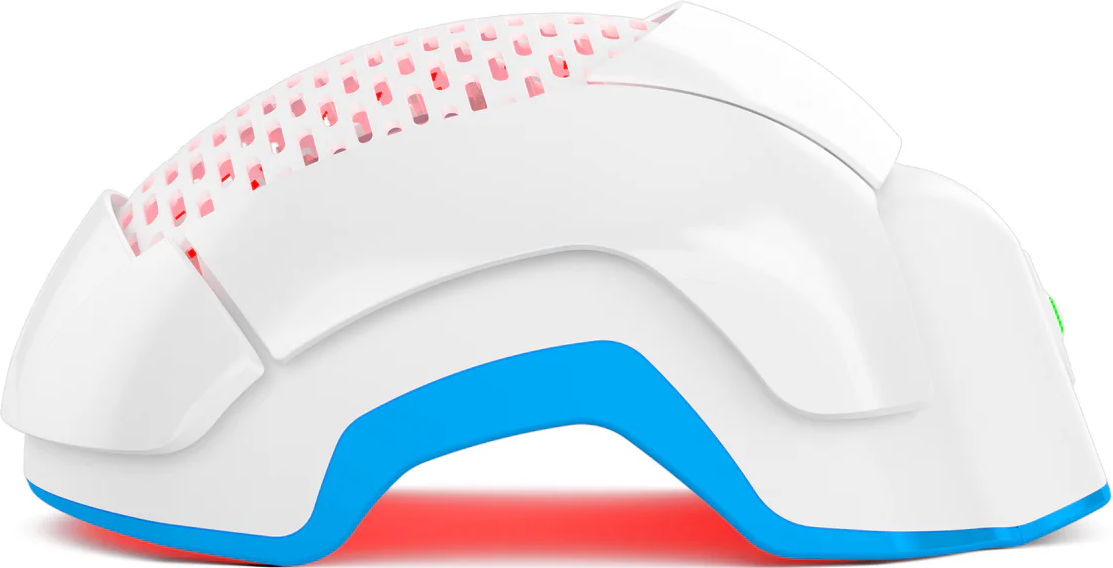
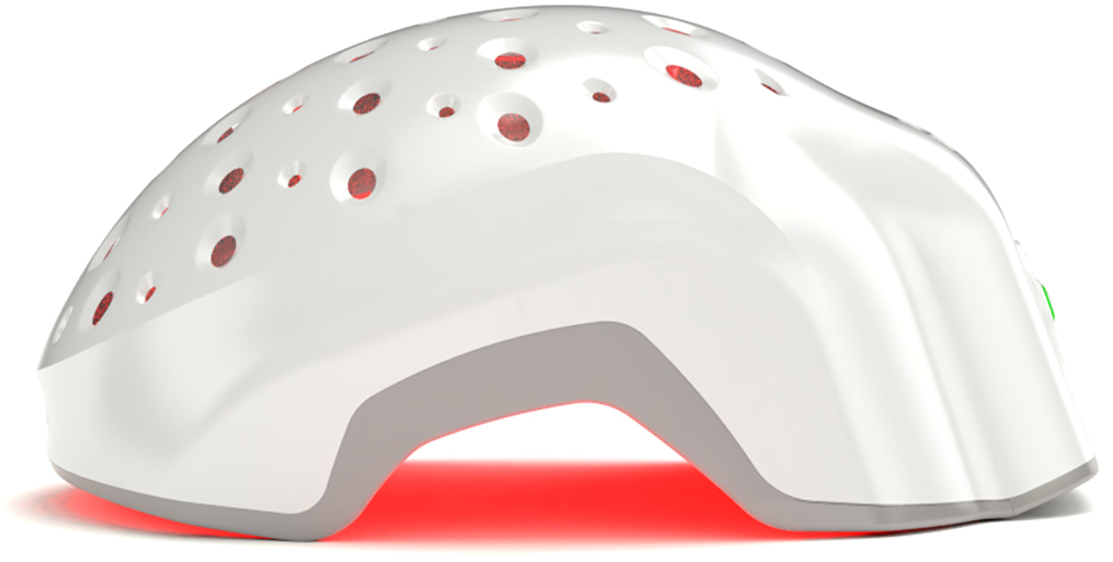
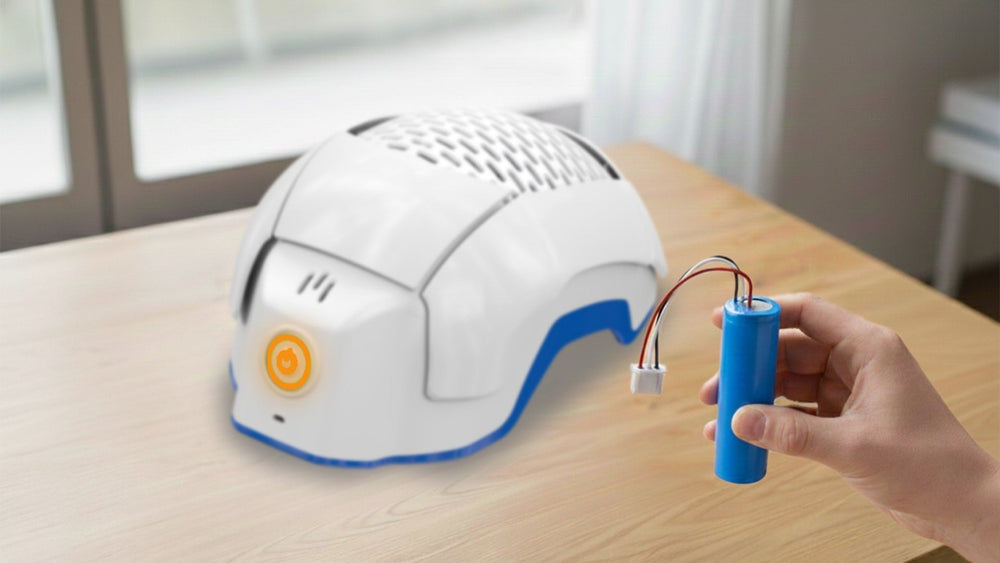
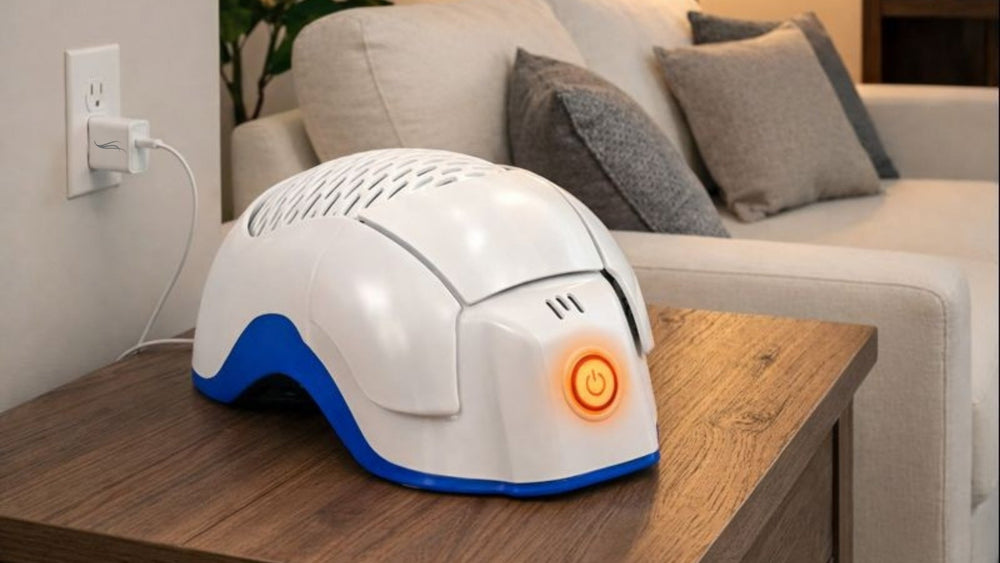
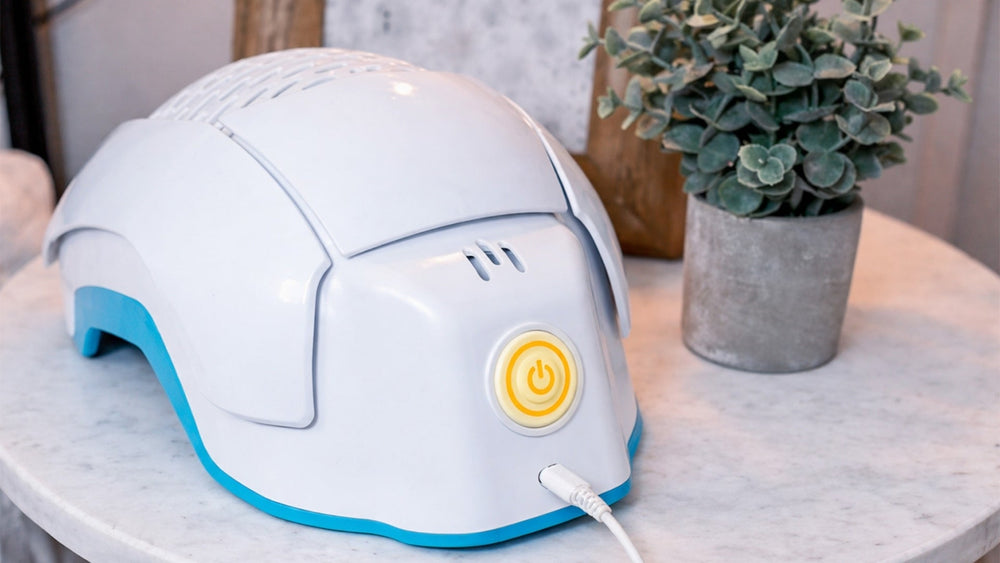
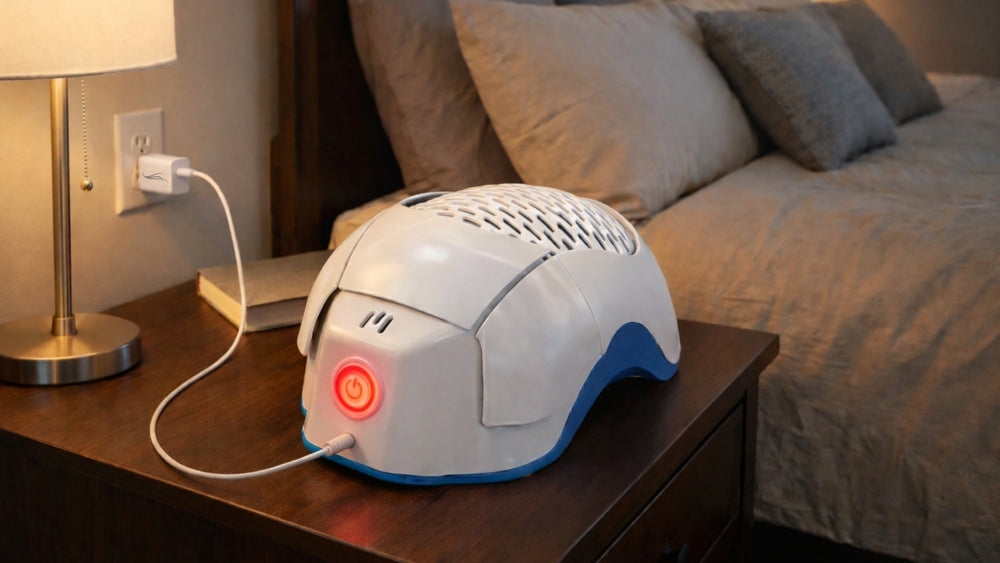
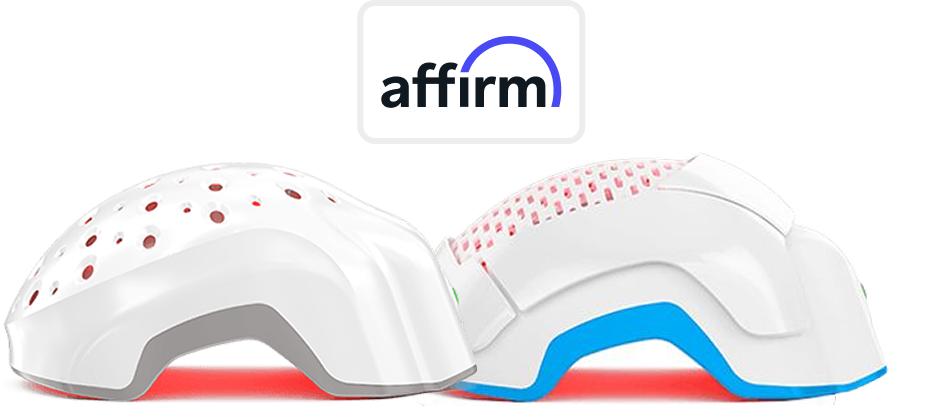
Theradome sits in this category: a wearable LPT helmet using cold lasers, designed to deliver consistent, non-thermal fluence to the scalp for androgenetic alopecia in men and women.

What Do “Fluence” And “Joules Per Square Centimeter” Actually Mean For You?
Engineers calculate fluence by combining three ingredients:
- How strong the light is at the scalp (power).
- How long it stays on (treatment time).
- How large an area each beam covers (beam area).
If you take power at the scalp for a single beam, divide it by the beam area to get irradiance, then multiply by the number of seconds in a session, you end up with a fluence value in J/cm².
That number tells you, in a single metric, how much energy a small patch of scalp actually received during one treatment.
It is the closest thing you will find to a “dose per area” for light-based hair therapy.
From One Diode to A Whole Helmet
In Theradome’s internal testing, a single VL680 laser measured at the scalp delivered:
- Optical power around 4.85 milliwatts
- Beam area around 0.64 square centimeters
- Treatment duration of 1,200 seconds (20 minutes)
From those numbers, you get an irradiance a little under 8 milliwatts per square centimeter and a fluence of roughly 9.1 J/cm² at that beam during a standard session.
When you scale that to the full array:
- The EVO configuration, with 40 lasers, yields a cumulative delivered fluence around 364 J/cm².
- The PRO configuration, with 80 lasers, yields around 727 J/cm².
These values are time-integrated, based on measured power at the scalp, and describe energy truly delivered over the full session, not a brief peak reading at the diode chip.
That is a very different way of talking about dose than simply listing diode count or nominal power per laser.
Fluence Deception: How Device Specs Get Inflated
Once you start reading spec sheets through a fluence lens, some patterns jump out.
Common shortcuts include:
- Quoting peak diode output, measured directly at the chip, rather than power at the scalp after housing and distance losses.
- Listing LED radiant intensity without translating it into J/cm² on skin.
- Ignoring beam area, so power looks high but is spread thinly.
- Ignoring treatment duration, which means you hear about watts or milliwatts without knowing how long they are applied.
- Skipping optical losses from hair, sebum, and skin, which can be substantial.
None of those by themselves tell you what dose your follicles receive.
They tell you the device can light up a room. They do not tell you whether it delivers a clinically relevant fluence to scalp structures.
Why Diode Count and “Multiple Wavelengths” Don’t Tell You Dose
Diode count has become a popular shorthand in marketing. “Hundreds of diodes” sounds impressive, and adding several wavelengths is often presented as a major advance.
The research, however, leans toward a quieter message: energy fluence, session duration, and pulsing characteristics have more influence on outcomes than diode count alone.
You can distribute very low power across many diodes and still deliver a minimal dose. You can also use a sensible number of well-spaced lasers, with carefully controlled power and time, and deliver a much higher, more consistent fluence.
What Real Fluence Reporting Looks Like
Authentic fluence reporting includes all four pillars:
- Power at the scalp, not just at the diode.
- Beam area at the treatment distance.
- Continuous or well-defined output over time.
- Full treatment duration.
Theradome reports these parameters and calculates session fluence from measured values. Most consumer devices publish one or two of them, and leave the rest to assumption.
That gap matters. It is where marketing and meaningful dose tend to part ways.
Fluence And Heat: Why Some Devices Shed While Others Don’t
When A Device Overheats, Your Follicles Feel It
Thermal comfort is not just a user-experience detail. It can change dose.
As sealed caps warm up, several things can happen at once:
- Protective circuitry may reduce laser power.
- Pulsing patterns may become more aggressive.
- The wearer may cut sessions short because the device feels too hot.
All of those lower cumulative fluence over time, even if the spec sheet never changes.
On the biological side, significant heat at the scalp can act as a stressor. Telogen effluvium, a shedding pattern triggered by stressors such as illness, surgery, or severe irritation, is a known phenomenon in trichology. Adding thermal stress under an unventilated cap in someone already dealing with miniaturized follicles is not ideal.
So a system that overheats, pulses heavily, and still claims high fluence deserves extra scrutiny.
Why Cooling And Ventilation Are Part of Dose Control
The most effective LPT systems are engineered not only around power and wavelength, but also around heat management.
That means designing:
- Helmets that allow air movement around the scalp.
- Laser spacing that avoids intense hot spots.
- Continuous output within non-thermal safety margins, so the device does not need to throttle itself mid-treatment.
Or, to put it more bluntly:
A device that keeps a cool head can keep a steady dose.
Theradome’s design goal is to deliver substantial cumulative fluence while controlling heat.
Theradome delivers substantially higher cumulative laser fluence per session compared to LED-based and mixed-light devices, due to continuous medical-grade laser output, optimized beam spacing, and controlled heat management.
This reflects how engineering choices translate into dose stability and user comfort, not just cosmetic design.
Where Theradome Sits on the Fluence Map
Based on internal analysis of different device categories, a simplified comparison looks like this:
- LED helmets: roughly 0.1 to 1 J/cm² per session
- LED plus weak laser mixes: roughly 1 to 5 J/cm²
- Pulsed clinic caps: around 10 to 30 J/cm²
-
Theradome EVO (40 lasers): about 364 J/cm² cumulative
-
Theradome PRO (80 lasers): about 727 J/cm² cumulative
Even allowing for scalp and hair losses, those cumulative values remain well above the ranges typically associated with LED-dominant devices and mixed systems.
The point is not that small differences in J/cm² decide everything. The point is that being one or two orders of magnitude higher in dose, while still non-thermal and comfortable, places Theradome in a different category of energy delivery.
Why This Is Hard For Competitors to Argue With
To genuinely dispute those fluence numbers, a competitor would need to provide:
- Per-beam power measured at the scalp.
- Beam area at the treatment distance.
- Duty cycle or pulsing characteristics.
- Full treatment duration for each mode.
Once those are on the table, any brand can calculate and compare delivered fluence transparently.
Most, however, do not publish that full set of parameters. Doing so often reveals that their true dose is far below their marketing emphasis.
Theradome does not win by using more lights. It wins by delivering measured fluence at levels LED systems physically struggle to reach while staying non-thermal.
What Fluence Means For Your Timeline And Expectations
Laser phototherapy is not a short-term stunt. Even at appropriate fluence, clinical trials typically report results over 16 to 26 weeks or longer, often with continued gains over subsequent months.
In androgenetic alopecia, a realistic progression with adequate fluence and consistent use looks something like this for many users:
- Early phase: stabilization or slowing of excessive shedding.
- Intermediate phase: gradual changes in hair caliber and density in affected zones.
- Later phase: consolidation of gains, with ongoing use acting as maintenance.
Not everyone responds to the same degree, and no device can guarantee regrowth in long-standing, advanced loss. But if fluence is too low, the odds of any visible improvement drop sharply, even with perfect adherence.
Why “Early Shedding Is Normal” Is Worth a Second Look
You may have seen device marketing that leans heavily on the idea that increased shedding early on is a reassuring sign.
While transitions in hair cycling can involve some temporary shedding for certain interventions, consistently pairing aggressive early shedding with devices that:
- run hot
- sit directly against the scalp with minimal airflow
- rely on pulsed or throttled output
…raises a reasonable question: are follicles being supported, or stressed?
A system that delivers high yet non-thermal fluence without over-heating does not need to rely on heavy shedding as a selling point.
How to Judge Fluence When Comparing Devices
When you are evaluating a laser hair device, you can move past the brochure by asking very concrete questions:
- What is the power per laser measured at the scalp, in milliwatts?
- What is the beam area at that distance, in square centimeters?
- Is the output continuous, or pulsed? If pulsed, what is the duty cycle?
- How long is each recommended treatment session, in minutes?
- Do you publish calculated J/cm² per session at the scalp, not just at the diode?
If those questions cannot be answered clearly, it becomes difficult to know whether the device is delivering a dose similar to what has been studied in clinical trials for androgenetic alopecia.
Red Flags to be Careful About
Some warning signs that should prompt caution:
- Marketing focuses almost entirely on diode count and glowing photos.
- Technical information lists wattage without area or time.
- The device is a sealed cap that sits under a hat, with little or no mention of ventilation.
- The brand leans heavily on messages that “early shedding is normal,” without explaining heat, dose, or design choices.
On the other hand, a manufacturer that can speak openly about fluence, beam geometry, and heat control is usually signaling a more engineering-driven approach.
Fluence, In Plain Language
Fluence is the total light energy each small patch of your scalp receives during a laser session.
Your follicles live deep enough that very low doses from weak or heavily scattered light often never reach the threshold that research has associated with photobiomodulation.
Devices that are designed around measured fluence, continuous non-thermal output, and heat management can deliver a stable, higher dose at depth. Devices that rely on diode count, cosmetic glow, or pulsed output under a hot cap often cannot.
When you understand fluence, you can read past marketing language and focus on the single question that matters most:
“How much real energy are my follicles receiving, per square centimeter, each time I treat?”
Conclusion
In laser hair therapy, fluence is the quiet metric that actually connects a device to follicle biology. It blends power, time, and coverage into one value that says, “This is the dose your scalp received.”
LED-heavy helmets and hot, pulsed caps can look impressive while delivering a very small dose at depth or throttling output as heat rises. Systems built around measured, continuous, non-thermal fluence and ventilation sit much closer to the conditions tested in clinical research.
When you read past diode counts and ask direct questions about J/cm², you move from shopping for bright helmets to choosing genuine phototherapy. That shift is where engineering and trichology finally meet your real goal: supporting vulnerable hair in a steady, rational way over months, not days.