







Not in the clean, official, package-insert sense most people mean. “Dark circles” are not a standard listed side effect of topical minoxidil, but some people can notice a darker or more tired-looking under-eye area because of things minoxidil can cause or worsen, such as puffiness, irritation, accidental facial exposure, or unwanted facial hair.
What People Mean When They Say “Minoxidil Dark Circles”
A lot of people are not using a medical term when they type does minoxidil cause dark circles. They are describing a face that suddenly looks more tired... a little puffy, maybe duller, maybe just “off.” And under-eye changes are weirdly good at causing panic because the eye area is thin, delicate, and brutally honest under bathroom lighting.

The difference between true pigmentation and under-eye shadowing
This matters. Real under-eye darkness can come from pigment, yes, but it can also come from visible vessels through thin skin, fluid-related swelling, and shadowing from anatomy or puffiness. So when someone says minoxidil gave them dark circles, the first question is not “Did the drug dye the skin darker?” It is more like... what exactly changed?
Why the eye area exaggerates small changes
The lower eyelid does not need much to look different. A bit more edema. A touch of irritation. Slight vascular show-through. Even a small change can create that bruised, hollow, or sleep-deprived look. Dermatology reviews on periorbital hyperpigmentation repeatedly note that under-eye darkness is usually multifactorial, not one tidy single-cause event.
Why many people notice facial changes after starting hair treatment
Because once you start treating hair loss, you stare at yourself more. That sounds flippant. It is not. People on a new hair routine often inspect their scalp, hairline, temples, forehead, cheeks... the whole face, really, much more closely. That does not make the concern fake. It just means timing can be deceptive, and pre-existing under-eye darkness may suddenly get promoted from background noise to front-page crisis.
How Minoxidil Works in the Scalp
Topical minoxidil is one of the best-studied treatments for androgenetic alopecia in men and women. It was originally developed as a vasodilator, and modern reviews describe several mechanisms that may help hair growth, including effects on follicle cycling and signaling pathways. Importantly, the hair benefit is not something we should reduce to a lazy “more circulation” slogan. The biology is more layered than that.
What minoxidil actually does
Minoxidil is a prodrug, which means it has to be converted to minoxidil sulfate to become active. In the scalp, follicular sulfotransferase activity seems to matter for response. That partly explains why some people do well on it and others stare at the bottle after four months like it personally insulted them.
What happens when it touches skin
With ordinary topical scalp use, absorption is generally low. A major review puts average topical absorption at about 1.4% through intact skin. Still, “low” is not the same as “nothing,” and absorption can rise when skin integrity is altered, when more product is used, or when the product gets where it should not.
Known documented side effects
The documented side effects of topical minoxidil are much more ordinary than internet lore makes them sound. Official labeling and reviews focus on itching, irritation, redness, dermatitis, unwanted facial hair, and, more rarely, signs that may suggest broader absorption such as swelling or unexplained weight gain. Notice what is missing there... “dark circles” as an official named adverse effect.
That absence is important. Not because it proves nobody ever notices a darker under-eye area, but because it changes how we should explain it. Carefully. A little less drama, a little more mechanism.
Also Read: Can minoxidil cause hair loss?
Why Some People Notice Dark Circles While Using Minoxidil
Minoxidil probably does not commonly cause classic, standalone under-eye pigmentation as a direct and officially established side effect. But it can set up conditions that make the under-eye area look worse. And those conditions are medically documented.
Under-eye puffiness and fluid retention
Periorbital darkness is often worsened by edema. When tissue under the eyes puffs up, shadows deepen and the area can look darker even if pigment has not increased much at all. Reviews of periorbital hyperpigmentation specifically list periorbital edema as one of the contributors to dark under-eyes.
Topical minoxidil labeling warns users to stop and seek medical advice if they develop swelling of the hands or feet or unexplained weight gain. Drug monographs also note that facial swelling can occur in rare cases. So while this is not a common everyday outcome, it is medically plausible that someone who develops minoxidil-related puffiness may notice darker-looking under-eyes because of shadowing.
And yes... sometimes the face gets involved before people even clock it as “swelling.” They just think they look rough.
Skin irritation or allergic reactions
This is probably the most underappreciated pathway. Topical minoxidil can cause contact dermatitis, and a 2025 systematic review found that typical presentations included erythema, pruritus, and scaling. In some cases, the allergen is minoxidil itself. In others, it is propylene glycol or another vehicle ingredient.
Why does that matter for dark circles? Because dermatology literature on under-eye hyperpigmentation notes that post-inflammatory hyperpigmentation secondary to atopic dermatitis or allergic contact dermatitis can darken the periorbital area. If minoxidil or its vehicle irritates skin near the face, or if residue repeatedly reaches the periocular area, that can plausibly leave the eye area looking darker.
Product transfer to the face
Official minoxidil directions make a point of this, and for good reason. Labels tell users to apply it only to the scalp, wash hands thoroughly after application, and allow the product to dry for 2 to 4 hours before bed. They also warn that wet product can be transferred to other areas through hands, pillows, or linens.
So yes, pillow transfer is plausible. So is touching the scalp and then rubbing the eye area without thinking. And because the skin near the eyes is much more sensitive than the scalp, even a small recurring amount can cause burning, irritation, or localized swelling. The official foam label explicitly warns that alcohol-containing minoxidil can burn or irritate eyes or sensitive skin areas.
Increased facial hair growth
Unwanted facial hair from topical minoxidil is real, especially in women, and it appears to be dose-related. In clinical trial data involving 1,333 females, spontaneous reports of hypertrichosis or facial hair occurred in about 4% of participants, with higher rates at higher concentrations. Official labels also note that facial hair growth is rare and reversible.
Facial hypertrichosis is not the same thing as dark circles. Still, it can subtly change facial contrast and shadow around the temples, cheeks, forehead, and sideburn area, which may make the whole upper face look heavier or darker. Some people interpret that as “minoxidil face.” Not a formal diagnosis, obviously. More a mirror-based complaint with a few possible biological roots.
Are Dark Circles an Official Side Effect of Minoxidil?
No, not in the straightforward label language people usually expect. Major topical minoxidil labels list scalp irritation, unwanted facial hair growth, and warning signs like swelling or dizziness. Broad reviews do the same. They do not generally list “dark circles under the eyes” as a standard adverse effect.
That does not mean everyone reporting darker under-eyes is mistaken. It means the literature supports a more careful interpretation. When doctors and researchers talk about under-eye darkness, they usually break it into categories like pigment, vascular visibility, edema, and shadowing, rather than labeling it one direct drug effect.
So if you were hoping for a clean yes or no... sorry. Medicine can be a bit unromantic like that. The honest answer is closer to this: not officially, not commonly, but sometimes indirectly, and that distinction really matters.
Other Common Causes of Dark Circles (Often Mistaken for Minoxidil)
Genetics and skin structure
Some people are simply more prone to periorbital darkness because of inherited pigmentation patterns, thinner lower-eyelid skin, or facial anatomy that creates deeper tear-trough shadowing. Reviews consistently describe under-eye darkness as highly multifactorial, with heredity playing a major role.
Thin skin and visible blood vessels
The under-eye area is translucent compared with much of the face. When vessels show through more clearly, the area can look blue, purple, or brownish depending on skin tone and lighting. That change can be especially noticeable after poor sleep, swelling, rubbing, or irritation.
Allergies and eczema
Allergic conditions and eczema matter more than many people realize. Infra-orbital dark circles are more common in people with atopic dermatitis, allergic contact dermatitis, and other allergic conditions. Rubbing, chronic inflammation, and post-inflammatory hyperpigmentation can all darken the eye area.
Sleep, stress, and lifestyle
Sleep is not the sole villain in every under-eye complaint, but poor sleep, stress, dehydration, and general facial fatigue can absolutely make existing circles look worse. They often act as amplifiers rather than sole causes. Which, honestly, is part of why people get confused when they start a new hair treatment during a stressful season and then blame the bottle for everything.
Aging and facial anatomy
Age-related volume loss, skin laxity, and tear-trough prominence can deepen shadows and make darkness seem more pronounced over time. Sometimes minoxidil gets blamed simply because it arrived on the timeline around the same moment those natural changes became more obvious.
How to Prevent Dark Circles While Using Minoxidil
Apply only to the scalp
This sounds painfully obvious. Yet it is the first thing official instructions emphasize. Keep topical minoxidil on the scalp, not the forehead, not the temples beyond the intended area, and definitely not near the eyes. Limiting application to the scalp also reduces the chance of unwanted facial hair growth.
Allow minoxidil to dry before sleep
If you apply minoxidil at night, labels advise letting it dry completely before going to bed, usually 2 to 4 hours. That helps reduce transfer to pillowcases and then to facial skin. It is one of the easiest ways to lower the odds of accidental periocular exposure.
Wash hands after application
Again, yes, obvious. Also oddly neglected. Washing your hands thoroughly after application is part of official use instructions because even trace amounts can get moved to the face, eyebrows, or eye area later.
Use the correct dosage
More is not better here. Official labeling states that using minoxidil more often or in larger amounts does not speed hair growth and may increase the chance of side effects. If someone is applying with a sort of enthusiastic panic... fair enough, hair loss is emotional... but the scalp does not reward that behavior.
Consider switching formulation
For some users, the issue is less minoxidil itself and more irritation from the liquid vehicle. Liquid formulations often contain propylene glycol, which has long been associated with irritation and contact dermatitis in some users. A randomized trial in women found that 5% foam once daily had practical and aesthetic advantages compared with 2% solution twice daily, and foam is propylene glycol-free.
That does not mean foam is magic. It just may be less irritating for certain people.
What To Do If You Already Have Dark Circles From Minoxidil
First step — review application habits
Before assuming the drug is directly damaging the under-eye area, check the basics. Are you applying too close to the hairline? Going to bed before it dries? Rubbing your eyes after application? Using more than directed? These are boring questions, yes. They are also the questions most likely to save you hassle.
Reduce irritation around the eyes
If the eye area feels itchy, stingy, swollen, or flaky, do not keep powering through out of stubbornness. Official labeling advises stopping use and contacting a doctor if irritation persists. If dermatitis is the issue, continuing exposure can prolong or worsen the problem.
Adjust timing of application
Night use is common, but if you suspect pillow transfer, shifting the timing earlier in the evening can help. Some people do better with a routine that leaves a generous dry-down window before bed instead of the classic “apply, scroll, pass out” sequence. Not very glamorous advice. Still solid.
When to consult a dermatologist
If there is facial swelling, persistent eye-area irritation, significant rash, or obvious unwanted facial hair growth, it is worth getting a clinician involved. Those patterns fit documented topical minoxidil adverse effects more closely than “plain dark circles” do, and they may warrant a change in formulation or treatment plan.
And if you are dealing with pre-existing eczema or allergies, mention that too. It changes the conversation.
Do Minoxidil Dark Circles Go Away?
Often, yes... when the issue is really puffiness, irritation, transfer, or reversible facial hair growth rather than some permanent structural change. Official labels note that unwanted facial hair from topical minoxidil is generally rare and reversible after stopping use. Irritation-related discoloration and edema can also improve when exposure patterns are corrected or the product is discontinued.
That said, if someone already has genetically driven or anatomically driven under-eye darkness, minoxidil adjustments will not erase all of it. This is where the mirror can be a bit rude. The treatment may be revealing or amplifying something that was already there rather than creating it from nothing.
So the answer to do minoxidil dark circles go away is not a dramatic universal yes. It is more like... they often improve if the minoxidil-related trigger improves, but not every under-eye problem was minoxidil’s fault to begin with.
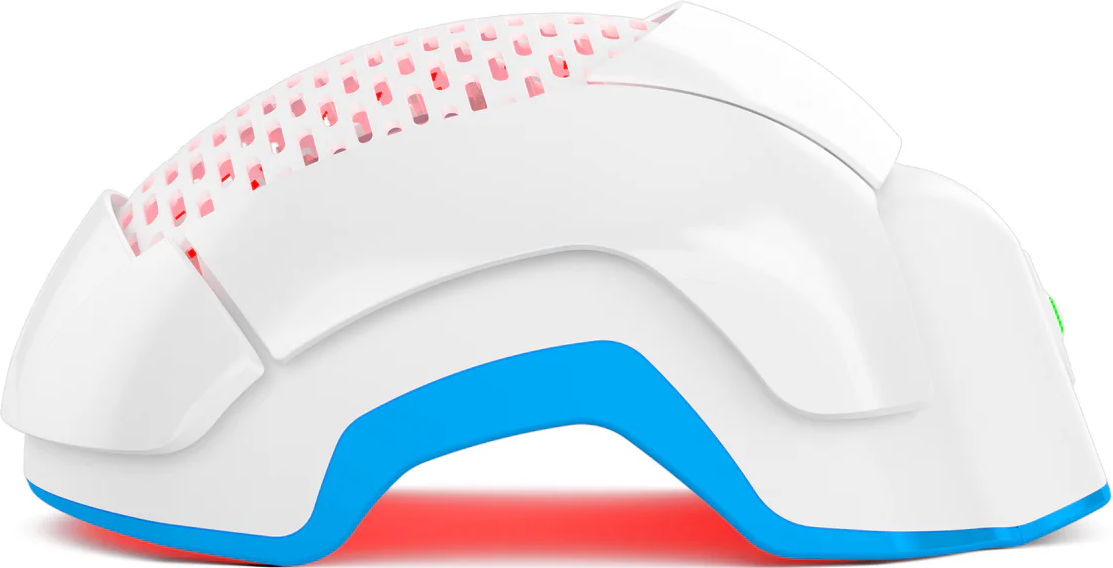
A Non-Drug Option for Hair Loss: Laser Phototherapy
Not everyone wants a topical medication on their scalp every day. That is a practical preference, not a moral stance. And dermatology guidance does recognize laser therapy as an option for some people with hereditary hair loss. The American Academy of Dermatology notes that laser therapy may help some patients, and Mayo Clinic also notes FDA-cleared low-level laser devices for hereditary hair loss while pointing out that longer-term evidence still needs work.
What Laser Phototherapy is
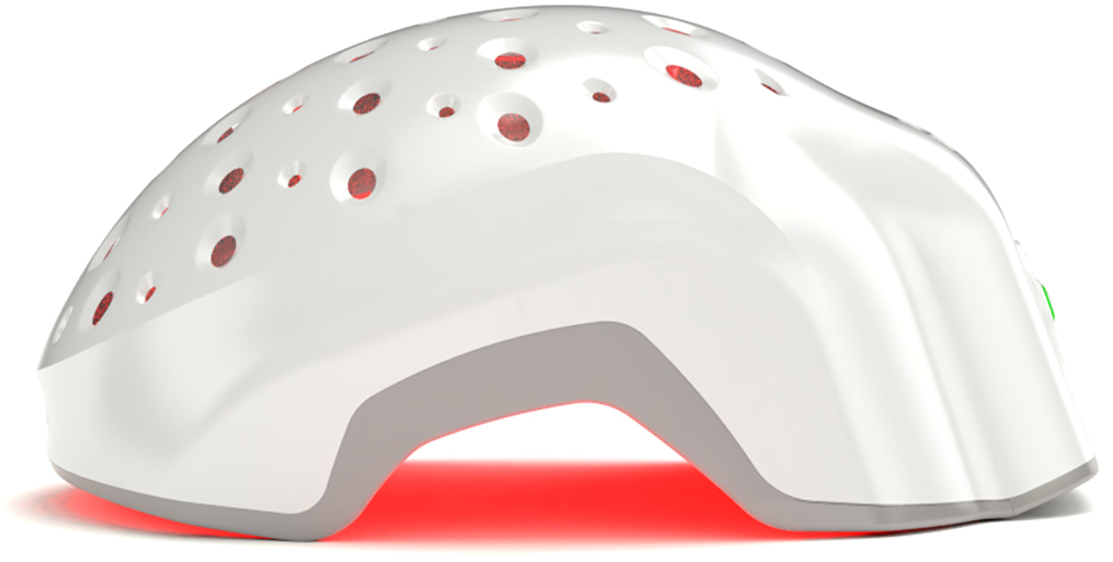
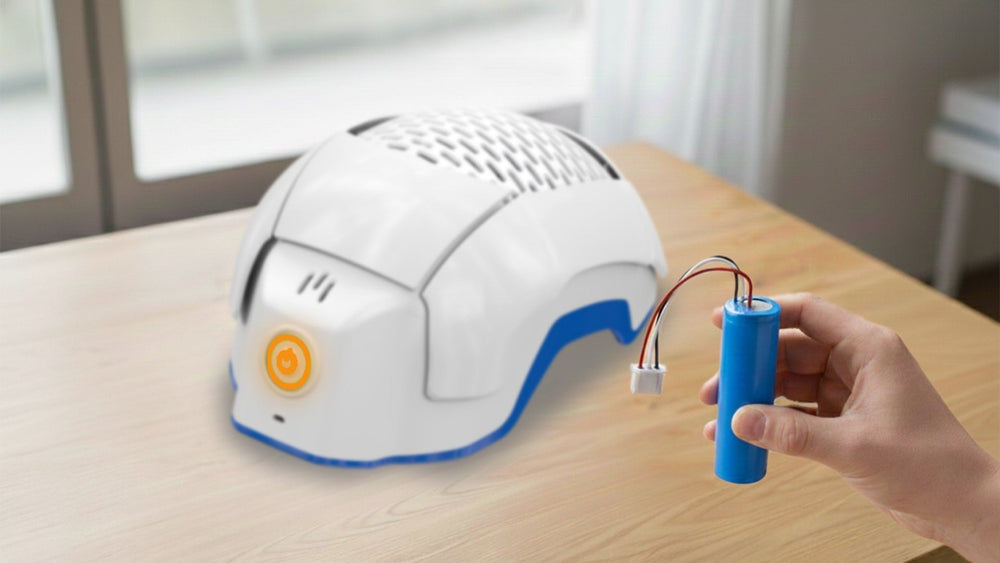
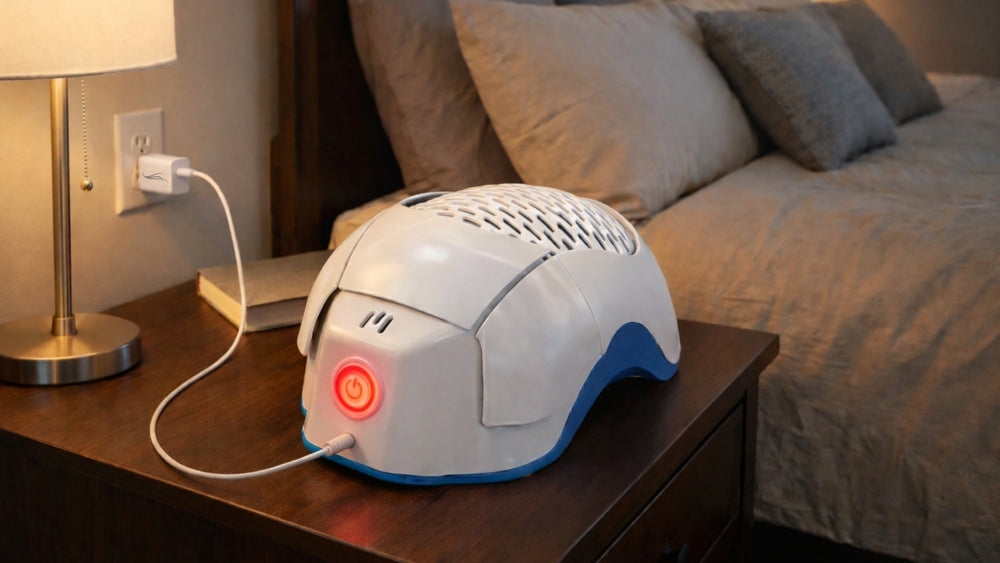
When we talk about Laser Phototherapy (LPT) here, we are talking about a light-based, non-drug approach used on the scalp. Reviews of low-level light therapy for androgenetic alopecia suggest it may help stimulate hair growth and improve hair density in some patients, though study quality and durability vary.
Why some people prefer device-based treatments
One reason some people lean toward device-based treatment is simple: there is no topical residue to migrate onto the pillow, face, or eye area. LPT does not depend on rubbing a liquid or foam into the scalp every day, so it avoids the very specific problems of transfer, vehicle irritation, and facial hypertrichosis that topical minoxidil can create in some users.
When people combine approaches
Some evidence suggests combination treatment can outperform monotherapy in certain settings, including studies comparing low-level laser treatment plus topical minoxidil versus topical minoxidil alone. Still, the best plan depends on diagnosis, tolerance, budget, and how much complexity someone is realistically going to stick with for months. Which... matters more than people admit.
This is also where we circle back to the beginning. If your scalp treatment is helping the hair but making your face feel like collateral damage, that is not trivial vanity. It is part of adherence. People stop treatments they dislike. Quietly. Constantly.
When Should Someone Seek Professional Advice?
See a dermatologist or other qualified clinician if you notice eyelid or facial swelling, persistent burning or rash near the eyes, obvious unwanted facial hair, or any symptom that feels systemic such as dizziness, chest discomfort, faintness, or unexplained weight gain. Those warning signs line up much more closely with documented minoxidil adverse effects than “ordinary dark circles” do.
If the concern is mostly cosmetic but ongoing, it is still worth a proper assessment. Under-eye darkness has many causes, and a clinician can help separate minoxidil-related irritation or edema from allergic disease, pre-existing pigmentation, tear-trough anatomy, or something else entirely.
Conclusion
Minoxidil does not appear to be a standard, officially recognized cause of dark circles under the eyes. But it can sometimes make the area look darker through things that are documented... puffiness, irritation, accidental facial exposure, or unwanted facial hair. That is the more honest answer. If your under-eyes changed after starting minoxidil, check the basics first: dose, dry time, transfer, formulation, irritation. And if swelling or rash is in the mix, get medical guidance. Hair regrowth should not have to come with a daily argument with your own reflection.