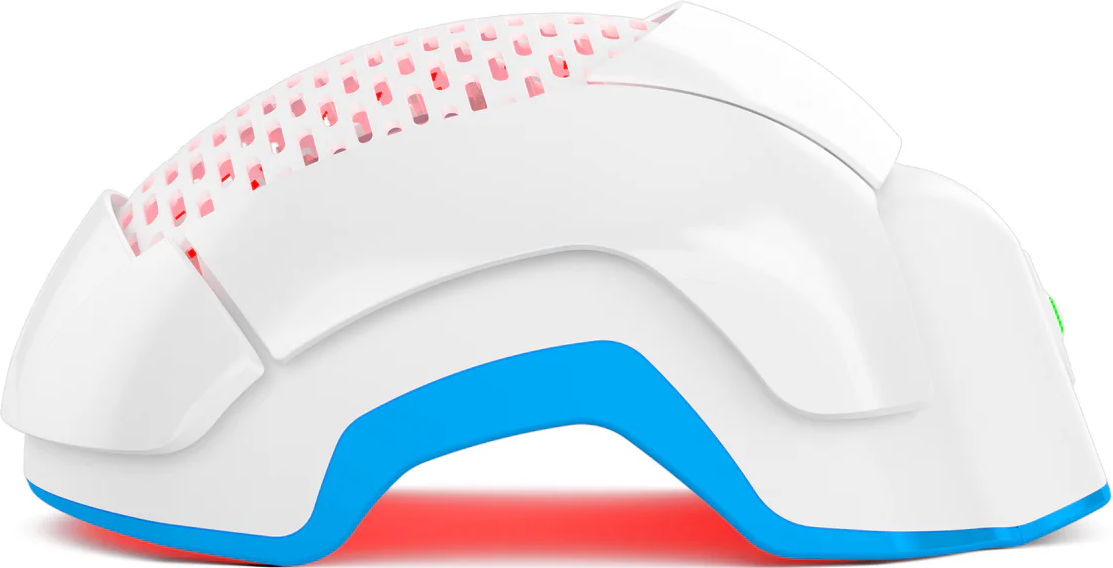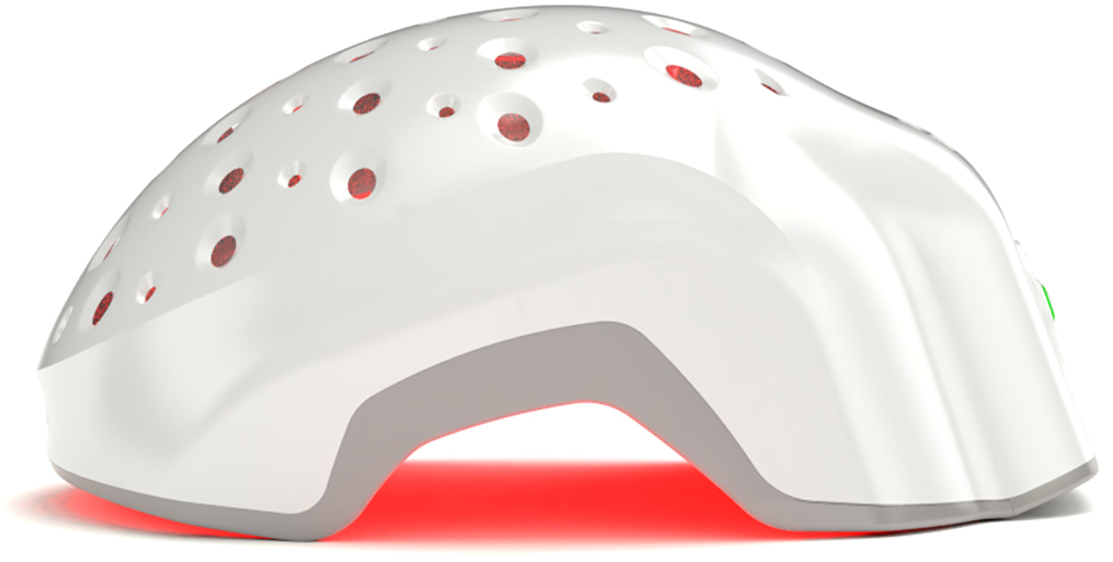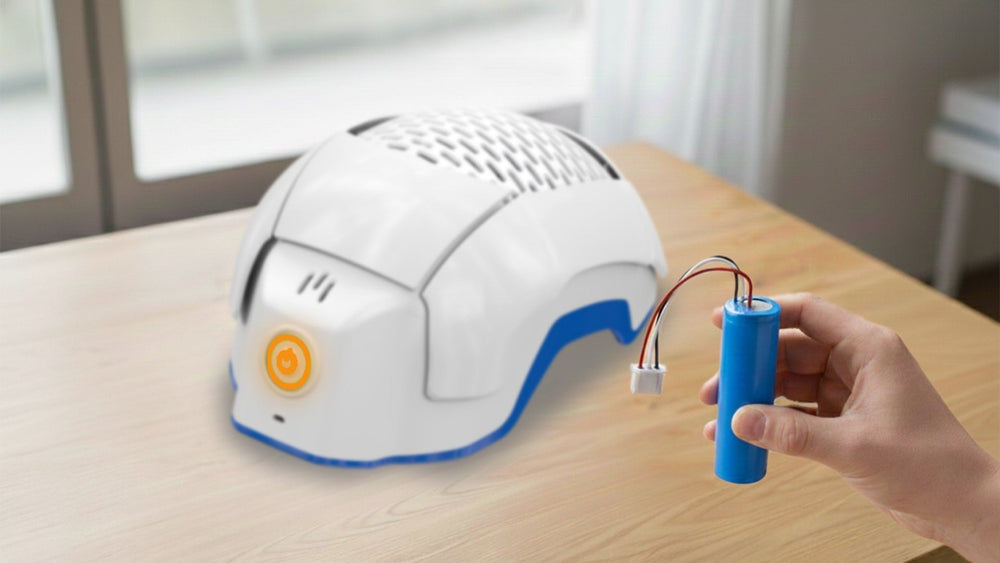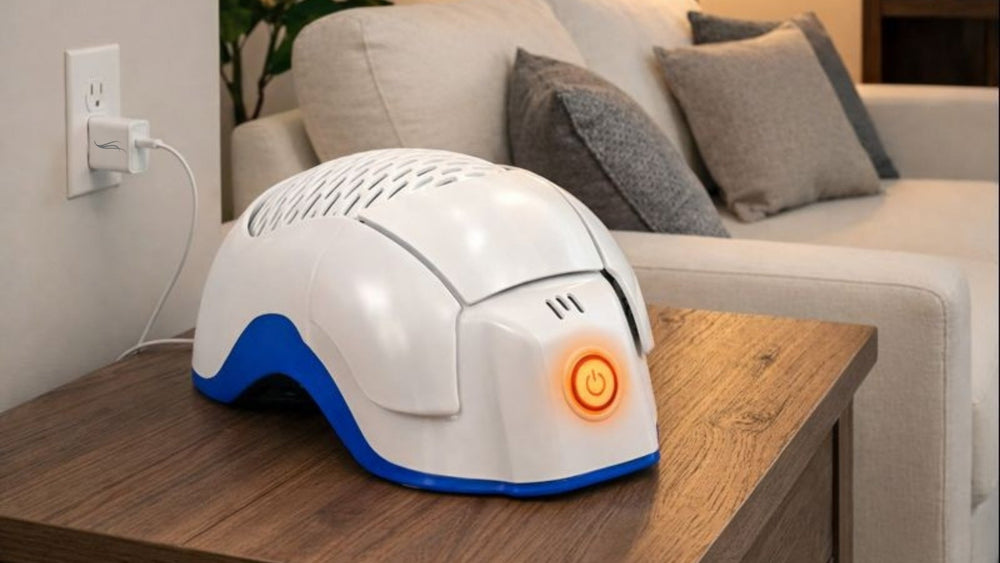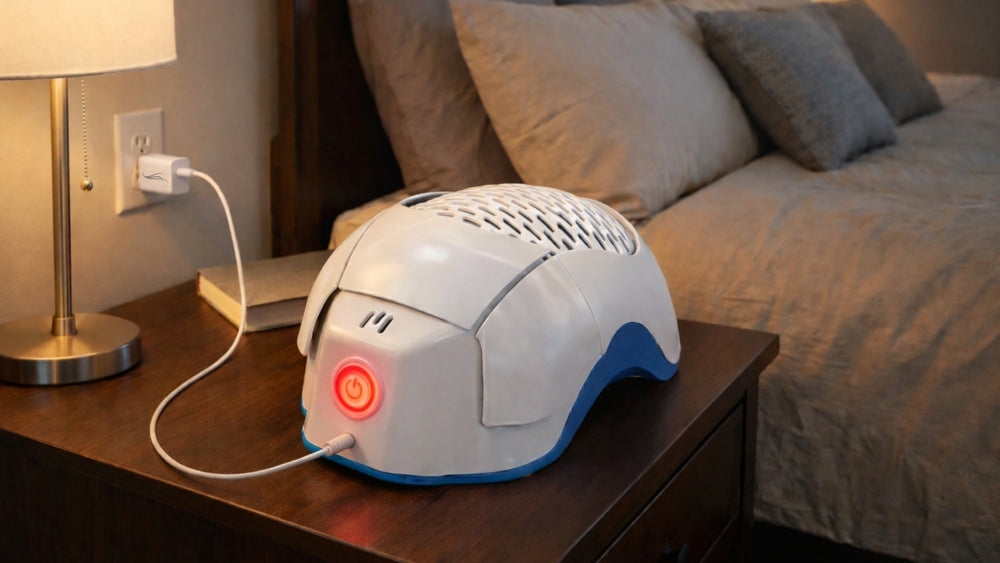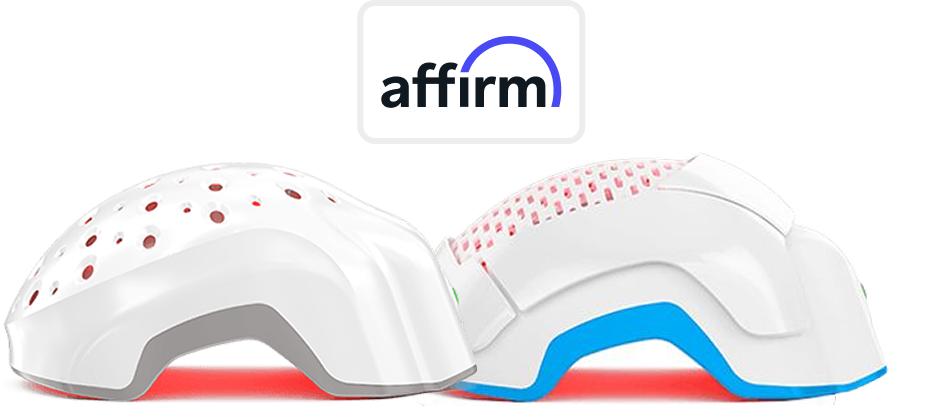






If you have androgenetic alopecia (pattern hair loss) and you want the most reliable home Laser Phototherapy (LPT) routine, a laser helmet usually wins on coverage and consistency. A laser comb can still help, but it asks more of you, every session, for months, and that’s where results often get quietly lost.
Why This Comparison Even Matters
If you’re shopping in this category, both devices can sound weirdly similar. Red light. Lasers. A few minutes per session. Promises that feel… optimistic.
And then you get stuck on a simple question that isn’t actually simple.
Which device gives you the best shot at consistent scalp exposure over months, not days?
Because the biology is one side of the coin. The other side is you, on a random Tuesday, tired, busy, not in the mood to play “perfect technique” with your hair.
That part matters more than people admit.

What Laser Phototherapy Actually Does
Laser Phototherapy (LPT) is often discussed under the broader umbrella of low-level light or laser therapy. The core idea is photobiomodulation, meaning light triggers cellular signaling rather than heat damage. No cutting. No burning. No “surgical laser”.
LPT vs Other Laser Uses
Ablative or surgical lasers are designed to generate tissue effects through controlled energy delivery and, in many cases, heat. LPT devices for hair are designed to stay low power and non-thermal in intended use, with biological effects linked to photobiomodulation mechanisms rather than tissue injury.
If the word “radiation” ever made you flinch, it’s worth one calm clarification. In physics, light is electromagnetic radiation. That sounds dramatic until you remember the sun exists, and your phone screen exists, and your kitchen light exists.
The point with LPT is not drama. It’s dose, placement, repetition.
What Needs to Happen for LPT to Work
Most hair-loss LPT devices in studies use red wavelengths in the general range used for photobiomodulation, and they’re used repeatedly for months. Outcomes in trials are commonly measured as changes in hair density or hair counts versus sham devices.
Mechanistically, photobiomodulation research often discusses mitochondrial targets and downstream signaling effects. Cytochrome c oxidase is frequently cited as a chromophore involved in PBM, with proposed effects on cellular energy processes and signaling molecules.
Here’s the catch.
If light doesn’t reliably reach the scalp, at a consistent routine, you do not get to “borrow” results from the studies. You just get… effort.
The Laser Comb
A laser comb is the older, hands-on style of home laser device. It can work. It also asks you to do more work than you think you’ll do long-term.
How Laser Combs Are Designed to Work
From an engineering standpoint, most laser combs use a brush-like format that requires the user to part the hair and hold the device in place for a few seconds before moving to the next area. Some devices advertise multiple beams, but in many designs this is achieved by splitting a single laser through fiber optics rather than using multiple independent laser diodes.
That distinction matters. Splitting one laser into several beams does not behave the same way, optically or biologically, as delivering light from multiple discrete sources.
In practice, users are asked to treat each spot for roughly two to four seconds, wait for a signal, then move on. This process is repeated until the full scalp is covered, often taking fifteen to thirty minutes per session.
It works on paper. In real life, it becomes demanding.
Limitations That Don’t Show Up on the Box
The main issue with laser combs is not just effort. It is dosage control.
When you combine short dwell times per spot with relatively low power density, the total energy delivered to any single area of the scalp can fall below levels typically associated with photobiostimulation in laboratory and clinical settings. Estimates cited for many comb-style devices suggest energy delivery that may be insufficient to reliably stimulate follicular tissue, especially when compounded by movement and missed areas.
There is also the question of consistency. Manual devices introduce variability every time the user speeds up, slows down, or shifts technique. Over weeks and months, those small variations add up.
Laser combs played an important role in bringing attention to laser phototherapy. But from a design and compliance standpoint, they ask a lot of the user while delivering relatively limited control over exposure. As laser phototherapy technology has matured, this has pushed newer devices toward formats that prioritise stable positioning, longer exposure, and independent laser sources rather than split beams.
That shift is about engineering, not fashion.
Where Laser Combs Can Make Sense
- You want a smaller device and you don’t mind doing the session actively, start to finish.
- Your hair is short or easy to part, so scalp access is less fiddly.
- You’re working on a smaller thinning zone and you’re willing to be consistent.
That last bit is doing a lot of lifting.
Limitations That Don’t Show Up on the Box
Manual devices create variability. The moment your technique changes, your scalp exposure changes.
And humans do change technique. We rush. We get distracted. We skip a section and tell ourselves it’s fine because we’ll “make it up later” (we don’t).
Also, combs can be awkward with dense hair, longer hair, textured hair, or simple impatience. Not because those hair types “block” LPT in some absolute way, but because the practical challenge is scalp access.
It’s a friction problem.
The Laser Helmet
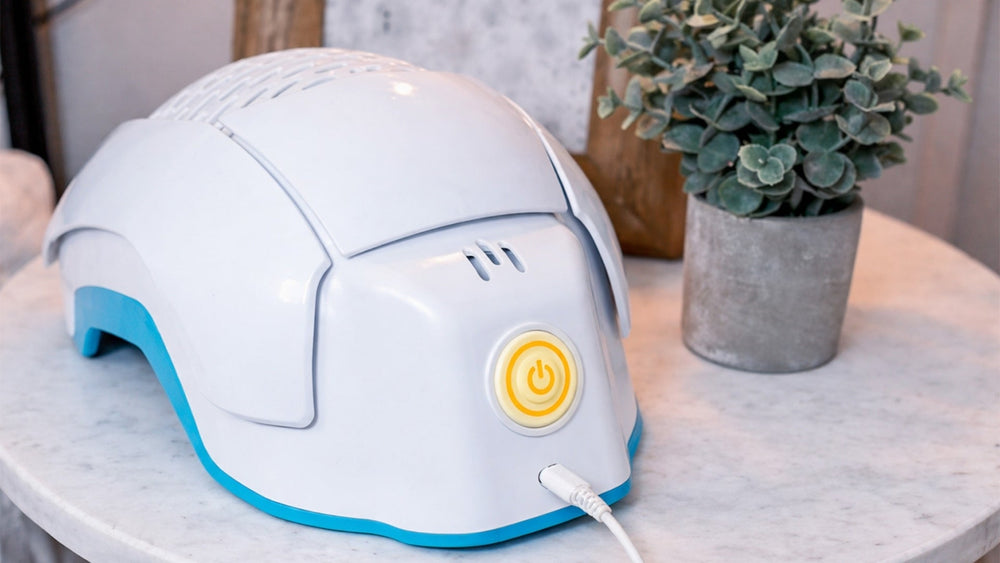
A laser helmet is a hands-free wearable device designed to expose a broader area of the scalp per session. Mechanically, it reduces the technique burden. That’s the main advantage. Not magic.
What Makes a Helmet Different by Design
With a helmet, you place it on, the session runs, and the device delivers light exposure without requiring you to micromanage coverage across sections. That doesn’t guarantee results, but it does remove a big cause of inconsistent treatment.
You still need a routine. But you don’t need perfect hand skills.
Coverage and Dosage Consistency
Helmets are designed to cover more of the top scalp at once, which can reduce the risk of missed areas compared to section-by-section manual use.
This is not a “helmet always delivers more” statement. Device parameters differ across brands. What we can say cleanly is that the form factor lends itself to more uniform delivery because it reduces user-dependent coverage variability.
And in photobiomodulation, consistent exposure matters because biological effects are often described as dose-dependent and protocol-dependent.
Consistency.
Ease of Use and Long-Term Adherence
Most people don’t fail because they’re lazy. They fail because a routine is annoying, and annoying routines get “tomorrow’d” to death.
Wearable devices lower that friction. You can sit, read, scroll, cook, listen to music. You’re not standing there doing scalp choreography.
And yes, in clinical practice and in real life, adherence can be the difference between a protocol that has a chance and a protocol that never stabilizes long enough to show anything.
A Note on Engineering Quality
In FDA documentation, device details like indication, intended population, and session duration are specified for the cleared device. For example, the Theradome LH40 EVO 510(k) summary describes its OTC indication for androgenetic alopecia and includes technical characteristics and lab testing references.
If you’re comparing products, look for transparency around:
- regulatory clearance for the hair-growth indication
- protocol length per session
- the type of light source and device design choices (presented clearly)
Side-by-Side Comparison

|
Feature |
Laser Comb |
Laser Helmet |
|
Scalp coverage per session |
Section-by-section |
Broader, more simultaneous coverage |
|
Technique demand |
High |
Low |
|
Missed-spot risk |
Higher |
Lower |
|
Time feel |
Active and hands-on |
Passive and easier to repeat |
|
Best-fit user profile |
Highly disciplined, ok with manual sessions |
Wants lower friction and better coverage consistency |
|
Energy dosage |
0.02 j/cm2. Lower and variable due to short dwell time and manual movement |
6.09 j/cm2. More uniform due to longer exposure and stable positioning |
Also Read: What are the differences between laser helmets, laser caps and laser combs?
Why Energy Delivery Matters
Photobiomodulation research consistently describes biological response as dose-dependent and protocol-dependent, not just wavelength-dependent. When exposure time per area is very short and user-controlled, the total energy delivered to the scalp can vary widely from session to session. Helmet-style devices reduce that variability by holding the light source in a fixed position for a defined duration, which helps stabilize cumulative exposure over time.
Safety and Regulation
What FDA Clearance Actually Means
For devices, the standard language is FDA-cleared, often via the 510(k) pathway. In simple terms, that pathway evaluates whether a device is substantially equivalent to a predicate device and can legally be marketed for that intended use.
You don’t need to memorize regulatory jargon. You just need to know it’s a meaningful filter when you’re trying to avoid devices that make bold claims without accountability.
Laser Safety
Home-use LPT devices are designed as low-power, non-thermal devices when used as directed. Trials and reviews generally describe them as well tolerated, with adverse effects uncommon, though individual sensitivity can vary.
If you have photosensitivity conditions, are on photosensitizing medications, or have a scalp condition that needs diagnosis, get professional guidance first. That’s not fear. That’s just adult decision-making. The AAD hair loss resource center is a good starting point for recognizing when an evaluation matters.
Common Mistakes That Undercut Results
- Choosing a device that doesn’t match your routine reality. If you hate manual sessions now, you’ll hate them more in week nine.
- Ignoring scalp access. Hair length, density, texture, styling habits, all of it affects how easily light reaches scalp.
- Focusing on price and forgetting time. Months of use is a long relationship with a tool.
- Expecting fast change. Many studies assess outcomes over months, not days.
- Skipping diagnosis. Not all shedding is androgenetic alopecia. Some causes need very different care paths.
So… Which One Is Better?
If you’ll truly use a comb correctly, consistently, for months, you can get value from it. The evidence for FDA-cleared home-use LPT devices overall suggests a positive effect on hair density versus sham in pattern hair loss, with study quality varying and device protocols differing.
But if you’re choosing based on what most people actually do, not what they plan to do, a helmet tends to be the better fit because it lowers user error and improves the odds of repeating the protocol.
Conclusion
You’re not choosing between “good science” and “bad science.” You’re choosing between two delivery styles that ask different things from you.
A laser comb can be a decent option if you like hands-on routines and you’ll stick to the section-by-section process consistently. A laser helmet is usually easier to repeat, and that matters because LPT is a months-long protocol in studies, not a quick fix.
If you want one guiding rule, keep it plain. Pick the device you’ll actually use when life is busy, your motivation is low, and you still want progress.
Slow progress, but real.
That’s the deal with hair.