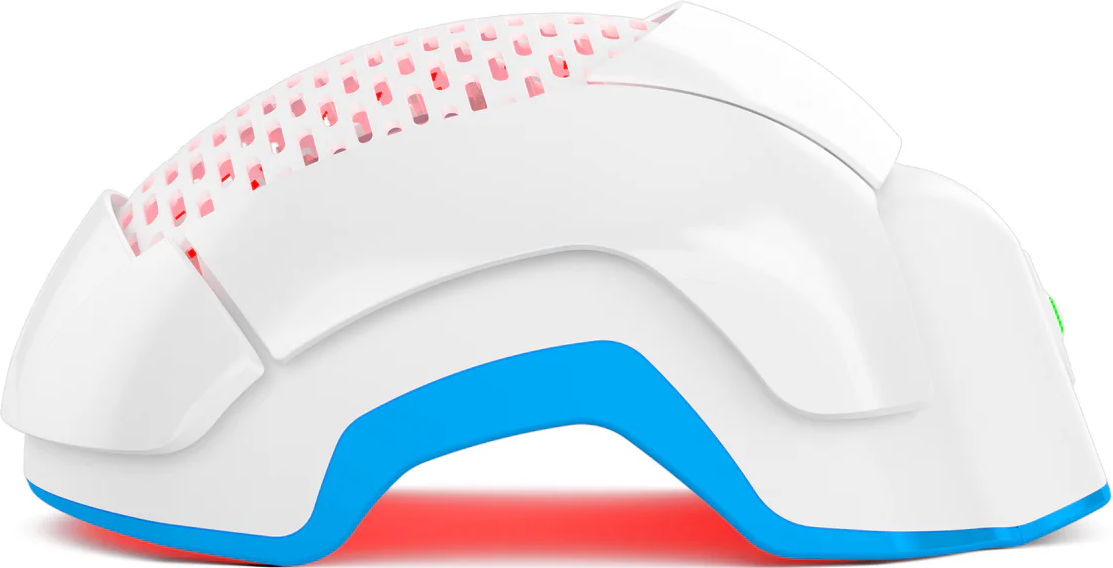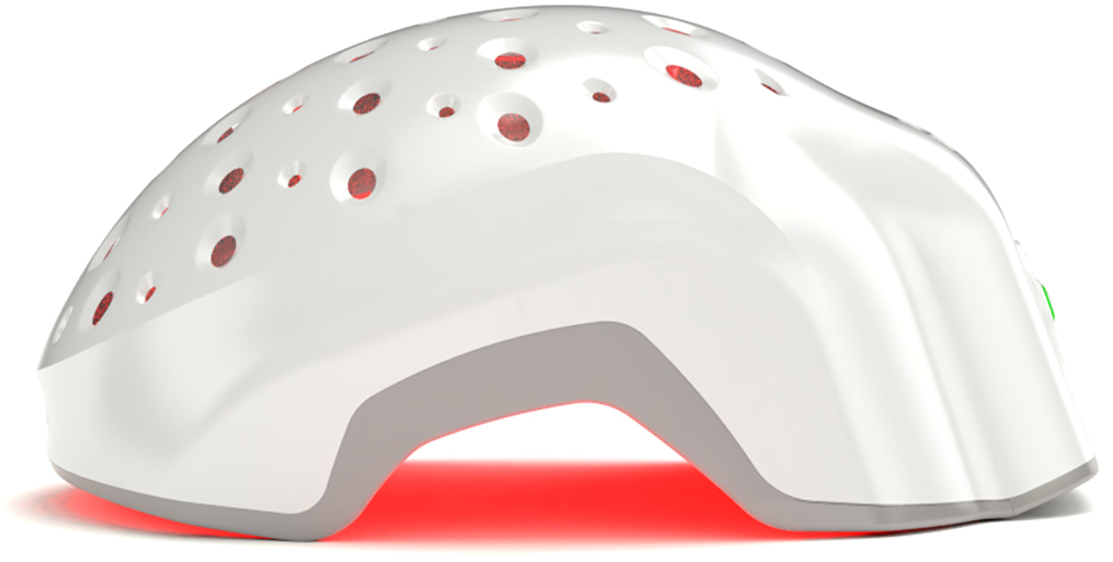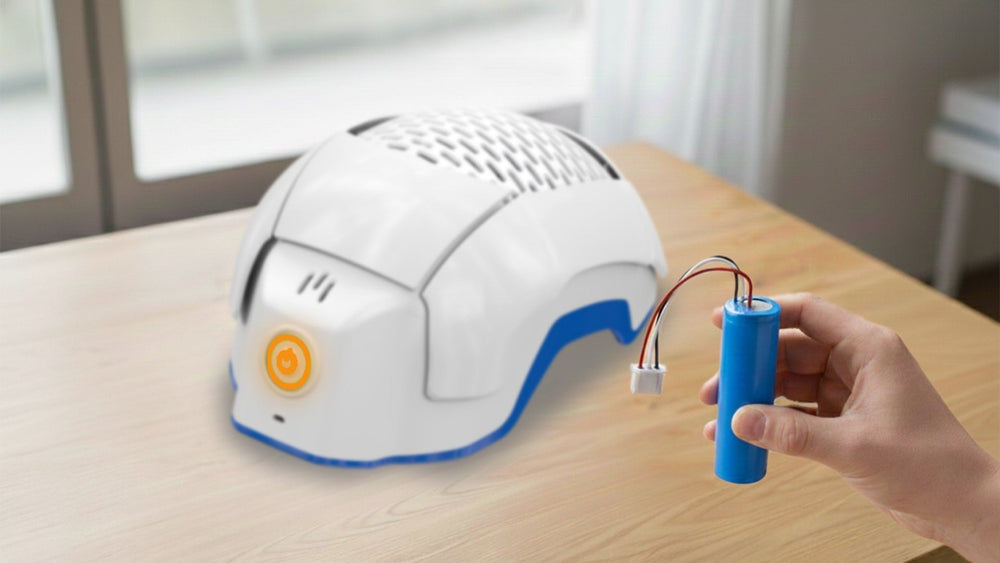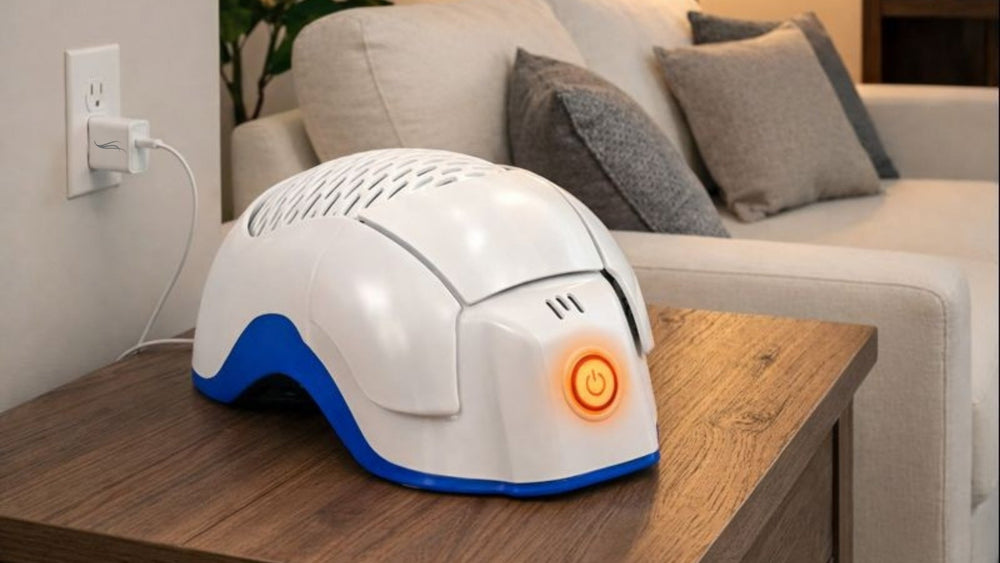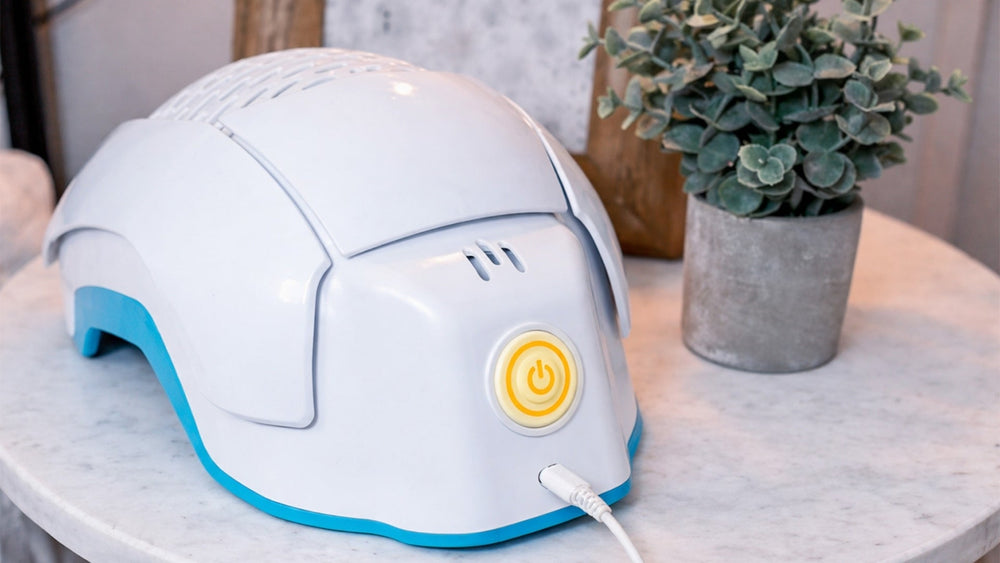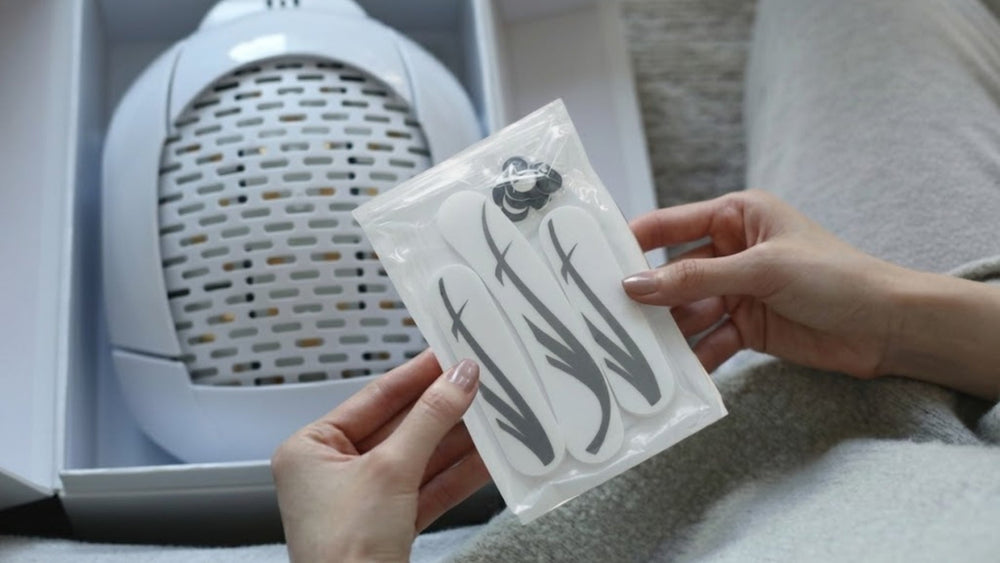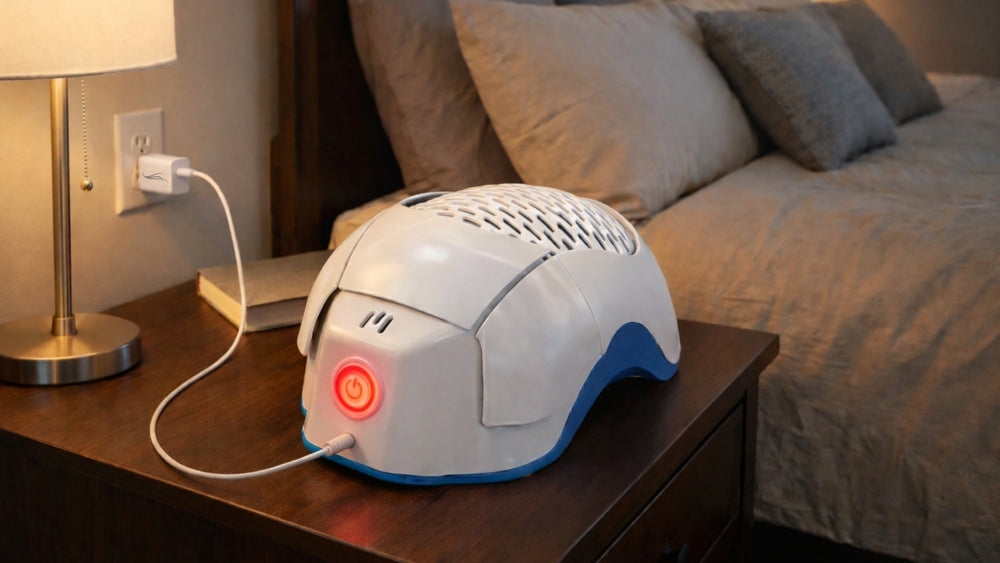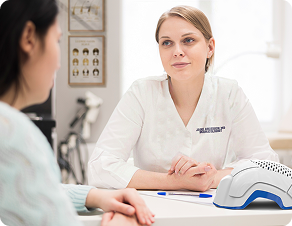

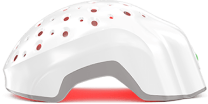





A cordless laser hair growth helmet can be a real advantage because it makes it easier to stay consistent with laser phototherapy (LPT) sessions, and consistency is the boring, unsexy thing that actually decides results for most people with androgenetic alopecia. Cordless does not change the biology of light. It changes you using it.
What Is a Cordless Laser Hair Growth Helmet, Really?
A laser hair growth helmet is a wearable device designed to deliver low-level light to the scalp, usually in the red or near-infrared range used in photobiomodulation research.
The condition most people are trying to treat with it is androgenetic alopecia (pattern hair loss). That’s the slow, genetically primed miniaturization process, not the sudden “I’m shedding like a golden retriever in summer” event that can happen after stress, illness, childbirth, or medication changes. Different causes, different game plan.
One more thing (because people get this wrong): these devices are typically home-use, low-level. They are not the cutting, burning, ablative lasers used in surgery. They’re not meant to heat your scalp. The mechanism is discussed as photobiomodulation, not tissue destruction.
How helmets differ from caps, combs, and panels
Think of the format as a delivery method.
A helmet-style device is built to give broad scalp coverage with minimal technique. A comb or handheld device can be more “spot-by-spot,” which adds user error and inconsistency. Panels can work too, but they’re often less wearable, and wearability matters when you’re doing something for months.
Cordless doesn’t automatically mean “better light.” It often means “more likely to finish your sessions without negotiating with a wall socket.” That’s the advantage we’re about to talk about.
Why Convenience Is Non-Negotiable in Hair Growth
Hair growth is slow, humans are not
Hair biology moves at its own pace. Clinical trials for hair devices commonly run 16–24 weeks before meaningful endpoints are assessed, because follicles don’t flip from “fine” to “full” in a weekend.
That long horizon creates a real-life problem.
People start strong, then drift. Not because they’re lazy. Because long-term routines are hard. The World Health Organization has written plainly about adherence as a major issue in chronic therapies, and it’s not a moral failing, it’s a structural thing.
Long story short: the plan that fits your life tends to get done.
What actually breaks consistency
Cords do it. Sometimes.
Not always, but often enough that it matters. A corded setup makes the session location-dependent. That increases the friction cost. And friction, in behavioral terms, is a thief. It steals your follow-through in small, quiet ways.
A dermatology adherence review summarizes how common nonadherence is in skin conditions and discusses barriers and interventions. One recurring theme is that complexity and inconvenience can undermine adherence, while simplifying a regimen can help. So yes, “convenience” is clinical-adjacent. It’s not glamorous but still relevant.
The Real Advantages of Going Cordless
Hands-free use lowers friction
A cordless helmet is hands-free and location-flexible. That sounds like lifestyle copy until you connect it to adherence science.
If the device is wearable and doesn’t tether you to one spot, you remove one of the common session-killers: “I’ll do it later when I’m near the outlet.” Later becomes never. (You know this.)
This is also why helmets can be psychologically easier than topical routines that require daily effort and tolerance for mess, smell, or skin irritation. Not everyone struggles with that, but many do.
Movement matters more than people admit
Truth is, sitting perfectly still is weirdly annoying.
A cordless helmet lets you do normal, low-stakes life while the session runs. That can increase completion, and completion matters. Dermatology adherence work is blunt about it: adherence influences outcomes.
And because this is hair, the timeline is long. So you need the routine to feel… tolerable and sustainable. Something you can do even on a low-energy day.
Travel and routine disruption
A lot of hair-loss routines collapse when life gets messy. Trips. Holidays. Family stuff. Work pressure.
A cordless helmet can travel and function without the “plug logistics,” which helps maintain rhythm across disruptions. I’m not saying you’ll never miss a session. You will. People do. The point is the device design can make missing fewer sessions more realistic.
Small misses compound over months. That’s the part nobody wants to think about.
Consistency beats intensity
The best protocol is the one you can repeat.
Evidence suggests LLLT can increase hair density compared with sham in adult androgenetic alopecia, with subgroup analyses noting differences across treatment frequencies and considerable heterogeneity across trials. So, more isn’t always more, and protocols matter.
This is where cordless helps indirectly. It supports a steady cadence. Not heroic bursts followed by silence.
Does Cordless Change the Science?
Cordless does not magically make photons smarter.
It doesn’t automatically increase penetration depth, “activate” follicles faster, or rewrite the biology of androgenetic alopecia. If you see claims like that, pause. The mechanism discussed in the literature is photobiomodulation. Not “cordless energy amplification.”
Also, no, you should not frame results as guaranteed. Clinical evidence supports potential benefit, not certainty for every scalp.
What a cordless helmet reliably improves
It improves the odds of:
- using the device as intended,
- completing sessions,
- staying with it long enough to see whether you respond.
That’s the honest advantage. And it aligns with what we know about adherence: it’s hard, it’s common to struggle, and reducing barriers helps.
Full-Coverage Helmets vs Spot-Treatment Devices
Pattern hair loss often affects broad regions, not a single dot. Men may see frontal and vertex changes, women often notice diffuse thinning over the crown while retaining the frontal hairline. The distribution varies, but “widespread” is a recurring theme.
If your thinning pattern is broad, consistent coverage matters. A wearable helmet is designed to bathe the scalp more evenly than tools that rely heavily on user technique.
How helmets reduce user error
Helmets reduce technique load. You place it, you run the session. That’s it.
A sham-controlled 24-week home-use trial in Thai men and women with androgenetic alopecia reported that the helmet-type device improved hair density and hair diameter compared with sham, with minimal adverse effects reported.
Notice what’s being measured: density, diameter, global assessment. Not magic. Not instant.
Engineering Behind a Good Cordless Helmet
A cordless device is only as good as its ability to deliver consistent output across a session.
High-quality manufacturers will design around stable energy delivery so performance does not sag halfway through. This matters because LPT research is already heterogeneous. If your device delivery is inconsistent on top of that, you muddy the waters further.
This is also why “dose” discussions can get messy in consumer marketing. You’ll see lots of numbers, fewer explanations. The evidence base emphasizes variability across devices and protocols.
If you want a practical filter: look for clear protocol guidance, safety information, and regulatory transparency.
Weight, balance, and comfort
Comfort is not cosmetic. It determines whether you’ll keep doing it.
If the device is heavy, poorly balanced, or irritating, adherence drops. And adherence is not optional when the biology takes months.
Comfort is a compliance tool. It’s design doing behavioral work.
Thoughtful automation
Timers and session controls sound simple, but they matter.
Automation reduces decision fatigue. It also reduces user error, like “Did I do 10 minutes or 25?” Over long timelines, tiny ambiguities become routine drift.
Then you blame the device when the real issue is your protocol got wobbly.
It happens.
Safety, Regulation, and What “FDA-Cleared” Means
Low-level laser therapy is discussed as a non-thermal modality. The goal is not heating, not burning, not tissue ablation. It’s photobiomodulation.
The American Academy of Dermatology notes that laser therapy (LLLT) may be an option and cites that a few studies suggest it may help hereditary hair loss, among other indications. If you have eye safety questions, follow the device instructions and avoid direct eye exposure. Basic, but worth saying once.
FDA-cleared vs FDA-approved
For devices marketed under the 510(k) pathway, FDA describes a 510(k) as a premarket submission intended to demonstrate the device is as safe and effective as, meaning substantially equivalent to, a legally marketed predicate device. That is the foundation for saying FDA-cleared.
That distinction matters because “approved” is commonly associated with drugs and different regulatory pathways. Precision language signals credibility. It also keeps you compliant.
Who Benefits Most From a Cordless Laser Helmet
In the evidence base, the clearest use case is androgenetic alopecia in adults, often early to moderate stages, used consistently over months.
You may be a better fit if you:
- want a non-drug or adjunct option,
- can commit to a steady schedule,
- prefer wearable, low-effort routines.
And yes, both men and women were included in the 24-week helmet study mentioned earlier.
When to pause and seek evaluation
If you have sudden shedding, scalp pain, significant inflammation, or patchy loss, you need assessment. Pattern hair loss is common, but it is not the only explanation for thinning.
Clinical guidance emphasizes diagnostic clarity, and dermatology sources remind people that diagnosis and tailored treatment matter.
If something feels off, trust that instinct.
Common Misconceptions
1. “Cordless means weaker.”
Not necessarily. Cordless speaks to power source and design, not automatically to efficacy.
2. “More sessions will speed it up.”
Not always. Meta-analytic work suggests frequency differences can influence outcomes, and the broader issue is that protocols vary across trials. More is not a guaranteed upgrade.
3. “If I miss a week, it’s ruined.”
No. But if missing weeks becomes your norm, results become less likely. That’s the honest version.
You can probably see the theme. Adherence.
Conclusion
A cordless laser hair growth helmet doesn’t win because it has “cordless magic.” It wins because it’s easier to live with, and living with it is the point. Pattern hair loss is slow. Your routine has to be steadier than your motivation.
If you’re considering LPT, treat it like any long-term health habit: choose the format you can repeat, use it long enough to judge response, and keep expectations human-sized. A helmet like Theradome can support hair density and thickness for some people, based on sham-controlled evidence, but it won’t rewrite genetics overnight.
Quiet consistency. That’s the advantage.