







Estradiol can be connected to hair shedding, but it is rarely a neat one-cause explanation. In many people, the bigger issue is a shift in estrogen levels, menopause, postpartum change, hormone therapy adjustments, telogen effluvium, female pattern hair loss, or a medication combination that needs proper review. Estradiol itself can influence hair follicles through estrogen receptor pathways, and some estradiol labels list hair loss as a possible side effect, but that does not mean every shed hair should be blamed on estradiol alone.
Does Estradiol Cause Hair Loss?
Estradiol can be associated with hair loss, but it is not usually a simple “estradiol did it” situation. Hair loss after starting, stopping, or changing estradiol may come from the hormone shift itself, a delayed shedding response, menopause-related changes, postpartum estrogen decline, another medication in the regimen, or female pattern hair loss that was already brewing quietly. The hair follicle is dramatic like that. Quiet for months, then suddenly the bathroom floor is giving crime scene.
Official labeling matters too. DailyMed, the U.S. National Library of Medicine’s drug-label database, lists hair loss among additional adverse reactions reported with estrogen and/or progestin therapy for some estradiol tablet labels. That means the symptom is worth taking seriously. It does not mean estradiol is always the root cause in every person who sheds while taking it.
The safest next step is not to stop estradiol abruptly unless your clinician tells you to. Track your timing, dose changes, route changes, other medications, recent illness, childbirth, menopause symptoms, stress, diet changes, and the pattern of shedding. Then bring that timeline to your prescribing clinician or a dermatologist. Treatment works better when the cause is identified first, and effective hair-loss care begins with finding the cause.
What Is Estradiol, And Why Does It Matter For Hair?
Estradiol is one of the main forms of estrogen, a hormone involved in reproductive function, bone health, skin, brain activity, and yes, hair follicle biology. It may be prescribed during menopause, for some forms of low-estrogen states, or as part of gender-affirming hormone therapy. That medical context matters because estradiol is often not taken in isolation. It may be used with progesterone, progestins, anti-androgens, testosterone blockers, or other medications depending on the person’s care plan.
And hair is annoyingly sensitive to internal shifts. Not fragile, exactly. More like reactive.
How does estradiol interact with hair follicles?
Hair follicles are active mini-organs that respond to hormones, immune signals, nutrition, stress, genetics, and local scalp conditions. A 2020 peer-reviewed review in International Journal of Molecular Sciences notes that estradiol can significantly alter hair follicle growth and cycling by binding through estrogen-related pathways in the follicle.
Estradiol’s effect on hair can vary by scalp area, sex, receptor activity, life stage, and whether the research comes from human tissue, animal studies, or lab models. So no, “more estrogen means better hair” is not accurate enough.
Why the “estrogen protects hair” idea is only half-right
Many people notice thicker-feeling hair during pregnancy, when estrogen levels are higher. Then, after childbirth, estrogen falls and shedding can spike a few months later. AAD describes this postpartum shedding as telogen effluvium caused by falling estrogen levels.
So estrogen can be protective in certain contexts. But estrogen biology is not a vending machine where you insert estradiol and receive thicker hair. The follicle has more than one button.
How Does Estrogen Affect The Hair Growth Cycle?
Scalp hair moves through phases. Anagen is the active growth phase. Catagen is the short transition phase. Telogen is the resting phase, and shedding follows when that resting hair finally exits. Telogen effluvium happens when a larger-than-usual share of hairs shifts into that resting and shedding pathway after a trigger. The British Association of Dermatologists notes that normally about 15% of scalp hair is in the shedding phase, but in telogen effluvium that can rise to 30% or more.
That is why hair loss often feels delayed. The trigger happens first. The shedding shows up later, often around three months after the event.
Where estradiol may fit in
Estradiol may influence how follicles behave during the hair cycle. The current evidence supports the idea that estrogen signaling matters in follicle biology, but the exact result is not identical for every person or every scalp region.
A hormonal change can affect how many hairs remain in the growth phase or drift toward the resting phase. That is one reason someone may notice shedding after a hormone shift, even if estradiol is not “bad for hair.” The shift itself can be the jolt.
Why falling estrogen matters
Postpartum shedding is the clearest example. During pregnancy, higher estrogen can keep more hairs in the growth phase, which is why some people feel their hair looks fuller. After childbirth, estrogen levels fall. The excessive shedding new mothers notice a few months after delivery is caused by falling estrogen levels, and Cleveland Clinic similarly explains that estrogen drops after childbirth, pushing many hairs into the resting phase before they shed months later.
Postpartum shedding is usually excessive shedding, not permanent follicle death. Hair follicles are not gone. They are just cycling through a loud, messy reset.
Why Can Hair Shed After Starting, Stopping, Or Changing Estradiol?

Hormone shifts can trigger telogen effluvium
Telogen effluvium is one of the most common explanations for sudden diffuse shedding. It can follow childbirth, illness, fever, surgery, major stress, marked weight loss, restrictive dieting, scalp disease, a new medication, or withdrawal of a medication. The British Association of Dermatologists lists these triggers and notes that the increased shedding often appears around three months after the trigger.
So if someone starts estradiol and sheds immediately the next week, estradiol may not fit the timing. If shedding begins two to four months after a hormone change, telogen effluvium becomes more plausible.
Estradiol may not be the only medication involved
Many are not taking estradiol alone. Some are using progesterone or progestins. Some are on gender-affirming hormone therapy with anti-androgens. Some are taking medications for fibroids, endometriosis, menopause symptoms, thyroid disease, blood pressure, mood, or acne. Each can change the hair-loss investigation.
Combination hormone drugs need special care. DailyMed lists hair loss and hair thinning for ORIAHNN, a medication that contains elagolix, estradiol, and norethindrone acetate. That label cannot be fairly translated into “estradiol alone causes hair loss,” because the medication changes the hormone environment through more than one mechanism.
Menopause can reveal female pattern hair loss
Menopause changes the hormonal setting around the follicle. A 2025 review on menopause and hair loss reports that hormonal shifts during menopause can alter hair shaft and hair-cycle features, including decreased density and caliber, and that female pattern hair loss, telogen effluvium, and frontal fibrosing alopecia are reported more often in postmenopausal women.
That does not mean low estradiol is the only cause. Genetics, aging follicles, androgen sensitivity, medications, thyroid health, iron status, scalp inflammation, and stress can all be part of the same crowded little room.
A 2022 cross-sectional study of 178 healthy postmenopausal women aged 50 to 65 reported female pattern hair loss in 52.2% of participants. Useful number, but don’t stretch it too far. It was one study population, not a universal law carved into a shampoo bottle.
“Dread shed” needs careful handling
People sometimes call any early shedding a “dread shed.” The phrase gets tossed around mostly with treatments like minoxidil, where a temporary increase in shedding can happen in the first weeks of use. With minoxidil, some people notice increased hair loss for the first two to eight weeks before regrowth begins.
Estradiol is different. A temporary shed after a hormone change may happen in some people, but it should not be promised, normalized too casually, or written off without context. The better wording is: a hormone shift may trigger telogen effluvium in some people, especially if the timing fits.
The real question is timing
Timing is the boring detective that usually wins.
If shedding starts within days of taking estradiol, the hair-cycle biology may not line up cleanly. If shedding begins two to four months after starting, stopping, missing, or changing estradiol, telogen effluvium becomes more believable. If thinning is slow, patterned, and centered around the part or crown, female pattern hair loss needs to be considered.
What Does Estradiol-Related Hair Loss Look Like?
Diffuse shedding
Diffuse shedding usually means hair is coming from all over the scalp rather than one tidy patch. You may see more hair in the shower, brush, pillow, sink, or wrapped around your fingers after washing. Telogen effluvium often looks this way because many resting hairs shed over the same general window. Telogen effluvium is temporary excessive shedding of resting hairs after a shock to the system, while new hair continues to grow.
Diffuse shedding can feel catastrophic because it is visible. Dramatic. Very “what fresh nonsense is this?” But visible shedding does not automatically mean permanent hair loss.
Pattern thinning
Pattern thinning is different. Female pattern hair loss often shows as a widening part, reduced density over the top of the scalp, or crown thinning. The front hairline may stay fairly intact, which can make the change harder to catch early unless you compare photos in the same lighting. AAD describes female pattern hair loss as a common hereditary hair-loss type that becomes more common after menopause.
This type of thinning is usually not just a temporary shed. It involves follicle miniaturization, meaning affected follicles gradually produce finer, shorter hairs. That is why treatment should not wait forever if the part is widening month after month.
Red flags that are not “just hormones”
Some signs deserve faster professional evaluation: patchy bald spots, scalp pain, burning, scaling, redness, scarring, sudden severe loss, eyebrow thinning, frontal hairline recession, or shedding that continues beyond six months. Accurate diagnosis matters because hair loss has many causes, and Mayo Clinic lists diagnostic tools such as blood testing, pull test, and scalp biopsy when needed.
If the scalp hurts, burns, flakes heavily, or looks inflamed, do not just blame estradiol and soldier on.
Breakage versus shedding
Shedding usually means the hair comes out from the root, often with a small club-shaped bulb at one end. Breakage means the strand snaps along the shaft, so you may see shorter, uneven pieces. Bleach, heat styling, tight hairstyles, harsh brushing, and chemical services can all create breakage that looks like “hair loss” at first glance.
Estradiol does not explain every short hair in the sink.
Does Low Estrogen Cause Hair Loss?
Low or falling estrogen can be linked to shedding in certain settings, especially postpartum. AAD directly states that postpartum excessive shedding is caused by falling estrogen levels.
In menopause, the picture is broader. Estrogen declines, yes, but menopause-related hair changes may also involve aging follicles, androgen sensitivity, genetics, health shifts, and coexisting scalp disorders. The 2025 review on menopause and hair loss reports changes in density and caliber during menopause, but it also notes multiple hair disorders seen more often after menopause.
Low estrogen can matter. It just does not get to hog the whole stage.
Postpartum shedding is the clearest example
Postpartum hair shedding usually appears a few months after giving birth. AAD calls this telogen effluvium and describes it as excessive shedding caused by falling estrogen levels. Cleveland Clinic explains the same basic mechanism: higher estrogen during pregnancy can reduce normal shedding, then estrogen drops after childbirth and many hairs enter the resting phase before shedding months later.
Most postpartum shedding improves with time. Still, if shedding is severe, patchy, painful, or prolonged, it should not be dismissed as “just postpartum.” New parenthood is already enough of a circus without being medically brushed off.
Menopause is more layered
Menopause can affect hair density, shaft caliber, and shedding patterns. But the phrase “menopause hair loss” can cover several different conditions, including female pattern hair loss, telogen effluvium, and frontal fibrosing alopecia.
That distinction matters because the treatments differ. Telogen effluvium often improves when the trigger resolves. Female pattern hair loss usually needs ongoing treatment. Scarring alopecias need earlier specialist care because follicle damage can become permanent.
Same mirror. Different biology.
Can High Estradiol Cause Hair Loss?
There is not strong evidence that “high estradiol” by itself is a common standalone cause of hair loss in the general population. Estradiol can affect follicle cycling, and some estradiol product labels list hair loss among reported adverse reactions, but hair loss usually needs a fuller clinical context: dose, route, timing, other hormones, medications, genetics, scalp signs, and the pattern of shedding.
So if someone has “high estrogen” on a lab result and shedding in the shower, the answer is not automatically “there it is.” Bodies are rude like that. They refuse to be single-variable spreadsheets.
Why hormone ratios get discussed
Clinicians may look beyond one hormone number. Estradiol, progesterone, testosterone, thyroid hormones, prolactin, iron status, nutritional health, and stress physiology can all affect hair or mimic hair-related symptoms. But popular phrases like “estrogen dominance” are often used loosely online and can become a shortcut for everything from bloating to shedding to bad moods.
Use caution. If the ratio of hormones matters in a person’s case, that should come from proper clinical evaluation, not a caption written over a stock photo of a woman touching her temples.
What to do instead of guessing
Track the timeline. Note the estradiol dose, route, missed doses, medication changes, new symptoms, and when shedding started. Then bring that to the prescribing clinician. If thinning is patterned, persistent, patchy, painful, or scalp symptoms are present, add a dermatologist to the conversation. AAD is clear that hair-loss treatment works best when the cause is identified first.
Is Hair Loss A Side Effect Of Estradiol?
Yes, hair loss can appear in official estradiol labeling. DailyMed lists hair loss among additional adverse reactions reported with estrogen and/or progestin therapy for some estradiol tablets.
That matters.
Why label language is not the same as diagnosis
A side-effect list records events reported in association with a medication or medication class. It does not always prove that the medication is the only cause of a symptom in one person. Hair loss can come from telogen effluvium, female pattern hair loss, thyroid disease, iron deficiency, illness, childbirth, surgery, stress, scalp disease, autoimmune conditions, traction, medications, and more. Diagnosis starts with identifying the cause because many conditions can lead to hair loss.
So yes, take the label seriously. But no, do not build the whole case on the label alone.
Combined hormone medicines need extra caution
Combination products can be especially easy to misread. ORIAHNN, for example, includes elagolix, estradiol, and norethindrone acetate, and its labeling includes hair loss and hair thinning. That does not isolate estradiol as the cause because elagolix suppresses ovarian hormone production and the medication contains multiple active ingredients.
This is why your medication list matters. The boring list. The one people forget to mention because “it’s probably unrelated.”
It may be very related.
Does Estradiol Help Hair Growth?
Some people notice better hair quality when their low-estrogen symptoms are properly managed. That can happen. But estradiol therapy should not be framed as a standard hair-growth treatment. A 2026 dermatology review on hormone replacement therapy and hair states that there are currently no treatment guidelines or dosage recommendations for estrogen-containing HRT for alopecia.
So, estradiol may be medically appropriate for reasons such as menopause symptoms or gender-affirming care, but hair regrowth should not be the casual sales promise slapped onto it.
Why “my friend’s hair improved on HRT” is not a treatment guideline
Individual stories matter emotionally. They just do not replace diagnosis.
One person may shed after stopping estrogen. Another may improve after stabilizing hormone therapy. Someone else may have female pattern hair loss, low ferritin, thyroid disease, or chronic telogen effluvium hiding under the hormone conversation. That is why two people can take estradiol and report opposite hair outcomes without either one lying.
When estradiol might be relevant medically
Estradiol may be relevant when a clinician is treating menopause symptoms, hypoestrogenism, surgical menopause, or as part of gender-affirming hormone therapy. The hair conversation should sit inside that larger medical context. If shedding starts after an estradiol change, the clinician may review route, dose, timing, other hormones, and possible non-hormonal triggers.
But again: do not change estradiol on your own because the drain got mouthy.
How Do You Tell Estradiol Shedding From Female Pattern Hair Loss?
Telogen effluvium pattern
Telogen effluvium usually looks like sudden, diffuse shedding. More hair comes out from many parts of the scalp, often after a trigger such as childbirth, illness, fever, surgery, stress, rapid weight loss, diet restriction, medication change, or medication withdrawal. Telogen effluvium can appear around three months after a trigger, and DermNet describes it as temporary excessive shedding after a shock to the system.
The emotional problem is that telogen effluvium can look enormous. The clinical point is that it often improves once the trigger settles, though persistent shedding needs evaluation.
Female pattern hair loss pattern
Female pattern hair loss tends to be slower. The part widens. The top of the scalp looks less dense. The ponytail may feel smaller. The crown may show more scalp under bright bathroom lighting, which is rude because bathroom lighting already has a criminal record.
Female pattern hair loss is common, hereditary, more common after menopause, and often treated with minoxidil. Products containing 2% or 5% minoxidil are approved for female pattern hair loss, and AAD notes that dermatologists may use more than one treatment for best results.
They can overlap, which is deeply annoying
Telogen effluvium can make underlying pattern thinning more obvious. A person may have a temporary shed that reveals a part line that was already thinning slowly. Postpartum shedding, menopause, illness, and medication shifts can all pull the curtain back on an existing vulnerability.
So yes, someone can have both: a shedding event and female pattern hair loss. Biology really said, “why choose?”
Simple comparison: shedding versus pattern thinning
|
Feature |
Telogen effluvium |
Female pattern hair loss |
|
Main look |
Diffuse shedding from many scalp areas |
Widening part, crown thinning, reduced top density |
|
Typical timing |
Often 2 to 4 months after a trigger |
Gradual over months or years |
|
Main follicle issue |
More hairs shift into resting and shedding |
Follicles miniaturize over time |
|
Usual course |
Often improves when the trigger resolves |
Often progressive without treatment |
|
Best next step |
Identify the trigger and check medical contributors |
Dermatology diagnosis and treatment plan |
What Should You Do If Your Hair Starts Falling Out On Estradiol?
Do not stop estradiol suddenly without medical guidance
If your hair starts shedding after starting or changing estradiol, call the clinician who prescribed it before making changes. Estradiol may be treating menopause symptoms, low-estrogen states, or part of gender-affirming care. Stopping suddenly may create more hormone fluctuation, and fluctuation is already one of the suspects in the hair drama.
This is not “ignore it.” This is “do not yank the steering wheel.”
Build a 90-day hair and hormone timeline
Write down:
- when estradiol started
- any dose changes
- route changes, such as pill, patch, gel, injection, or local vaginal product
- missed doses
- new medications
- stopping medications
- childbirth
- illness, fever, COVID, or surgery
- major stress
- rapid weight loss
- restrictive dieting
- scalp symptoms
- when shedding began
This timeline is not busywork. Telogen effluvium often appears months after a trigger, so the event that caused shedding may not be the thing you changed last week.
Take useful photos, not panic photos
Use the same lighting, same part, same camera distance, and same angles once a month. Take photos of the center part, crown, temples, and hairline. Do not check every six hours.
Seriously.
Hourly scalp photos will not grow hair. They will, however, ruin a perfectly decent Tuesday.
Ask for diagnosis, not just hormone blame
Ask your clinician or dermatologist what type of hair loss the pattern suggests. A pull test, scalp exam, medication review, blood testing, or trichoscopy may be useful depending on the case. Mayo Clinic lists blood testing, pull test, and scalp biopsy among diagnostic tools used when appropriate.
The goal is not to win an argument against estradiol. The goal is to find the correct lever.
Labs to discuss with a clinician
Depending on your symptoms and history, a clinician may consider thyroid testing, ferritin or iron studies, vitamin D, B12, zinc, androgen markers if there are signs of hyperandrogenism, and estradiol levels if relevant to the hormone therapy context. This should be individualized. Random testing and random supplements can create noise, not clarity.
Nutrition does matter when deficiency is present. A review on diet and hair loss notes that nutrient deficiencies may contribute to hair loss, while over-supplementation of some nutrients, including selenium, vitamin A, and vitamin E, has been linked to hair loss.
More pills is not always more help. Sometimes it is just expensive urine with ambition.
What Treatments Actually Help Estrogen-Linked Hair Thinning?
If it is telogen effluvium, treat the trigger and give the cycle time
If the diagnosis is telogen effluvium, the main work is finding and correcting the trigger. That may mean stabilizing hormone therapy with your clinician, recovering from illness, improving protein intake, correcting iron deficiency, addressing thyroid disease, reducing traction, or treating scalp inflammation.
Telogen effluvium is temporary excessive shedding where new hair continues to grow, and BAD notes the shedding often follows a disturbance in the hair cycle.
The hardest treatment here is patience. Which is irritating, because nobody wants to be prescribed “wait calmly” when hair is coming out in the shower.
Hormone-related medications may help some patients, but they need clinician oversight
Some patients with androgen-related pattern thinning may be treated with medications such as spironolactone, finasteride, dutasteride, or low-dose oral minoxidil. They require medical screening, pregnancy-related safety considerations where relevant, dosing judgment, and side-effect review.
Low-dose oral minoxidil has growing evidence and is used off-label for several hair-loss conditions, but it should be clinician-guided because side effects may include excess facial or body hair, swelling, palpitations, or blood pressure-related concerns.
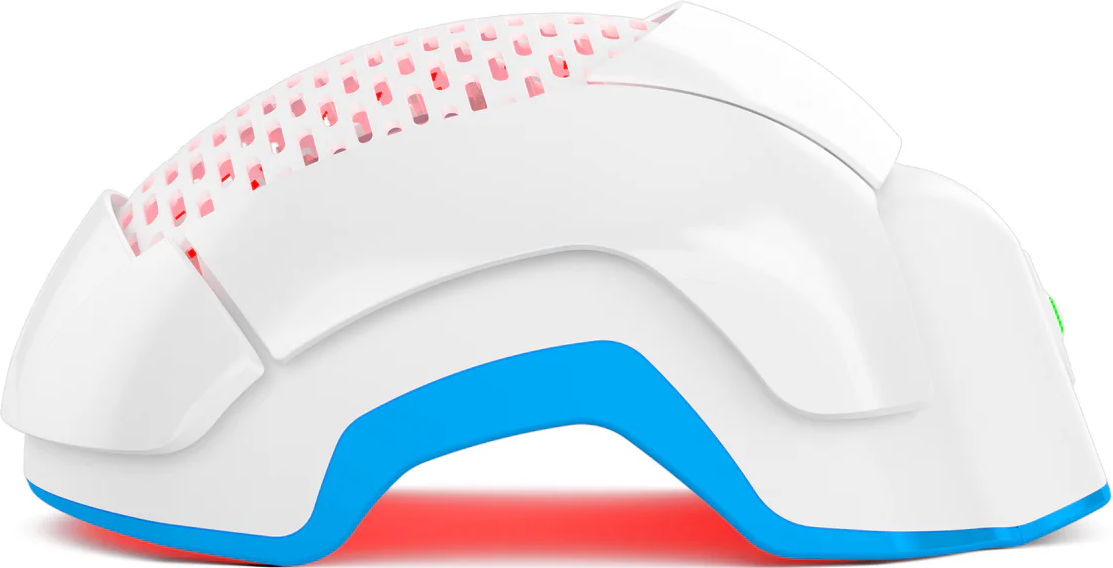
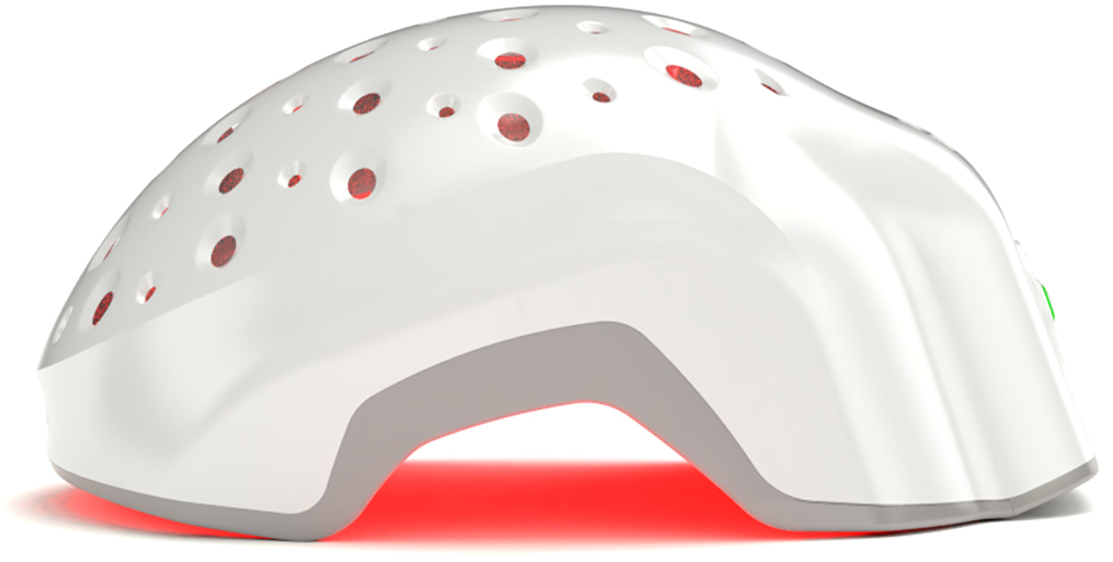
Laser Phototherapy can fit androgenetic alopecia or pattern thinning
Laser Phototherapy (LPT) can be a strong foundation for people dealing with androgenetic alopecia or pattern thinning, especially when they want a non-drug option that does not depend on changing hormone levels. It is not a hormone treatment. It does not “balance” estradiol. And that is actually the point.
LPT works in a different lane.
Instead of adding a pharmaceutical into the body, FDA-cleared LPT devices use low-level laser light to support follicle activity in pattern hair loss. Research on low-level laser therapy for androgenetic alopecia has found it can improve hair growth outcomes, with reviews generally describing it as safe and well tolerated, though study design, device type, and treatment protocols vary. One review in Journal of Drugs in Dermatology noted that LLLT appears effective for pattern hair loss in both men and women, with only minor adverse effects reported, while also cautioning that some studies have industry ties.
That makes LPT especially relevant for people who are already thinking about estradiol, HRT, or medication side effects. If someone is shedding because of telogen effluvium, the priority is still to find and correct the trigger. But if the real issue is androgenetic alopecia, or if a hormone shift has revealed pattern thinning that was already developing, LPT can sit beside topical or clinician-guided medications as a serious evidence-based option.
For some people, it may even be the preferred starting point: no daily topical residue, no systemic hormone effect, no chemical drug exposure, and no need to alter an estradiol plan that may be medically important. Used consistently and as directed, it offers a non-invasive way to support the living follicle’s energy needs while the broader hair-loss picture is being properly diagnosed.
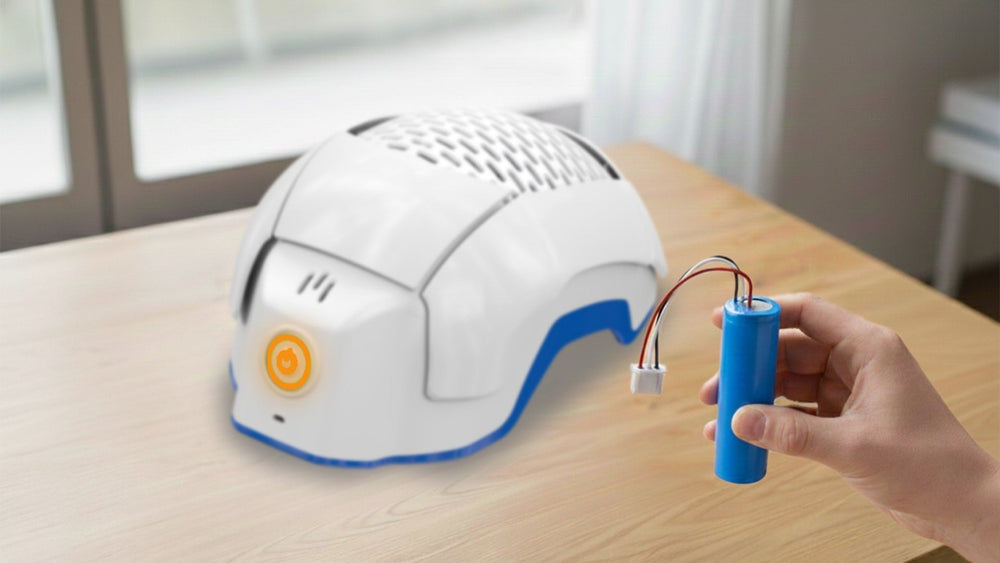
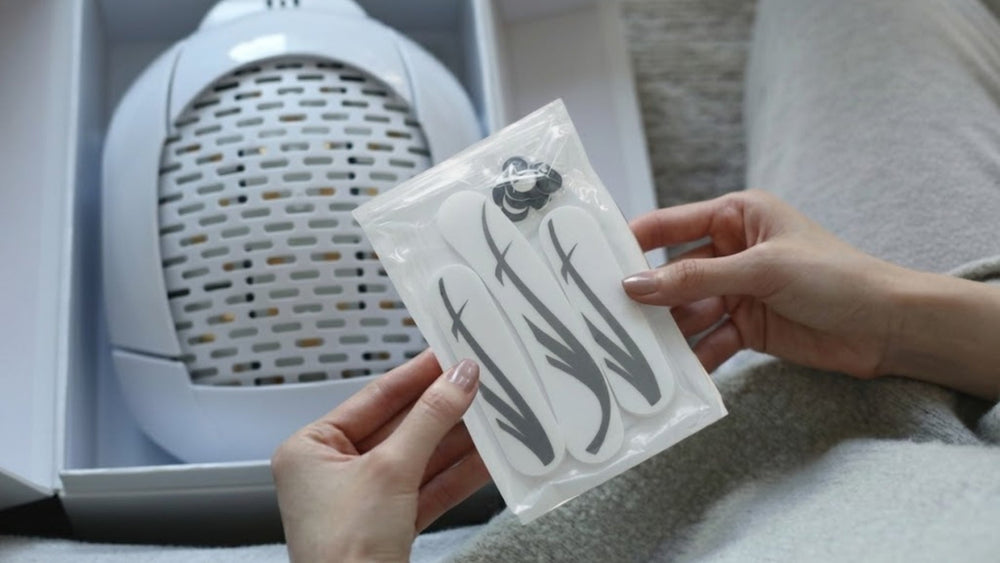
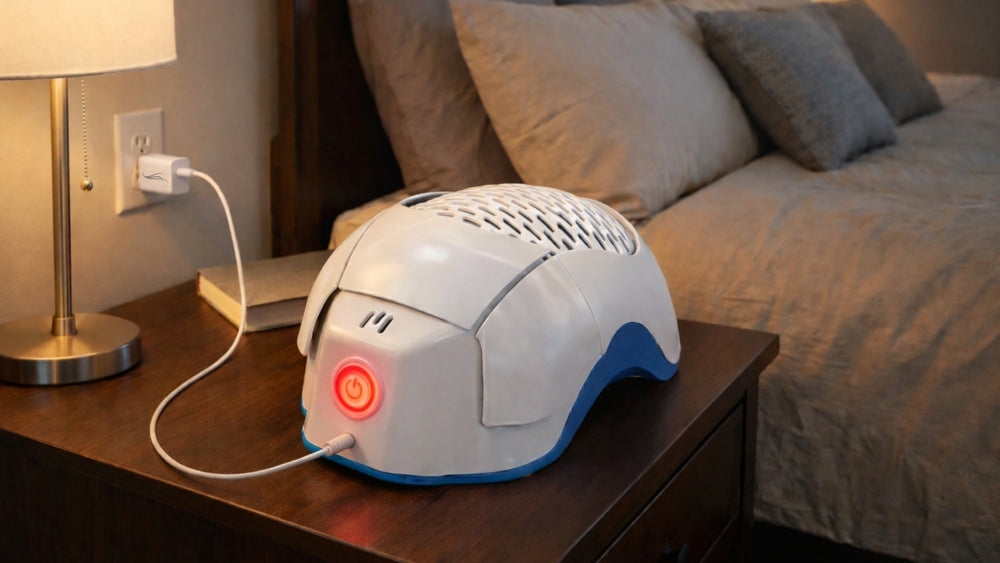
Theradome is an FDA-cleared wearable Laser Phototherapy device intended to treat androgenetic alopecia and promote hair growth in specific male and female hair-loss classifications. FDA’s 510(k) summary for the Theradome LH80 PRO describes indications for androgenetic alopecia and hair growth promotion in males with Norwood-Hamilton IIa to V patterns and females with Ludwig-Savin I-1 to I-4, II-1, II-2, with Fitzpatrick Skin Types I to IV.
Nutrition helps when something is actually low
Nutritional support belongs in the article, but not as a supplement shopping spree. Iron status, vitamin D, protein intake, zinc, and other nutrients may matter when deficiency or undernutrition is present. A review on diet and hair loss notes that deficiencies can contribute to hair loss, but also warns that over-supplementation of certain nutrients has been linked to hair loss.
PRP and newer options
Platelet-rich plasma, or PRP, may help some women with hair loss, especially androgenetic alopecia, but protocols differ across clinics and studies. A 2024 systematic review reported that PRP can improve hair density and thickness in women with hair loss and appears to have a favorable safety profile, but this does not mean every PRP clinic, protocol, or patient outcome is equal.
PRP may be worth discussing with a dermatologist if pattern hair loss is diagnosed and standard options are not enough. It is not usually the first stop for every person shedding after a hormone change.
What not to rely on
Be careful with “hormone balancing” supplements, random scalp oils, megadose vitamins, and social-media diagnosis. A product can feel soothing and still do very little for follicle miniaturization. A supplement can sound scientific and still be irrelevant if you are not deficient.
Also, cutting your hair does not stop hormonal shedding. It may make hair easier to manage and reduce the visual weight of shed strands, but it does not change follicle cycling.
Can Estradiol Hair Loss Be Prevented?
Not every shedding event can be prevented. Postpartum hormone shifts, illness, fever, surgery, severe stress, medication changes, and major weight loss can all trigger telogen effluvium. Telogen effluvium as a shedding response after internal or external stressors.
That may feel unfair. It is.
But “not fully preventable” does not mean “untreatable” or “hopeless.” It means the plan should be realistic.
Steady medical management may reduce unnecessary hormone swings
If you are prescribed estradiol, take it as directed. Do not skip, double, stop, or change route without your clinician’s input. If symptoms fluctuate, ask whether route, absorption, dose timing, or another medication could be involved.
This is especially relevant with patches, gels, pills, injections, and local vaginal forms because systemic exposure and consistency can differ. The route question belongs with your clinician, not a comment thread full of strangers comparing doses like they are trading soup recipes.
Early diagnosis can prevent avoidable density loss
Some shedding improves once the trigger resolves. Pattern hair loss is different. The earlier it is recognized, the better the chance of protecting density with evidence-based treatment. AAD says effective treatment starts with finding the cause, and female pattern hair loss may need minoxidil or combined treatment approaches.
If your part is widening, your crown is thinning, or shedding keeps going past six months, get assessed. Waiting can feel cheaper. Sometimes it is not.
Is Estradiol Really The Most Likely Trigger?
Use this as a quick self-check, not a diagnosis.
Ask yourself:
- Did shedding start two to four months after starting, stopping, missing, or changing estradiol?
- Did you recently give birth?
- Are you in perimenopause or menopause?
- Did you recently have illness, fever, surgery, COVID, severe stress, or rapid weight loss?
- Is the hair coming out diffusely, or is the part/crown getting thinner?
- Are there scalp symptoms like itching, burning, redness, scaling, or pain?
- Are there bald patches?
- Are you taking estradiol with progesterone, progestins, anti-androgens, or other hormone-related medications?
- Have thyroid, ferritin or iron status, vitamin D, and other relevant markers been reviewed by a clinician?
- Has shedding lasted longer than six months?
If several answers point to a delayed trigger, telogen effluvium may be worth discussing. If the part or crown is changing, female pattern hair loss deserves attention. If the scalp is painful, inflamed, patchy, or scarred-looking, book professional care sooner.
When Should You See A Doctor About Hair Loss On Estradiol?
Contact the prescribing clinician if…
Contact the clinician who prescribed estradiol if shedding began after a dose change, route change, missed doses, starting estradiol, stopping estradiol, or adding another hormone medication. Also call if you have new side effects, worsening menopause symptoms, gender-affirming hormone concerns, abnormal bleeding, mood changes, or anything that makes you wonder whether the regimen needs review.
Do not silently wrestle with it for months because you think hair loss is “not serious enough.” Hair loss can be medically relevant and emotionally brutal. Both count.
See a dermatologist if…
See a dermatologist if hair loss is progressive, patterned, patchy, painful, inflamed, scaly, or continuing longer than six months. Also consider dermatology care if your part is widening, crown density is dropping, eyebrows are thinning, or the frontal hairline is changing.
AAD recommends seeing a board-certified dermatologist for accurate diagnosis because dermatologists understand the many causes of hair loss and how treatment changes by cause.
Seek faster care if…
Seek faster medical care if hair loss is sudden and severe, patchy, painful, or paired with scalp redness, swelling, pus, crusting, scarring, fever, or other systemic symptoms. Those signs are not something to file under “hormones being weird.”
Nope.
That is the scalp asking for backup.
Conclusion
Estradiol and hair loss are connected, but not in a tidy “estradiol means hair loss” way. Sometimes the issue is falling estrogen. Sometimes it is a dose change, postpartum shedding, menopause, a listed medication side effect, telogen effluvium, or female pattern hair loss finally making itself known.
Track your timeline, speak with your prescribing clinician, and get a proper hair-loss diagnosis before changing treatment. If androgenetic alopecia is part of the picture, evidence-based options such as FDA-cleared Laser Phototherapy may be worth discussing.