


4 Stages of a Receding Hairline: What Causes It and How to Stop?
Let’s tackle a topic that hits close to home for many of us - the receding hairline. Yep,...
Read More

GREAT VALUE

Item added to your cart
Your first Theradome session is straightforward. No complicated prep. No strange sensations. Just a clean scalp, a charged device, and twenty quiet minutes where your only job is to sit still and let the light do what it’s designed to do. We’ll walk this slowly, gently — because starting something new with your hair can feel personal.
Maybe there’s a little hope sitting with you. Maybe a little uncertainty too. Both are normal.
Let’s start by making sure your scalp and device are ready. This isn’t complicated — just intentional.
The Theradome battery needs a full charge, especially the very first time. The indicator lights or voice cue will tell you when it’s ready. Think of this as making sure the treatment is steady and uninterrupted — a simple baseline.
This part matters more than people realize.
Why? Light scatters when it hits residue. We want it reaching the scalp clearly.
Water also interferes with how light behaves.
Dry hair = predictable, consistent light delivery.
If your hair is thick, textured, or coily, a gentle part in one to three sections can help the light get closer to the scalp. Not a full styling session — just a small adjustment.
Clips, high buns, oversized scrunchies, tension styles — anything that creates distance between the helmet and your scalp.
The device works with all hair types and curl patterns. This is just about access, not compatibility.
This is one of those steps people underestimate. You’d think, “Helmet goes on head. Done.”
But a few millimeters off? That can actually affect whether the light fully covers the crown or if it’s missing zones entirely.
Anywhere with a backrest works — couch, bed, desk chair. This is not the time for multitasking gymnastics. Just pick a spot where your head can stay still for 20 minutes without you clenching your jaw or hovering weirdly.
Theradome comes with foam pads — they’re not optional packaging filler.
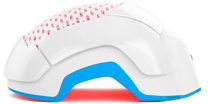
Use them if the helmet feels too loose or slides backward. The proper placement is:
If your hair is styled high or tied up, let it down first. Anything pushing up from beneath will disrupt contact and scatter light.
One press of the button. The voice cue will chime in and the internal countdown begins.
You’ll hear “20 minutes remaining,” and similar prompts at halfway and near the end.
No guesswork. No fiddling. Just... light.
If you're expecting dramatic sci-fi sensations? You’re going to be a little underwhelmed.
And that’s a good thing.
Laser Phototherapy doesn’t buzz, heat up, pulse, or tingle. It doesn’t need to. The laser diodes quietly do their thing, stimulating mitochondrial activity in your follicles without fanfare or friction.
The beauty of a hands-free device is that it frees you up — but don’t take that as permission to do a downward dog or start vacuuming.
Reading? Great.
Emails? Fine.
TV? Even better.
But stay reasonably still so the helmet maintains full scalp contact.
You’ll hear cues like:
The device automatically shuts off after the full 20 minutes. You don’t have to time anything.
This one comes up a lot.
“Am I doing it wrong? I don’t feel anything.”
Nope — that’s exactly right. These are cold lasers, emitting under 5 mW of optical power per diode (Class 3R), which is about 20,000 times less luminous than a standard light bulb.
They are supposed to be imperceptible. That’s why they’re safe.
And yes, they’re still clinically proven effective when used correctly.
You’re done with your first treatment. The instinct now might be: “Okay... now what?”
This is the part that turns one session into a system. The part where you build results quietly over time — not by doing more, but by doing it regularly.
Consistency matters more than frequency. Start with:
Your scalp doesn't need to “rest” in between, but your routine brain probably does.
This is where a lot of people start feeling uncertain — “Is it working?”
Here's what clinical studies and patient reports tend to show:
Again, this varies.
Yes. And in some cases, it may help.
But let’s break it down.
Even with something as simple as a helmet that lights up quietly, there are still moments when you stop mid-routine and think: "Wait... is this right?"
You’re not alone.
Nope. Cold laser = no heat, no buzz, no prickling. That’s how it’s designed.
In fact, if you did feel something intense? That would be a red flag. Cold lasers (Class 3R) stay under 5 milliwatts — they’re medically safe, and their lack of sensation is intentional.
Right. Because this isn’t a serum ad — it’s hair biology.
What often happens first is:
Give it 3–4 months of consistent use before evaluating change.
Study-backed growth tends to appear between weeks 12 and 24.
Check if you’re using the included foam pads.
Also check that your hairstyle isn't lifting the device — even thick braids or twists can shift the helmet slightly. Hair down, pads on = stable contact.
That can happen. And counterintuitive as it sounds, it may be a good sign.
It means older, weaker hairs are being pushed out of resting phase earlier — making room for stronger anagen growth. If it continues past 6–8 sessions, check with a clinician.
Hair loss can feel murky — like no one’s telling you anything straight. But starting your first laser phototherapy session doesn’t have to be another confusing chapter.
You clean your hair. You charge your device. You sit still for 20 minutes. And then you do that again. And again. And somewhere between the 12th and the 30th session, something subtle shifts.
You notice fewer strands on the pillow. A little less scalp peeking through in photos. A strand that feels just a bit more substantial than it used to. You keep going.
Theradome doesn’t change your biology overnight.
But it gives it something real to work with.
And that, over time, can change everything else.
Stick with 3–4 times per week. More isn’t necessarily better. The biological process benefits from consistent stimulation with recovery time in between.
Yes. Laser phototherapy is texture-agnostic — but denser curls may require a gentle part to let the light reach the scalp. The device doesn’t discriminate, but physics still applies.
Yes — color-treated, relaxed, or keratin-treated hair is fine. The light doesn’t affect pigment or chemical bonds in strands. It’s targeting the follicle beneath.
There’s no evidence suggesting harm, but because research on LPT in pregnancy is limited, it’s best to consult your OB-GYN before starting. Always err on the side of caution.
Technically, yes. But most studies on LPT focus on adults (18+), and teenage hair loss often has non-genetic causes that should be professionally evaluated first.
The benefits taper gradually. You won’t lose your gains immediately, but since androgenetic alopecia is progressive, halting treatment means the condition can resume over time. Maintenance matters.

Both FSA (Flexible Spending Account) and HSA (Health Savings Accounts) can be used to buy FDA-cleared medical devices, like a Theradome. If you have been diagnosed with Androgenetic Alopecia you should be able to use both a FSA/HSA accounts to purchase the Theradome. To check eligibility, review your employer’s benefits package or contact your HR department for FSA. For HSA, check your health plan details to ensure it qualifies as an HDHP and verify other eligibility criteria.
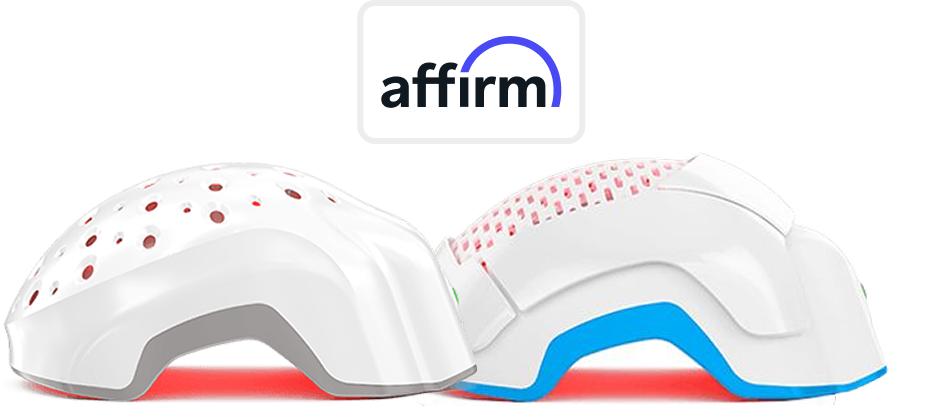
Make your Theradome purchase more manageable with our convenient Affirm financing methods.
How it works
Select Affirm at checkout to see your personalized payment options.


