
GREAT VALUE

ALL-IN-ONE


GREAT VALUE
ALL-IN-ONE

Item added to your cart
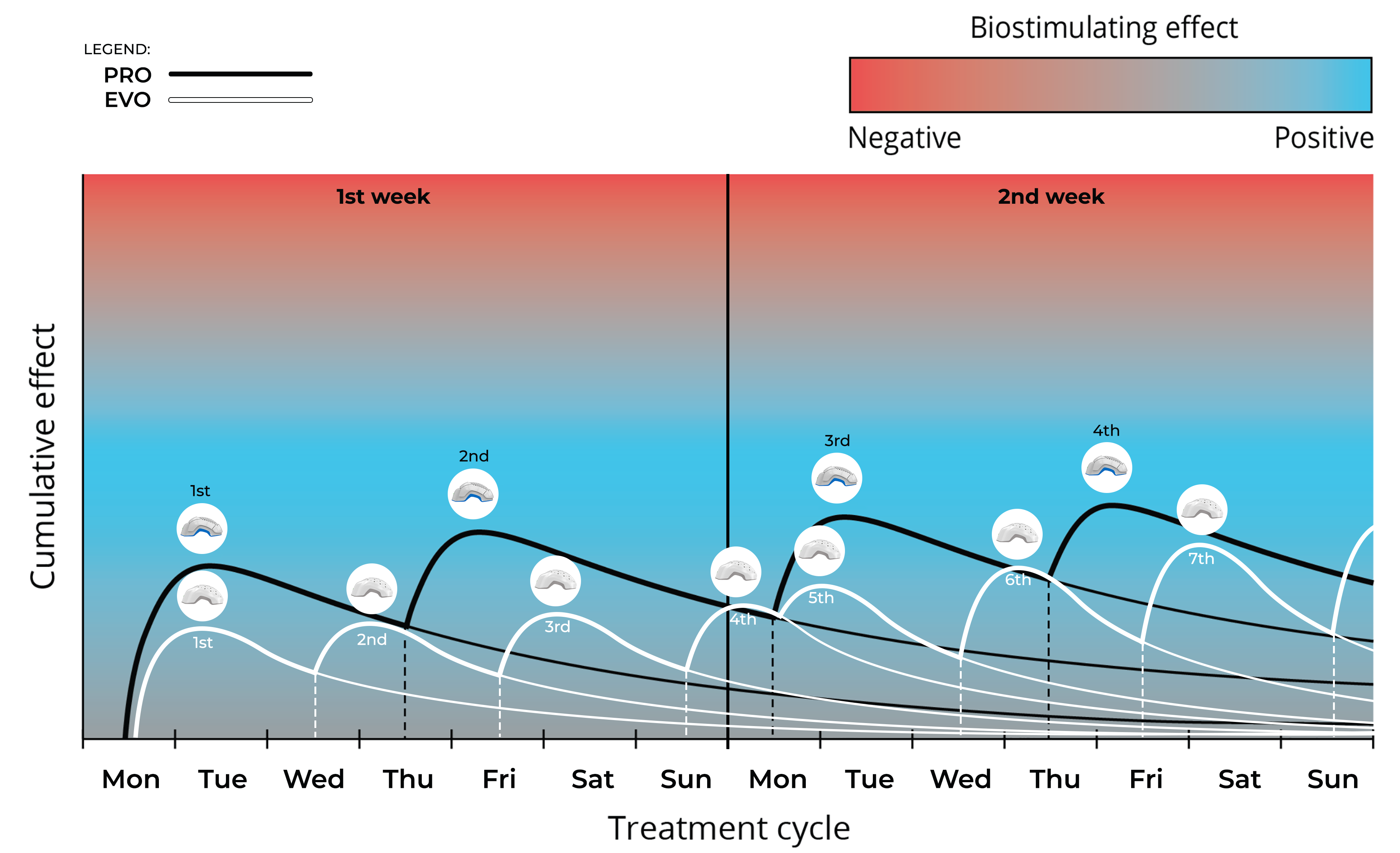
This graph illustrates how laser energy from LPT accumulates and fades in the scalp over time.
When you complete one LPT session, light energy is delivered to the scalp and absorbed by hair follicle cells. That effect does not drop back to zero once the session ends. Instead, the biological response continues for weeks, gradually tapering.
Even a single session provides benefit because the cellular response remains active for approximately 2–3 weeks, slowly declining rather than disappearing.
That lingering effect is why LPT works as a cumulative therapy, not a one-time event.
When a second session is performed before the previous energy fully fades, the effects compound.
You are not starting from zero again.
You still have residual stimulation from the earlier session, and the next treatment adds to it. Over time, this creates a layered, cumulative signal that continues activating mitochondrial processes inside hair follicles.
For example:
Spacing treatments two to four times per week helps maintain this cumulative effect while preventing the energy level from dropping too low.
The graph also shows why spacing matters in the other direction.
If sessions are performed too close together, the cumulative energy can move into an overstimulation zone. In photobiomodulation, this can reduce effectiveness rather than improve it.
Proper spacing keeps the scalp within an optimal stimulation range instead of pushing into excess.
Theradome helmets are designed so that when you remove and reposition the device, the lasers shift slightly, typically by 1–2 millimeters.
This small shift means:
This design supports broader follicle coverage while helping manage cumulative effects, especially if sessions are performed close together.
For most people using Theradome for androgenetic alopecia, “optimal usage” mostly means consistent 20-minute sessions on the schedule recommended for your specific model, plus enough spacing between sessions to avoid stacking treatments back-to-back. Results usually show up in months, not days, because hair cycling is slow.
Optimal use means delivering enough laser energy to stimulate follicles, then stepping back so cellular processes can complete before the next exposure. Not maximum use.
Not guessing.
Not copying someone else’s schedule.
Theradome devices are low-level laser (photobiostimulation / photobiomodulation style) devices used to promote hair growth for androgenetic alopecia, delivered via a wearable helmet format with timed sessions.
Different devices have different dose delivery (laser count, power, geometry, time). So “optimal” is not “what your cousin on Reddit did.” It’s model-specific.
Laser phototherapy uses low-level, cold lasers to deliver light energy to scalp tissue. These lasers do not heat or damage skin. They operate in a wavelength range shown to interact with mitochondrial activity inside hair follicle cells.
The goal is photobiostimulation.
Cold lasers used in LPT are classified by the FDA as Class 3R and have been used safely in medical and consumer settings for decades without evidence of permanent tissue harm when used as directed.
What schedule should you follow?
Start with the schedule for your specific Theradome model.
Theradome publishes a “recommended usage” schedule by model:
And the FDA 510(k) summary for the LH80 PRO describes the device as delivering a 20-minute treatment with an audible timer that turns off automatically.
If you under-dose by being inconsistent, your “trial” becomes a random experiment with missing data.
If you over-stack sessions, you’re drifting into the other problem: dose-response in light therapy can be biphasic. So… too little may do nothing, a moderate dose can help, and more can flatten or worsen the effect.
“Is it safe to do two sessions in a row?”
Practically: don’t.
Spacing isn’t just politeness to your scalp. It’s also consistent with what PBM/LLLT literature describes about dosing patterns and biphasic response risks when parameters are pushed.
A simple spacing rule that stays conservative
Scalp follicles cycle through anagen (growth), catagen (transition), telogen (rest/shedding). Anagen can last years. Telogen can last months.
That means your earliest visible changes often show up slowly because you’re working with biology that moves like… well, biology.
Many hair interventions (in general) are judged over months, not weeks. Many hair loss treatments often take 3–6 months before you notice changes.
So “optimal usage” includes one emotional skill: patience.
This is one of those things everyone nods at and then… doesn’t do.
A simple photo protocol that actually works
One month might look like “nothing.” Two or three months can still look like “nothing.” Then you compare month 0 to month 4 and go, “Oh. That’s different.”
This is not a moral lecture about haircare. It’s just… mechanics.
Heat + tension + harsh styling can inflate the “hair loss” feeling
If you’re tugging, over-brushing, using aggressive heat, or constantly stressing the shaft, you can create breakage, which looks like thinning even when follicles are doing their job.
So your best pairing with LPT is usually:
(And yes, alcohol-heavy styling choices can leave some scalps feeling dry and reactive. People vary.)
If it’s androgenetic alopecia
That’s the classic “pattern” loss and the main setting where LLLT is commonly discussed as an option alongside other evidence-based choices.
If it’s telogen effluvium (sudden shedding)
Different timeline, different expectations.
Telogen effluvium often resolves after the trigger is addressed, and hair regrowth is often described in the 3–6 month range (with many cases settling within 6–8 months).
If you try to judge your laser device in the middle of TE shedding… you’ll basically be grading a student while the classroom is on fire.
Consider a dermatologist / qualified clinician sooner if:
Androgenetic alopecia is common, but it’s not the only thing on earth.
LLLT is often discussed as one option among others (topicals, oral meds, procedural approaches), tailored to the person.
Two guardrails:
(That second one stings. But it’s real.)
For most users, 2 to 4 sessions per week is effective. Some advanced users use it more often, but spacing matters.
Clinical and observational data suggest that hair follicles respond best when laser sessions are separated by time, allowing cellular signaling to complete before the next exposure.
Using LPT daily is not inherently unsafe, but back-to-back sessions without rest are discouraged.
Why?
Because overstimulation can stall progress rather than accelerate it.
This is consistent with photobiomodulation research showing a biphasic dose response, where too little light does nothing, enough light helps, and too much light reduces benefit.
Space LPT sessions by at least 12 hours, preferably longer.
Most guidelines and clinical protocols favor every other day or several times per week, rather than clustered use.
Hair follicles are metabolically active structures. Once stimulated, they need time to process that signal.
Laser therapy behaves more like training muscle, not flipping a switch.
This is the question behind most frustration.
Enough:
Too much:
More sessions do not override biology.
Excessive exposure can flatten the response curve, leading to stalled results.
Some users do.
Many do not need to.
Daily use is generally tolerated when sessions are spaced and the scalp remains comfortable. What is not recommended is stacking sessions closely together.
If you choose higher frequency use, allow several hours of rest between sessions.
If irritation, sensitivity, or shedding anxiety appears, step back.
Hair responds slowly. Panic helps nothing.
Hair follicles rely on mitochondrial signaling. That process follows a cycle.
Laser light initiates cellular events. Those events take time to complete. Interrupting them repeatedly does not compound results. It can blunt them.
This is observed across phototherapy applications in dermatology and wound healing.
Expect 3 to 6 months before visible changes. Sometimes longer.
Hair cycles are slow. Anagen phases do not rush because we want them to.
This is why photographs matter.
Memory lies. Lighting changes. Hair length shifts perception.
Consistent photos, same angle, same lighting, same distance, are the only reliable way to track progress.
Most users who believe nothing is happening later discover change when comparing images side by side.
It is boring.
But it works.
Gentle matters.
Dry, irritated scalp tissue does not respond optimally to light-based treatments.
This is about reducing friction, not adding miracle products.
If a true deficiency exists, correcting it helps general health.
Beyond that, evidence does not support supplement megadoses as hair loss treatment.
Laser phototherapy does not require supplementation to function.
This is not a supplement-led system.
Hair responds best to steady routines, not pressure. Use products that keep the scalp comfortable, support your hair gently, and stick with your laser sessions consistently. Results cannot be rushed. Progress happens quietly and over time. Taking regular photos gives you a clear record of what is actually changing, separate from daily impressions. Theradome was designed as part of a broader care approach that prioritizes consistency over intensity.
Once improvement stabilizes, many users shift into maintenance mode.
This often means:
Laser phototherapy supports follicles. It does not permanently alter genetic sensitivity.
Stopping entirely often leads to gradual regression.
This mirrors what is seen with other non-surgical hair loss treatments.
Theradome does not create follicles.
It supports existing ones.
It works best when:
Optimal usage is mostly: stick to the schedule, space sessions, track with photos, and give hair the months it needs. If you do those four, you’ve already beaten the most common failure mode… inconsistency dressed up as “this doesn’t work.” And if something feels off (sudden shedding, scalp symptoms, patchy loss), don’t self-diagnose into a corner.
Use the schedule for your model listed by Theradome (it varies by device).
More sessions aren’t automatically better in light therapies because dose response can be biphasic. If you’re tempted to “go daily,” keep it conservative and avoid stacking sessions back-to-back.
Hair cycling is slow. Many hair treatments are judged over months, and LLLT trials often run ~24–26 weeks.
Sudden diffuse shedding can be telogen effluvium, which often resolves after the trigger is addressed, with regrowth commonly occurring within months. If shedding is extreme or persistent, get evaluated.
If you want your future self to trust your present self… yes. (Annoying. But effective.)
How To Replace Battery
What to do when you get a ‘Battery Low’ on your Theradome
Adjusting Helmet Sound on your Theradome
Getting out of System Pause on your Theradome
Best Way to Clean your Theradome
What To Do When Your Theradome Does Not Turn On or Charge
How To Register Your Theradome Manufacturer’s Warranty
How to Install Foam Pads on Your Theradome
What to do when you receive a Laser Error message on your Theradome
What to do when you receive a “System Error” message on your Theradome
What to do if the master switch is flashing red on your Theradome
What to do when you are getting a temperature error on your Theradome

Both FSA (Flexible Spending Account) and HSA (Health Savings Accounts) can be used to buy FDA-cleared medical devices, like a Theradome. If you have been diagnosed with Androgenetic Alopecia you should be able to use both a FSA/HSA accounts to purchase the Theradome. To check eligibility, review your employer’s benefits package or contact your HR department for FSA. For HSA, check your health plan details to ensure it qualifies as an HDHP and verify other eligibility criteria.
Make your Theradome purchase more manageable with our convenient Affirm financing methods.
How it works
Select Affirm at checkout to see your personalized payment options.

The Complete Hair Recovery System:


The Complete Hair Recovery System: